Silane promoted glycosylation and its applications for synthesis of sugar compounds and active pharmaceutical ingredients (APIs)
New Journal of Chemistry Pub Date: 2022-10-19 DOI: 10.1039/D2NJ04192H
Abstract
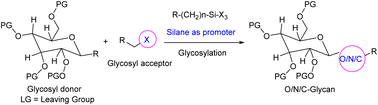
The structural diversity of carbohydrates through glycosylation reactions is the holy grail of carbohydrate chemistry. One or more carbohydrates covalently bonded to another molecule at selective sites by glycosylation/glycoconjugation are often required for better pharmacological activity and their synthesis is apparently more consistent. Selective conjugation of carbohydrates at the –OH group remains a challenge because of the similar reactivity of equivalent polyhydroxyl groups. Eventually a small variety of reagents have been demonstrated to promote site selective glycosylation reactions. Silanes have long provided a leverage in glycosylation reactions since they are easy to install and remove/modify in various synthetic procedures. Regardless of the fact that silanes have proven to be efficient promoters for facile glycoconjugation reactions, a thorough investigation has not been done on this subject. This review discusses the recent application and synthetic usefulness of versatile silanes like trimethylsilyl trifluoromethanesulfonate (TMSOTf), tert-butyldimethylsilyltrifluoromethanesulphonate (TBSOTf), N-(trimethylsilyl)bis(trifluoromethanesulfonyl)imide (TMSNTf2), potassium bis(trimethylsilyl)amide (KHMDS), trimethylsilyl perchlorate (TMSClO4), etc. in various site selective glycosylation reactions and also effective methods for the preparation of sugar compounds and active pharmaceutical ingredients (APIs).
Recommended Literature
- [1] Exciplex emission from the mixed dimer of naphthalene and 2-cyanonaphthalene in a supersonic jet Aloke Das,K. K. Mahato,Chayan K. Nandi,Tapas Chakraborty,Shridhar R. Gadre,Nikhil A. GokhalePhys. Chem. Chem. Phys., 2002,4, 2162-2168 10.1039/B200124C
- [2] Evolutionary de novo design of phenothiazine derivatives for dye-sensitized solar cells? Vishwesh Venkatraman,Marco Foscato,Vidar R. Jensen,Bj?rn K?re AlsbergJ. Mater. Chem. A, 2015,3, 9851-9860 10.1039/C5TA00625B
- [3] Emulsion soft templating of carbide-derived carbon nanospheres with controllable porosity for capacitive electrochemical energy storage? M. Zeiger,N. J?ckel,P. Strubel,L. Borchardt,R. Reinhold,W. Nickel,J. Eckert,V. Presser,S. KaskelJ. Mater. Chem. A, 2015,3, 17983-17990 10.1039/C5TA03730A
- [4] Excitation energies from ground-state density-functionals by means of generator coordinates A. B. F. da Silva,K. CapellePhys. Chem. Chem. Phys., 2009,11, 4564-4569 10.1039/B902529D
- [5] Fate of single walled carbon nanotubes in wetland ecosystems? Joseph H. Bisesi,Tara Sabo-AttwoodEnviron. Sci.: Nano, 2014,1, 574-583 10.1039/C4EN00063C
- [6] Fast-Track to Research Data Management in Experimental Material Science-Setting the Ground for Research Group Level Materials Digitalization. LarsBanko,AlfredLudwig 10.1021/acscombsci.0c00057
- [7] Establishing new scaling relations on two-dimensional MXenes for CO2 electroreduction? Albertus D. Handoko,Khoong Hong Khoo,Teck Leong Tan,Hongmei Jin,Zhi Wei SehJ. Mater. Chem. A, 2018,6, 21885-21890 10.1039/C8TA06567E
- [8] Exchangeability of amino acid residues with similar physicochemical properties in coiled-coil interactions? Guiying Zhang,Maosheng Cheng,Yanni Li,Keliang Liu,Lifeng CaiChem. Commun., 2013,49, 11086-11088 10.1039/C3CC46560H
- [9] Evidence of rutile-to-anatase photo-induced electron transfer in mixed-phase TiO2 by solid-state NMR spectroscopy? Weili Dai,Guangjun Wu,Michael HungerChem. Commun., 2015,51, 13779-13782 10.1039/C5CC04971G
- [10] Emulsion technologies for multicellular tumour spheroid radiation assays? Kay S. McMillan,Anthony G. McCluskey,Annette Sorensen,Marie Boyd,Michele ZagnoniAnalyst, 2016,141, 100-110 10.1039/C5AN01382H

Journal Name:New Journal of Chemistry
research_products
-

CAS no.: 89640-58-4

![1,2,3,4,5,6-Hexahydro-[2,3]bipyridinyl-6-ol](https://ossimg.kuujia.com/scimg/1271000/1270529-38-8x500.png)


![N-(3-cyanothiolan-3-yl)-2-[(2,2,2-trifluoroethyl)sulfanyl]pyridine-4-carboxamide](https://ossimg.kuujia.com/scimg/1444500/1444113-98-7x500.png)

![2,2-Difluoro-3-[methyl(2-methylbutyl)amino]propanoic acid](https://ossimg.kuujia.com/scimg/2138500/2138166-62-6x500.png)

![2-(1H-indol-3-yl)-N-{[6-(thiophen-2-yl)-[1,2,4]triazolo[4,3-b]pyridazin-3-yl]methyl}acetamide](https://ossimg.kuujia.com/scimg/2034500/2034271-14-0x500.png)