Novel aggregation-induced emission-photosensitizers with built-in capability of mitochondria targeting and glutathione depletion for efficient photodynamic therapy?
Nanoscale Pub Date: 2023-02-06 DOI: 10.1039/D2NR06593B
Abstract
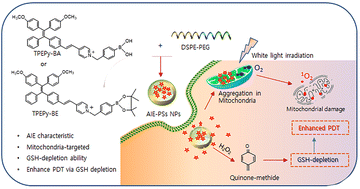
Owing to its non-invasive feature and excellent therapeutic effect, photodynamic therapy has received considerable interest in cancer therapy. However, the therapeutic efficacy of photodynamic therapy is limited by some intrinsic drawbacks of photosensitizers such as aggregation-caused quenching and non-specificity towards cellular organelles. Moreover, the overexpressed glutathione in tumour cells which exhibits a potent scavenging effect on reactive oxygen species generated during the photodynamic therapy process also reduces the efficacy of photodynamic therapy. Therefore, the synthesis of aggregation-induced emission based photosensitizers with cellular organelle targeting and glutathione-depletion capability is highly desirable in photodynamic therapy. Here, two new aggregation-induced emission based photosensitizers namely tetraphenylethylene-1-phenyvinyl-pyridine-phenylboronic acid (TPEPy-BA) and tetraphenylethylene-1-phenyvinyl-pyridine-phenylboronic acid pinacol ester (TPEPy-BE) were synthesized which easily aggregated under aqueous conditions and showed bright emission in the near infra-red region. Furthermore, these photosensitizers were encapsulated into an amphiphilic block copolymer (DSPE-PEG) to improve the aqueous stability and cellular internalization of photosensitizers. The developed photosensitizer nanoparticles showed high reactive oxygen species generation efficacy, mitochondria-targeting and glutathione-depletion capability. The results showed that tetraphenylethylene-1-phenyvinyl-pyridine-phenylboronic acid pinacol ester nanoparticles exhibited a highly efficient photodynamic ablation of MCF-7 cells compared to tetraphenylethylene-1-phenyvinyl-pyridine-phenylboronic acid nanoparticles, upon white light irradiation, due to its high intracellular reactive oxygen species generation efficiency and mitochondria-dysfunction ability. Moreover, tetraphenylethylene-1-phenyvinyl-pyridine-phenylboronic acid pinacol ester nanoparticles produced a glutathione-depleting adjuvant, quinone methide, which greatly reduced the glutathione level in cancer cells, thus enhancing the efficacy of photodynamic therapy. This study provides a new strategy for the synthesis of aggregation-induced emission based photosensitizers with combined mitochondria-targeting and glutathione-depletion capability for efficacious photodynamic therapy.
Recommended Literature
- [1] Fe(ii)-Assisted one-pot synthesis of ultra-small core–shell Au–Pt nanoparticles as superior catalysts towards the HER and ORR? Yi Cao,Yujiao Xiahou,Lixiang Xing,Xiang Zhang,Hong Li,ChenShou Wu,Haibing XiaNanoscale, 2020,12, 20456-20466 10.1039/D0NR04995F
- [2] Excimer formation effects and trap-assisted charge recombination loss channels in organic solar cells of perylene diimide dimer acceptors? Min Kim,Jae-Joon Lee,Tengling Ye,Panagiotis E. Keivanidis,Kilwon ChoJ. Mater. Chem. C, 2020,8, 1686-1696 10.1039/C9TC04955J
- [3] Evidence for the intrinsic nature of band-gap states electrochemically observed on atomically flat TiO2(110) surfaces? Shintaro Takata,Yoshihiro MiuraPhys. Chem. Chem. Phys., 2014,16, 24784-24789 10.1039/C4CP03280B
- [4] Examination of deposit in commercial diluted phosphoric acid Analyst, 1880,5, 146-147 10.1039/AN8800500146
- [5] Enabling non-flammable Li-metal batteries via electrolyte functionalization and interface engineering? Jing Yu,Yu-Qi Lyu,Jiapeng Liu,Mohammed B. Effat,Junxiong WuJ. Mater. Chem. A, 2019,7, 17995-18002 10.1039/C9TA03784E
- [6] Establishing plasmon contribution to chemical reactions: alkoxyamines as a thermal probe? Olga Guselnikova,Gérard Audran,Jean-Patrick Joly,Andrii Trelin,Evgeny V. Tretyakov,Vaclav Svorcik,Oleksiy Lyutakov,Sylvain R. A. MarqueChem. Sci., 2021,12, 4154-4161 10.1039/D0SC06470J
- [7] Enabling shape memory and healable effects in a conjugated polymer by incorporating siloxane via dynamic imine bond? Yaling Zhang,Chunhui Dai,Shiwei Zhou,Bin LiuChem. Commun., 2018,54, 10092-10095 10.1039/C8CC05410J
- [8] Dissociative electron attachment to HGaF4 Lewis–Br?nsted superacid Marcin Czapla,Jack SimonsPhys. Chem. Chem. Phys., 2018,20, 21739-21745 10.1039/C8CP04007A
- [9] Fe(iii)-mediated isomerization of α,α-diarylallylic alcohols to ketones via radical 1,2-aryl migration? Ziyang Deng,Changwei Chen,Sunliang CuiRSC Adv., 2016,6, 93753-93755 10.1039/C6RA20007A
- [10] Evolution in surface coverage of CH3NH3PbI3?XClXvia heat assisted solvent vapour treatment and their effects on photovoltaic performance of devices Dhirendra K. Chaudhary,Pramendra Kumar,Lokendra KumarRSC Adv., 2016,6, 94731-94738 10.1039/C6RA18729C
Journal Name:Nanoscale
research_products
-

CAS no.: 89640-58-4


![N-(3-cyanothiolan-3-yl)-2-[(2,2,2-trifluoroethyl)sulfanyl]pyridine-4-carboxamide](https://ossimg.kuujia.com/scimg/1444500/1444113-98-7x500.png)

![1,2,3,4,5,6-Hexahydro-[2,3]bipyridinyl-6-ol](https://ossimg.kuujia.com/scimg/1271000/1270529-38-8x500.png)

![2,2-Difluoro-3-[methyl(2-methylbutyl)amino]propanoic acid](https://ossimg.kuujia.com/scimg/2138500/2138166-62-6x500.png)

![2-(1H-indol-3-yl)-N-{[6-(thiophen-2-yl)-[1,2,4]triazolo[4,3-b]pyridazin-3-yl]methyl}acetamide](https://ossimg.kuujia.com/scimg/2034500/2034271-14-0x500.png)