Ultrathin Bi4O5Br2 nanosheets with surface oxygen vacancies and strong interaction with Bi2O2CO3 for highly efficient removal of water contaminants?
Environmental Science: Nano Pub Date: 2022-02-09 DOI: 10.1039/D1EN01024G
Abstract
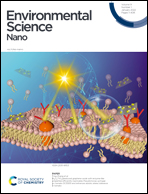
Ultrathin Bi4O5Br2 nanosheets with about a 10 nm thickness were synthesized by in situ intergrowth with Bi2O2CO3 sheets at room temperature. The degradation rates of organic pollutants on the catalyst were 28.1, 9.5, and 8.5 times higher than those on P25, N-TiO2 and 50 nm thick Bi4O5Br2 under a visible LED. The supreme catalytic activity was confirmed to be due to the significantly enhanced charge separation and transfer by surface oxygen vacancies on the ultrathin nanosheets, and the facilitated adsorption–degradation process at the solid–liquid micro-interface. The photogenerated electrons were demonstrated to be trapped on surface OVs to reduce surface adsorbed O2 into O2˙?. Meanwhile, the photogenerated holes were effectively utilized to directly oxidize organic pollutants at the catalyst surface. FTIR, HPLC-Q-TOF-MS and IC analysis confirmed that diclofenac (DCF) was degraded at the catalyst surface through decarboxylation, dechloridation and C–N cleavage, and further mineralized in reaction solution. In addition, the developed catalyst can work at different pH values (5–10) and was stable after eight reaction cycles, showing good potential in practical application.

Recommended Literature
- [1] Dissolved oxygen sensor based on fluorescence quenching of oxygen-sensitive ruthenium complexes immobilized in sol–gel-derived porous silica coatings Analyst, 1996,121, 785-788 10.1039/AN9962100785
- [2] Excitation dependent bidirectional electron transfer in phthalocyanine-functionalised MoS2 nanosheets? Christopher J. Harrison,Kyle J. Berean,Enrico Della Gaspera,Jian Zhen Ou,Richard B. Kaner,Kourosh Kalantar-zadeh,Torben DaenekeNanoscale, 2016,8, 16276-16283 10.1039/C6NR04326G
- [3] Excellent lithium ion storage property of porous MnCo2O4 nanorods? Peiyuan Zeng,Xiaoxiao Wang,Ming Ye,Qiuyang Ma,Jianwen Li,Wanwan Wang,Baoyou Geng,Zhen FangRSC Adv., 2016,6, 23074-23084 10.1039/C5RA26176G
- [4] Elusive 2-aminofuran Diels–Alder substrates for a straightforward synthesis of polysubstituted anilines? Ana G. Neo,Ana Bornadiego,Jesús Díaz,Stefano Marcaccini,Carlos F. MarcosOrg. Biomol. Chem., 2013,11, 6546-6555 10.1039/C3OB41411F
- [5] Dissociation of aryl sulfonyl phthalimide radical anions: relevance to the biological activity of arylsulfonyl amides? Abdelaziz Houmam,Emad M. HamedChem. Commun., 2012,48, 11328-11330 10.1039/C2CC36835H
- [6] Enabling non-flammable Li-metal batteries via electrolyte functionalization and interface engineering? Jing Yu,Yu-Qi Lyu,Jiapeng Liu,Mohammed B. Effat,Junxiong WuJ. Mater. Chem. A, 2019,7, 17995-18002 10.1039/C9TA03784E
- [7] Esterase-responsive polymeric prodrug-based tumor targeting nanoparticles for improved anti-tumor performance against colon cancer? Gang Pan,Yi-jie Bao,Jie Xu,Tao Liu,Cheng Liu,Yan-yan Qiu,Xiao-jing Shi,Hui Yu,Ting-ting Jia,Xia Yuan,Ze-ting Yuan,Yi-jun CaoRSC Adv., 2016,6, 42109-42119 10.1039/C6RA05236C
- [8] Exchangeability of amino acid residues with similar physicochemical properties in coiled-coil interactions? Guiying Zhang,Maosheng Cheng,Yanni Li,Keliang Liu,Lifeng CaiChem. Commun., 2013,49, 11086-11088 10.1039/C3CC46560H
- [9] Essential effect of the electrolyte on the mechanical and chemical degradation of LiNi0.8Co0.15Al0.05O2 cathodes upon long-term cycling?? Xiaoming Liu,Zachary D. Hood,Wangda Li,Donovan N. Leonard,Arumugam Manthiram,Miaofang ChiJ. Mater. Chem. A, 2021,9, 2111-2119 10.1039/D0TA07814J
- [10] Emerging investigator series: first-principles and thermodynamics comparison of compositionally-tuned delafossites: cation release from the (001) surface of complex metal oxides? Joseph W. Bennett,Diamond T. Jones,Blake G. Hudson,Joshua Melendez-Rivera,Robert J. Hamers,Sara E. MasonEnviron. Sci.: Nano, 2020,7, 1642-1651 10.1039/C9EN01304K
Journal Name:Environmental Science: Nano
research_products
-

CAS no.: 89640-58-4

![1,2,3,4,5,6-Hexahydro-[2,3]bipyridinyl-6-ol](https://ossimg.kuujia.com/scimg/1271000/1270529-38-8x500.png)


![N-(3-cyanothiolan-3-yl)-2-[(2,2,2-trifluoroethyl)sulfanyl]pyridine-4-carboxamide](https://ossimg.kuujia.com/scimg/1444500/1444113-98-7x500.png)

![2,2-Difluoro-3-[methyl(2-methylbutyl)amino]propanoic acid](https://ossimg.kuujia.com/scimg/2138500/2138166-62-6x500.png)

![2-(1H-indol-3-yl)-N-{[6-(thiophen-2-yl)-[1,2,4]triazolo[4,3-b]pyridazin-3-yl]methyl}acetamide](https://ossimg.kuujia.com/scimg/2034500/2034271-14-0x500.png)