The critical role of Asp206 stabilizing residues on the catalytic mechanism of the Ideonella sakaiensis PETase?
Catalysis Science & Technology Pub Date: 2022-04-12 DOI: 10.1039/D1CY02271G
Abstract
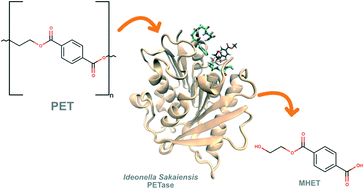
Plastic accumulation is one of the main environmental issues of our time. In 2016, two enzymes capable of degrading polyethylene terephthalate (PET), one of the most common plastic polymers, were discovered. PETase and MHETase from Ideonella sakaiensis (IsPETase and IsMHETase, respectively) work sequentially to degrade PET to its constituent monomers. PETase catalyzes the cleavage of PET repetitive units ((mono-(2-hydroxyethyl)terephthalic acid (MHET)), whereas MHETase hydrolyses MHET into terephthalic acid (TPA) and ethylene glycol (EG). In this work, the catalytic mechanism of IsPETase was studied by QM/MM. The reaction was found to progress in four distinct steps, divided into two major events: formation of the first transition intermediate and hydrolysis of the adduct. The transition state and respective reactant and product of each step were fully characterized and described. The rate-limiting step was found to be step 3, with an activation barrier of 12.5 kcal mol?1. Furthermore, in this study, we have shown the critical role of a triad of residues composed by Ser207, Ile208, and Ala209 in stabilizing the catalytic Asp206 residue. This finding confirms the importance of using a larger QM region since our results disclose some important differences when compared with previous computational studies of the same mechanism. These results provide valuable insights into the catalytic mechanism of IsPETase that can contribute to the rational development of more efficient engineered enzymes.
Recommended Literature
- [1] An investigation on the interaction modes of a single-strand DNA aptamer and RBP4 protein: a molecular dynamic simulations approach? Raheleh Torabi,Hedayatollah Ghourchian,Massoud AmanlouOrg. Biomol. Chem., 2016,14, 8141-8153 10.1039/C6OB01094F
- [2] An all-solid-state imprinted polymer-based potentiometric sensor for determination of bisphenol S? Rongning Liang,Tanji Yin,Ruiqing Yao,Wei QinRSC Adv., 2016,6, 73308-73312 10.1039/C6RA14461F
- [3] Aluminium alkyl and aryloxide complexes of pyrazine and bipyridines: synthesis and structure? Doug Ogrin,Laura H. van Poppel,Simon G. Bott,Andrew R. BarronDalton Trans., 2004, 3689-3694 10.1039/B410662H
- [4] An astrophysically-relevant mechanism for amino acid enantiomer enrichment Stephen P. Fletcher,Richard B. C. Jagt,Ben L. FeringaChem. Commun., 2007, 2578-2580 10.1039/B702882B
- [5] An approach to 7-aza-1-phosphanorbornane complexes: strain promoted rearrangement of 1-iminylphosphirane complexes and cycloaddition with olefins? Yang Xu,Min Wang,Donghui Wei,Rongqiang Tian,Zheng Duan,Fran?ois MatheyDalton Trans., 2019,48, 5523-5526 10.1039/C9DT00838A
- [6] An analyte-triggered artificial peroxidase system based on dimanganese complex for a versatile enzyme assay? Suji Lee,Min Su HanChem. Commun., 2021,57, 9450-9453 10.1039/D1CC03638F
- [7] An algal process treatment combined with the Fenton reaction for high concentrations of amoxicillin and cefradine Haitao Li,Yu Pan,Zhizhi Wang,Shan Chen,Ruixin Guo,Jianqiu ChenRSC Adv., 2015,5, 100775-100782 10.1039/C5RA21508K
- [8] An Assessment of the Laminar Hypersonic Double-Cone Experiments in the LENS-XX Tunnel JaideepRay,PatrickBlonigan,EricT.Phipps,KathrynMaupin 10.2514/1.j062802
- [9] An aquatic host–guest complex between a supramolecular G-quadruplex and the anticancer drug doxorubicin? José M. Rivera,Mariana Martín-Hidalgo,Jean C. Rivera-RíosOrg. Biomol. Chem., 2012,10, 7562-7565 10.1039/C2OB25913C
- [10] An amorphous lanthanum–iridium solid solution with an open structure for efficient water splitting? Wei Sun,Chenglong Ma,Xinlong Tian,Jianjun Liao,Ji Yang,Chengjun Ge,Weiwei HuangJ. Mater. Chem. A, 2020,8, 12518-12525 10.1039/D0TA03351K

Journal Name:Catalysis Science & Technology
research_products
-

CAS no.: 89640-58-4


![N-(3-cyanothiolan-3-yl)-2-[(2,2,2-trifluoroethyl)sulfanyl]pyridine-4-carboxamide](https://ossimg.kuujia.com/scimg/1444500/1444113-98-7x500.png)

![1,2,3,4,5,6-Hexahydro-[2,3]bipyridinyl-6-ol](https://ossimg.kuujia.com/scimg/1271000/1270529-38-8x500.png)

![2,2-Difluoro-3-[methyl(2-methylbutyl)amino]propanoic acid](https://ossimg.kuujia.com/scimg/2138500/2138166-62-6x500.png)

![2-(1H-indol-3-yl)-N-{[6-(thiophen-2-yl)-[1,2,4]triazolo[4,3-b]pyridazin-3-yl]methyl}acetamide](https://ossimg.kuujia.com/scimg/2034500/2034271-14-0x500.png)