Design of bio-based organic phase change materials containing a “safety valve”?
Green Chemistry Pub Date: 2021-10-01 DOI: 10.1039/D1GC02618F
Abstract
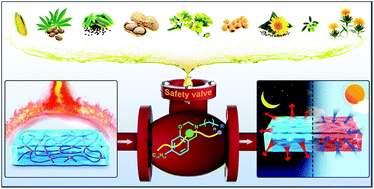
Energy efficiency and resource utilization are considered to be necessary for sustainable development. Organic phase change materials (PCMs) as an effective thermal energy storage tool have attracted great interest, but non-renewable ingredients, low stability and their unsafe nature largely restrict their sustainability. Herein, a series of bio-based benzoxazine-derived PCMs were developed, in which green preparation, efficient energy conversion, and safe utilization can be simultaneously achieved. Through the Mannich condensation reaction, novel PCMs can be easily synthesized with good yield and high atom economy by combining natural 3-pentadecylphenol (a cardanol derivative) and amine sources. The resulting PCMs exhibited adjustable latent heat (48.78–147.02 J g?1) by altering raw materials, which are close to their commercial unsustainable counterparts. As an example, C-aa-12 also showed considerable recycling ability after 100 times repeated use. In addition, due to the designed structure, as-prepared PCMs also possessed more excellent properties of thermal stability (Td50% was increased by 65.1%) and flame retardancy (HRR was reduced by 39.4%) compared with traditional ones, making them promising in a wider application field.
Recommended Literature
- [1] Ester-mediated peptide formation promoted by deep eutectic solvents: a facile pathway to proto-peptides? Chen-Yu Chien,Sheng-Sheng YuChem. Commun., 2020,56, 11949-11952 10.1039/D0CC03319G
- [2] Emergence of microfluidic wearable technologies Joo Chuan Yeo,KenryLab Chip, 2016,16, 4082-4090 10.1039/C6LC00926C
- [3] Empowering microfluidics by micro-3D printing and solution-based mineral coating? Hongxia Li,Aikifa Raza,Qiaoyu Ge,Jin-You Lu,TieJun ZhangSoft Matter, 2020,16, 6841-6849 10.1039/D0SM00958J
- [4] Excimer and exciplex formation in a pair of bright phosphorescent isomers constructed from Cu3(pyrazolate)3 and Cu3I3 coordination luminophores? Shun-Ze Zhan,Mian Li,Xiao-Ping Zhou,Dan Li,Seik Weng NgRSC Adv., 2011,1, 1457-1459 10.1039/C1RA00566A
- [5] Establishing the accuracy of position-specific carbon isotope analysis of propane by GC-pyrolysis-GC-IRMS ChangjieLiu,PengLiu,XiaofengWang,XiaoqiangLi,JuskeHorita 10.1002/rcm.9494
- [6] Enabling non-flammable Li-metal batteries via electrolyte functionalization and interface engineering? Jing Yu,Yu-Qi Lyu,Jiapeng Liu,Mohammed B. Effat,Junxiong WuJ. Mater. Chem. A, 2019,7, 17995-18002 10.1039/C9TA03784E
- [7] Fast synthesis of red Li3BaSrLn3(WO4)8:Eu3+ phosphors for white LEDs under near-UV excitation by a microwave-assisted solid state reaction method and photoluminescence studies Bo Wei,Zhenyu Liu,Chen Xie,Shu Yang,Wentao Tang,Aiwei Gu,Wing-Tak Wong,Ka-Leung WongJ. Mater. Chem. C, 2015,3, 12322-12327 10.1039/C5TC03165F
- [8] Dissolution of cork biopolymers in biocompatible ionic liquids Helga Garcia,Rui Ferreira,Marija Petkovic,Jamie L. Ferguson,Maria C. Leit?o,H. Q. Nimal Gunaratne,Luís Paulo N. RebeloGreen Chem., 2010,12, 367-369 10.1039/B922553F
- [9] Excitable dynamics in the bromate–sulfite–ferrocyanide reaction J. Zagora,M. Vosla?,L. Schreiberová,I. SchreiberPhys. Chem. Chem. Phys., 2002,4, 1284-1291 10.1039/B110048C
- [10] Excimer formation effects and trap-assisted charge recombination loss channels in organic solar cells of perylene diimide dimer acceptors? Min Kim,Jae-Joon Lee,Tengling Ye,Panagiotis E. Keivanidis,Kilwon ChoJ. Mater. Chem. C, 2020,8, 1686-1696 10.1039/C9TC04955J

Journal Name:Green Chemistry
research_products
-

CAS no.: 89640-58-4


![N-(3-cyanothiolan-3-yl)-2-[(2,2,2-trifluoroethyl)sulfanyl]pyridine-4-carboxamide](https://ossimg.kuujia.com/scimg/1444500/1444113-98-7x500.png)

![1,2,3,4,5,6-Hexahydro-[2,3]bipyridinyl-6-ol](https://ossimg.kuujia.com/scimg/1271000/1270529-38-8x500.png)

![2,2-Difluoro-3-[methyl(2-methylbutyl)amino]propanoic acid](https://ossimg.kuujia.com/scimg/2138500/2138166-62-6x500.png)

![2-(1H-indol-3-yl)-N-{[6-(thiophen-2-yl)-[1,2,4]triazolo[4,3-b]pyridazin-3-yl]methyl}acetamide](https://ossimg.kuujia.com/scimg/2034500/2034271-14-0x500.png)