Natural polyphenols as safe alternatives to hydroquinone for the organocatalyzed reduction of dioxygen dissolved in water by diethylhydroxylamine (DEHA)?
Green Chemistry Pub Date: 2012-02-09 DOI: 10.1039/C2GC16503A
Abstract
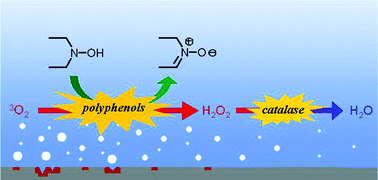
Reduction of dioxygen dissolved in water by diethylhydroxylamine (DEHA) in the presence of hydroquinones or quinones as organocatalysts is investigated with regard to reaction rate and catalyst turnover. Eleven p-benzoquinone derivatives bearing various electron-donating, electron-withdrawing and bulky substituents are studied. The catalytic activity of four benzenediols (hydroquinone, resorcinol, catechol and 4-tert-butylcatechol) and of four benzenetriols (hydroxyquinol, phloroglucinol, pyrogallol and 5-tert-butylpyrogallol) is compared. Mechanistic and kinetic studies indicate that the rate-determining step is the regeneration of hydroquinones through the reduction of the corresponding benzoquinones by DEHA. Then, eight natural polyphenols are tested as alternative catalysts to the potential carcinogen hydroquinone. Four of them (purpurin, myricetin, gallic acid and propyl gallate) exhibit some catalytic activity and gallic acid is shown to be even more efficient than hydroquinone itself. A further improvement of the catalytic system is achieved by adding catalase to disproportionate the generated hydrogen peroxide, which is detrimental for the catalyst. Thus, the oxygen scavenging system DEHA–gallic acid–catalase is found to be not only greener but also more efficient than the current system DEHA–hydroquinone since it gives water instead of hydrogen peroxide as the final reduction product of dioxygen.
Recommended Literature
- [1] Acetylcholinesterase amperometric detection system based on a cobalt(II) tetraphenylporphyrin-modified electrode Analyst, 1996,121, 1123-1126 10.1039/AN9962101123
- [2] An Appraisal of pH triggered Bacitracin drug release, through composite hydrogel systems RabailGul,MariamMir,MurtazaNAli 10.1177/08853282231160212
- [3] An atom efficient route to N-aryl and N-alkyl pyrrolines by transition metal catalysis? Supaporn Sawadjoon,Joseph S. M. SamecOrg. Biomol. Chem., 2011,9, 2548-2554 10.1039/C0OB00383B
- [4] An integrated chip for immunofluorescence and its application to analyze lysosomal storage disorders Jie Shen,Ying Zhou,Tu Lu,Junya Peng,Zhixiang Lin,Yuhong Pang,Li YuLab Chip, 2012,12, 317-324 10.1039/C1LC20845D
- [5] An integrated digital microfluidic chip for multiplexed proteomic sample preparation and analysis by MALDI-MS? Hyejin Moon,Aaron R. Wheeler,Robin L. Garrell,Chang-Jin “CJ” KimLab Chip, 2006,6, 1213-1219 10.1039/B601954D
- [6] An aquatic host–guest complex between a supramolecular G-quadruplex and the anticancer drug doxorubicin? José M. Rivera,Mariana Martín-Hidalgo,Jean C. Rivera-RíosOrg. Biomol. Chem., 2012,10, 7562-7565 10.1039/C2OB25913C
- [7] Aluminium complexes with thio-phosphorus ligands: syntheses and characterisations of [Al2(CyPS3)2(CyPHS2)2] and [Al(S2PPh2)3]? Robert P. Davies,Maria A. Giménez,Laura Patel,Andrew J. P. WhiteDalton Trans., 2008, 5705-5707 10.1039/B813427H
- [8] An atomistic mechanism for the degradation of perovskite solar cells by trapped charge? Eunhak Lim,Jiyoung Heo,Seong Keun KimNanoscale, 2019,11, 11369-11378 10.1039/C9NR02193K
- [9] An investigation into the origin of variations in photovoltaic performance using D–D–π–A and D–A–π–A triphenylimidazole dyes with a copper electrolyte? Govind ReddyMol. Syst. Des. Eng., 2021,6, 779-789 10.1039/D1ME00073J
- [10] An alkynylboronatecycloaddition strategy to functionalised benzyne derivatives? James D. Kirkham,Patrick M. Delaney,George J. Ellames,Eleanor C. Row,Joseph P. A. HarrityChem. Commun., 2010,46, 5154-5156 10.1039/C0CC01345E
Journal Name:Green Chemistry
research_products
-

CAS no.: 89640-58-4


![N-(3-cyanothiolan-3-yl)-2-[(2,2,2-trifluoroethyl)sulfanyl]pyridine-4-carboxamide](https://ossimg.kuujia.com/scimg/1444500/1444113-98-7x500.png)

![1,2,3,4,5,6-Hexahydro-[2,3]bipyridinyl-6-ol](https://ossimg.kuujia.com/scimg/1271000/1270529-38-8x500.png)

![2,2-Difluoro-3-[methyl(2-methylbutyl)amino]propanoic acid](https://ossimg.kuujia.com/scimg/2138500/2138166-62-6x500.png)

![2-(1H-indol-3-yl)-N-{[6-(thiophen-2-yl)-[1,2,4]triazolo[4,3-b]pyridazin-3-yl]methyl}acetamide](https://ossimg.kuujia.com/scimg/2034500/2034271-14-0x500.png)