Indoles and derivatives
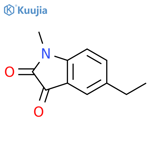
Indoles and their derivatives are a class of organic compounds derived from the heterocyclic aromatic ring system. They play crucial roles in both pharmaceuticals and natural products due to their unique structural features and biological activities. Indole, with its characteristic nitrogen-containing five-membered ring fused to an aromatic six-membered ring, serves as the core structure for various important molecules.
Indoles are widely used in medicinal chemistry due to their potential as lead compounds in drug discovery. They have been found to exhibit a wide range of biological activities, including antitumor, antimicrobial, and anti-inflammatory properties. The introduction of functional groups such as hydroxyl, amino, or carboxylic acid can enhance the bioactivity and modulate the physicochemical properties of indoles, making them versatile building blocks for synthetic chemistry.
Moreover, natural products containing indole moieties are abundant in nature, with many found in plants, fungi, and bacteria. These natural compounds often display potent biological activities, contributing to their extensive study in organic synthesis and biochemistry.
In summary, indoles and their derivatives represent a diverse family of molecules with significant applications in medicine, agriculture, and research, highlighting the importance of their study and development in various fields.
- N-alkylindoles
- Indoles
- Indolines
- Indolecarboxylic acids and derivatives
- Indolyl carboxylic acids and derivatives
- Carbazoles
- Tryptamines and derivatives
- Naphthoylindoles
- Pyridoindoles
- Hydroxyindoles
- Pyrroloindoles
- 3-alkylindoles
- Benzoylindoles
- Phenylacetylindoles
- Beta carbolines
- Serotonins
- Mitomycins
- Indolocarbazoles
- Indole-3-acetic acid derivatives
- Indolecarboxamides and derivatives
- Indolecarboxylic acids
- 3-methylindoles
- Indoles and derivatives
- Pyridoindolones
- N-acylserotonins
- Mitomycins, mitosane and mitosene derivatives
- Indolequinones
- Long-chain N-acylserotonins
- Alpha carbolines
- Pyrrolocarbazoles
- Gamma carbolines
- 2,3-Cyclopentanoindolines
- 2-phenylindoles









Related Literature
-
Byungho Lim,Jaewon Jin,Jin Yoo,Seung Yong Han,Kyeongyeol Kim,Sungah Kang,Nojin Park,Sang Moon Lee,Hae Jin Kim,Seung Uk Son Chem. Commun., 2014,50, 7723-7726
-
Brindha J.,Balamurali M. M.,Kaushik Chanda RSC Adv., 2019,9, 34720-34734
-
Yiding Jiao,Liqun Kang,Jasper Berry-Gair,Kit McColl,Jianwei Li,Haobo Dong,Hao Jiang,Ryan Wang,Furio Corà,Dan J. L. Brett,Ivan P. Parkin J. Mater. Chem. A, 2020,8, 22075-22082
-
Fereshteh Bayat Environ. Sci.: Nano, 2021,8, 367-389
Recommended suppliers
-
Suzhou Senfeida Chemical Co., LtdFactory Trade Brand reagentsCompany nature: Private enterprises
-
Shaanxi pure crystal photoelectric technology co. LTDFactory Trade Brand reagentsCompany nature: Private enterprises
-
Zhangzhou Sinobioway Peptide Co.,Ltd.Factory Trade Brand reagentsCompany nature: Private enterprises
-
Changzhou Guanjia Chemical Co., LtdFactory Trade Brand reagentsCompany nature: Private enterprises
-
Inner Mongolia Xinhong Biological Technology Co., LtdFactory Trade Brand reagentsCompany nature: Private enterprises
Recommended products