Chromo-fluorogenic sensing using vitamin B6 cofactors and their derivatives: a review
New Journal of Chemistry Pub Date: 2021-04-15 DOI: 10.1039/D1NJ01008E
Abstract
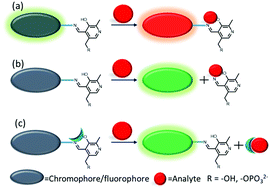
Chromo-fluorogenic chemosensors designed by using a signaling unit (chromophore/fluorophore) and a recognition unit are extensively developed for the sensing of various bioactive and toxic analytes owing to their low-cost, simplicity, and high selectivity and sensitivity. Recently, vitamin B6 cofactors like pyridoxal and pyridoxal 5′-phosphate (PLP) have been employed as a recognition unit for the design of chromo-fluorogenic chemosensors using various organic dyads and functionalized nanomaterials. This review summarizes the chromo-fluorogenic chemosensors developed using the cofactors pyridoxal and PLP. The design of sensors, sensing mechanisms and practical applications of the developed sensors are also discussed. The main aim of this review is to provide future scope for developing chemosensors using the bioactive cofactors as the recognition unit by presenting the results from our research group and the contributions from other groups.
Recommended Literature
- [1] Excimer and exciplex formation in a pair of bright phosphorescent isomers constructed from Cu3(pyrazolate)3 and Cu3I3 coordination luminophores? Shun-Ze Zhan,Mian Li,Xiao-Ping Zhou,Dan Li,Seik Weng NgRSC Adv., 2011,1, 1457-1459 10.1039/C1RA00566A
- [2] Excimer–monomer switch: a reaction-based approach for selective detection of fluoride? Qiao Song,Angela Bamesberger,Lingyun Yang,Haley Houtwed,Haishi CaoAnalyst, 2014,139, 3588-3592 10.1039/C4AN00522H
- [3] Excited state potential energy surfaces and their interactions in FeIVO active sites Shaun D. Wong,Edward I. SolomonDalton Trans., 2014,43, 17567-17577 10.1039/C4DT01366B
- [4] Excellent mechanical performance and enhanced dielectric properties of OBC/SiO2 elastomeric nanocomposites: effect of dispersion of the SiO2 nanoparticles? Xing Zhao,Lu Bai,Rui-Ying Bao,Zheng-Ying Liu,Ming-Bo Yang,Wei YangRSC Adv., 2017,7, 46297-46305 10.1039/C7RA08074C
- [5] EWOD-driven droplet microfluidic device integrated with optoelectronic tweezers as an automated platform for cellular isolation and analysis? Gaurav J. Shah,Eric P.-Y. Chiou,Ming C. Wu,Chang-Jin “CJ” KimLab Chip, 2009,9, 1732-1739 10.1039/B821508A
- [6] Dissolution of cork biopolymers in biocompatible ionic liquids Helga Garcia,Rui Ferreira,Marija Petkovic,Jamie L. Ferguson,Maria C. Leit?o,H. Q. Nimal Gunaratne,Luís Paulo N. RebeloGreen Chem., 2010,12, 367-369 10.1039/B922553F
- [7] Excellent kinetics of single-phase Gd-doped ceria fuel electrodes in solid oxide cells? Andreas Nenning,Manuel Holzmann,Jürgen Fleig,Alexander K. OpitzMater. Adv., 2021,2, 5422-5431 10.1039/D1MA00202C
- [8] Emergence of microfluidic wearable technologies Joo Chuan Yeo,KenryLab Chip, 2016,16, 4082-4090 10.1039/C6LC00926C
- [9] Evidence of rutile-to-anatase photo-induced electron transfer in mixed-phase TiO2 by solid-state NMR spectroscopy? Weili Dai,Guangjun Wu,Michael HungerChem. Commun., 2015,51, 13779-13782 10.1039/C5CC04971G
- [10] Fast synthesis of red Li3BaSrLn3(WO4)8:Eu3+ phosphors for white LEDs under near-UV excitation by a microwave-assisted solid state reaction method and photoluminescence studies Bo Wei,Zhenyu Liu,Chen Xie,Shu Yang,Wentao Tang,Aiwei Gu,Wing-Tak Wong,Ka-Leung WongJ. Mater. Chem. C, 2015,3, 12322-12327 10.1039/C5TC03165F

Journal Name:New Journal of Chemistry
research_products
-

CAS no.: 89640-58-4


![N-(3-cyanothiolan-3-yl)-2-[(2,2,2-trifluoroethyl)sulfanyl]pyridine-4-carboxamide](https://ossimg.kuujia.com/scimg/1444500/1444113-98-7x500.png)

![1,2,3,4,5,6-Hexahydro-[2,3]bipyridinyl-6-ol](https://ossimg.kuujia.com/scimg/1271000/1270529-38-8x500.png)

![2,2-Difluoro-3-[methyl(2-methylbutyl)amino]propanoic acid](https://ossimg.kuujia.com/scimg/2138500/2138166-62-6x500.png)

![2-(1H-indol-3-yl)-N-{[6-(thiophen-2-yl)-[1,2,4]triazolo[4,3-b]pyridazin-3-yl]methyl}acetamide](https://ossimg.kuujia.com/scimg/2034500/2034271-14-0x500.png)