Coloured chemical image-based models for the prediction of soil sorption of herbicides
RSC Advances Pub Date: 2014-12-16 DOI: 10.1039/C4RA12070A
Abstract
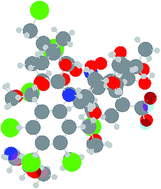
Herbicides with high soil sorption profiles constitute important organic pollutants leading to detrimental environmental effects, particularly due to prolonged use. Soil sorption is described in terms of log?KOC, the logarithm of the soil/water partition coefficient normalized to organic carbon. This work reports the use of molecular drawings to generate molecular descriptors, which are posteriorly correlated with the log?KOC values of a series of herbicides. These images are two-dimensional projections of chemical structures, with their atom sizes drawn to be proportional to the corresponding van der Waals radii and each chemical element assigned a different colour to distinguish atom types. The progressive changes in the molecular structures explain the variance in the corresponding soil sorption. Unlike previous QSPR studies on soil sorption, the series of herbicides employed in the present study included different classes of compounds (carboxylic acids, ethers, phenols, amines, amides and carbamates) guaranteeing a diverse chemical structural space. The obtained Partial Least Squares (PLS) and Multiple Linear Regression (MLR) based models for the log?KOC values were found to be robust and with high predictive power. Mechanistic interpretation of the effect of different substituents (bonded to the common structural moiety in the herbicides series) on the log?KOC values was performed yielding interesting results. These findings allow greater understanding of the chemical groups (or structural characteristics) responsible for high/low soil sorption, which in turn provides key leads for structural optimization to yield environmentally friendly and equally effective herbicides.
Recommended Literature
- [1] Enabling high-throughput single-animal gene-expression studies with molecular and micro-scale technologies Jason WanLab Chip, 2020,20, 4528-4538 10.1039/D0LC00881H
- [2] Emerging investigator series: kinetics of diopside reactivity for carbon mineralization in mafic–ultramafic rocks BrianaAguila,LandonHardee,H.ToddSchaef,SiavashZare,MohammadJavadAbdolhosseiniQomi,JarrodV.Crum,JadeE.HollimanJr.,ElenaTajueloRodriguez,LawrenceM.Anovitz,KevinM.Rosso,QuinR.S.Miller 10.1039/d3en00087g
- [3] Fe/S-Catalyzed synthesis of 2-benzoylbenzoxazoles and 2-quinolylbenzoxazoles via redox condensation of o-nitrophenols with acetophenones and methylquinolines? Thi Thu Tram Nguyen,Thanh Binh NguyenOrg. Biomol. Chem., 2021,19, 6015-6020 10.1039/D1OB00976A
- [4] Excellent lithium ion storage property of porous MnCo2O4 nanorods? Peiyuan Zeng,Xiaoxiao Wang,Ming Ye,Qiuyang Ma,Jianwen Li,Wanwan Wang,Baoyou Geng,Zhen FangRSC Adv., 2016,6, 23074-23084 10.1039/C5RA26176G
- [5] Fast synthesis of red Li3BaSrLn3(WO4)8:Eu3+ phosphors for white LEDs under near-UV excitation by a microwave-assisted solid state reaction method and photoluminescence studies Bo Wei,Zhenyu Liu,Chen Xie,Shu Yang,Wentao Tang,Aiwei Gu,Wing-Tak Wong,Ka-Leung WongJ. Mater. Chem. C, 2015,3, 12322-12327 10.1039/C5TC03165F
- [6] Fast-pulsing NMR techniques for the detection of weak interactions: successful natural abundance probe of hydrogen bonds in peptides? Amandine Altmayer-Henzien,Valérie Declerck,David J. Aitken,Ewen Lescop,Denis Merlet,Jonathan FarjonOrg. Biomol. Chem., 2013,11, 7611-7615 10.1039/C3OB41876F
- [7] Fe3O4/Au/Fe3O4 nanoflowers exhibiting tunable saturation magnetization and enhanced bioconjugation Feng Shi,Kunping Yan,Mingli Peng,Xiao Cheng,Yanling Luo,Xuemei Chen,V. A. L. Roy,Zuankai WangNanoscale, 2012,4, 747-751 10.1039/C2NR11489E
- [8] Fe(ii)-Assisted one-pot synthesis of ultra-small core–shell Au–Pt nanoparticles as superior catalysts towards the HER and ORR? Yi Cao,Yujiao Xiahou,Lixiang Xing,Xiang Zhang,Hong Li,ChenShou Wu,Haibing XiaNanoscale, 2020,12, 20456-20466 10.1039/D0NR04995F
- [9] Exchanged ligands on the surface of a giant cluster: [(MoO3)176(H2O)63(CH3OH)17Hn](32 – n)– Chem. Commun., 1998, 1501-1502 10.1039/A801804I
- [10] Enabling non-flammable Li-metal batteries via electrolyte functionalization and interface engineering? Jing Yu,Yu-Qi Lyu,Jiapeng Liu,Mohammed B. Effat,Junxiong WuJ. Mater. Chem. A, 2019,7, 17995-18002 10.1039/C9TA03784E

Journal Name:RSC Advances
research_products
-

CAS no.: 89640-58-4

![1,2,3,4,5,6-Hexahydro-[2,3]bipyridinyl-6-ol](https://ossimg.kuujia.com/scimg/1271000/1270529-38-8x500.png)


![N-(3-cyanothiolan-3-yl)-2-[(2,2,2-trifluoroethyl)sulfanyl]pyridine-4-carboxamide](https://ossimg.kuujia.com/scimg/1444500/1444113-98-7x500.png)

![2,2-Difluoro-3-[methyl(2-methylbutyl)amino]propanoic acid](https://ossimg.kuujia.com/scimg/2138500/2138166-62-6x500.png)

![2-(1H-indol-3-yl)-N-{[6-(thiophen-2-yl)-[1,2,4]triazolo[4,3-b]pyridazin-3-yl]methyl}acetamide](https://ossimg.kuujia.com/scimg/2034500/2034271-14-0x500.png)