Encompassing receptor flexibility in virtual screening using ensemble docking-based hybrid QSAR: discovery of novel phytochemicals for BACE1 inhibition?
Molecular BioSystems Pub Date: 2014-07-09 DOI: 10.1039/C4MB00307A
Abstract
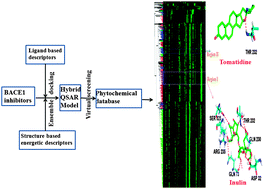
Mimicking receptor flexibility during receptor–ligand binding is a challenging task in computational drug design since it is associated with a large increase in the conformational search space. In the present study, we have devised an in silico design strategy incorporating receptor flexibility in virtual screening to identify potential lead compounds as inhibitors for flexible proteins. We have considered BACE1 (β-secretase), a key target protease from a therapeutic perspective for Alzheimer's disease, as the highly flexible receptor. The protein undergoes significant conformational transitions from open to closed form upon ligand binding, which makes it a difficult target for inhibitor design. We have designed a hybrid structure–activity model containing both ligand based descriptors and energetic descriptors obtained from molecular docking based on a dataset of structurally diverse BACE1 inhibitors. An ensemble of receptor conformations have been used in the docking study, further improving the prediction ability of the model. The designed model that shows significant prediction ability judged by several statistical parameters has been used to screen an in house developed 3-D structural library of 731 phytochemicals. 24 highly potent, novel BACE1 inhibitors with predicted activity (Ki) ≤ 50 nM have been identified. Detailed analysis reveals pharmacophoric features of these novel inhibitors required to inhibit BACE1.
Recommended Literature
- [1] Excellent mechanical performance and enhanced dielectric properties of OBC/SiO2 elastomeric nanocomposites: effect of dispersion of the SiO2 nanoparticles? Xing Zhao,Lu Bai,Rui-Ying Bao,Zheng-Ying Liu,Ming-Bo Yang,Wei YangRSC Adv., 2017,7, 46297-46305 10.1039/C7RA08074C
- [2] Fate of single walled carbon nanotubes in wetland ecosystems? Joseph H. Bisesi,Tara Sabo-AttwoodEnviron. Sci.: Nano, 2014,1, 574-583 10.1039/C4EN00063C
- [3] Exchangeability of amino acid residues with similar physicochemical properties in coiled-coil interactions? Guiying Zhang,Maosheng Cheng,Yanni Li,Keliang Liu,Lifeng CaiChem. Commun., 2013,49, 11086-11088 10.1039/C3CC46560H
- [4] Evolution study of photo-synthesized gold nanoparticles by spectral deconvolution model: a quantitative approach Chung-Sung Yang,Mong-Shian Shih,Fang-Yi ChangNew J. Chem., 2006,30, 729-735 10.1039/B516465F
- [5] Excimer formation effects and trap-assisted charge recombination loss channels in organic solar cells of perylene diimide dimer acceptors? Min Kim,Jae-Joon Lee,Tengling Ye,Panagiotis E. Keivanidis,Kilwon ChoJ. Mater. Chem. C, 2020,8, 1686-1696 10.1039/C9TC04955J
- [6] Emulsion soft templating of carbide-derived carbon nanospheres with controllable porosity for capacitive electrochemical energy storage? M. Zeiger,N. J?ckel,P. Strubel,L. Borchardt,R. Reinhold,W. Nickel,J. Eckert,V. Presser,S. KaskelJ. Mater. Chem. A, 2015,3, 17983-17990 10.1039/C5TA03730A
- [7] Evolution of calcium phosphate precipitation in hanging drop vapor diffusion by in situRaman microspectroscopy Gloria Belén Ramírez-Rodríguez,José Manuel Delgado-López,Jaime Gómez-MoralesCrystEngComm, 2013,15, 2206-2212 10.1039/C2CE26556G
- [8] Estimates of hydride ion stability in condensed systems: energy of formation and solvation in aqueous and polar-organic solvents Craig A. Kelly,David R. RosseinskyPhys. Chem. Chem. Phys., 2001,3, 2086-2090 10.1039/B010092G
- [9] Fe(iii)-mediated isomerization of α,α-diarylallylic alcohols to ketones via radical 1,2-aryl migration? Ziyang Deng,Changwei Chen,Sunliang CuiRSC Adv., 2016,6, 93753-93755 10.1039/C6RA20007A
- [10] Fc microparticles can modulate the physical extent and magnitude of complement activity? David White,Sean R. StowellBiomater. Sci., 2017,5, 463-474 10.1039/C6BM00608F
Journal Name:Molecular BioSystems
research_products
-

CAS no.: 89640-58-4


![N-(3-cyanothiolan-3-yl)-2-[(2,2,2-trifluoroethyl)sulfanyl]pyridine-4-carboxamide](https://ossimg.kuujia.com/scimg/1444500/1444113-98-7x500.png)

![1,2,3,4,5,6-Hexahydro-[2,3]bipyridinyl-6-ol](https://ossimg.kuujia.com/scimg/1271000/1270529-38-8x500.png)

![2,2-Difluoro-3-[methyl(2-methylbutyl)amino]propanoic acid](https://ossimg.kuujia.com/scimg/2138500/2138166-62-6x500.png)

![2-(1H-indol-3-yl)-N-{[6-(thiophen-2-yl)-[1,2,4]triazolo[4,3-b]pyridazin-3-yl]methyl}acetamide](https://ossimg.kuujia.com/scimg/2034500/2034271-14-0x500.png)