State-of-the-art iron-based nanozymes for biocatalytic tumor therapy
Nanoscale Horizons Pub Date: 2019-11-05 DOI: 10.1039/C9NH00577C
Abstract
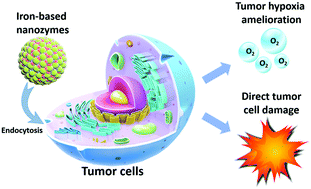
Biocatalytic tumor therapy with artificial nanoscale enzyme-mimics (nanozymes) is an emerging strategy for the therapeutic intervention of a variety of malignant conditions, which can provide the combined benefits of enzyme-dependent biocatalytic activities and nanotechnology. Generally, these novel nanocatalysts employ particular multivalent ions as the catalytic center; they have demonstrated high catalytic efficiencies, due to which they are even more potent than natural enzymes, and they also exhibit better in vivo stability, functional versatility and lower manufacturing cost. It is well established that a malignant tumor has many enzymatic mutations, which provides ample opportunities for the development of biocatalytic tumor therapy with nanozymes. Most of the current research in this area revolves around iron-based nanostructures due to their easy manufacturing process, intrinsic biocompatibility, promising physical properties, and versatile and efficient catalytic activity. A great variety of studies in the recent decade have consistently demonstrated the translational potential of iron-based nanozymes for tumor therapy. Therefore, it would be of great practical significance to summarize the previous reports on the treatment-facilitative effects and tumor cell-damaging mechanisms of iron-based nanozymes, which primarily include tumor hypoxia amelioration, Fenton-enhanced ROS damage and the activation of the ferroptosis pathway. Additionally, we also discuss the critical issues that may affect their clinical translation and future development. We hope that these iron-based nanozymes can overcome the limitations of conventional therapies and open new avenues for tumor treatment.
Recommended Literature
- [1] Essential effect of the electrolyte on the mechanical and chemical degradation of LiNi0.8Co0.15Al0.05O2 cathodes upon long-term cycling?? Xiaoming Liu,Zachary D. Hood,Wangda Li,Donovan N. Leonard,Arumugam Manthiram,Miaofang ChiJ. Mater. Chem. A, 2021,9, 2111-2119 10.1039/D0TA07814J
- [2] Enabling chloride salts for thermal energy storage: implications of salt purity? J. Matthew Kurley,Phillip W. Halstenberg,Abbey McAlister,Stephen Raiman,Richard T. MayesRSC Adv., 2019,9, 25602-25608 10.1039/C9RA03133B
- [3] Emerging enantiomeric resolution materials with homochiral nano-fabrications Ji-Ping WeiNanoscale, 2015,7, 11815-11832 10.1039/C5NR03048J
- [4] Evolution study of photo-synthesized gold nanoparticles by spectral deconvolution model: a quantitative approach Chung-Sung Yang,Mong-Shian Shih,Fang-Yi ChangNew J. Chem., 2006,30, 729-735 10.1039/B516465F
- [5] Exciplex emission from the mixed dimer of naphthalene and 2-cyanonaphthalene in a supersonic jet Aloke Das,K. K. Mahato,Chayan K. Nandi,Tapas Chakraborty,Shridhar R. Gadre,Nikhil A. GokhalePhys. Chem. Chem. Phys., 2002,4, 2162-2168 10.1039/B200124C
- [6] Evolved polymerases facilitate selection of fully 2′-OMe-modified aptamers? Zhixia Liu,Tingjian Chen,Floyd E. RomesbergChem. Sci., 2017,8, 8179-8182 10.1039/C7SC03747C
- [7] Exchangeability of amino acid residues with similar physicochemical properties in coiled-coil interactions? Guiying Zhang,Maosheng Cheng,Yanni Li,Keliang Liu,Lifeng CaiChem. Commun., 2013,49, 11086-11088 10.1039/C3CC46560H
- [8] Evolution of hierarchical porous structures in supramolecular guest–host hydrogels? Christopher B. Rodell,Christopher B. Highley,Minna H. Chen,Neville N. Dusaj,Chao Wang,Lin Han,Jason A. BurdickSoft Matter, 2016,12, 7839-7847 10.1039/C6SM01395C
- [9] Fate of single walled carbon nanotubes in wetland ecosystems? Joseph H. Bisesi,Tara Sabo-AttwoodEnviron. Sci.: Nano, 2014,1, 574-583 10.1039/C4EN00063C
- [10] Fe(iii)-mediated isomerization of α,α-diarylallylic alcohols to ketones via radical 1,2-aryl migration? Ziyang Deng,Changwei Chen,Sunliang CuiRSC Adv., 2016,6, 93753-93755 10.1039/C6RA20007A

Journal Name:Nanoscale Horizons
research_products
-

CAS no.: 89640-58-4


![N-(3-cyanothiolan-3-yl)-2-[(2,2,2-trifluoroethyl)sulfanyl]pyridine-4-carboxamide](https://ossimg.kuujia.com/scimg/1444500/1444113-98-7x500.png)

![1,2,3,4,5,6-Hexahydro-[2,3]bipyridinyl-6-ol](https://ossimg.kuujia.com/scimg/1271000/1270529-38-8x500.png)

![2,2-Difluoro-3-[methyl(2-methylbutyl)amino]propanoic acid](https://ossimg.kuujia.com/scimg/2138500/2138166-62-6x500.png)

![2-(1H-indol-3-yl)-N-{[6-(thiophen-2-yl)-[1,2,4]triazolo[4,3-b]pyridazin-3-yl]methyl}acetamide](https://ossimg.kuujia.com/scimg/2034500/2034271-14-0x500.png)