Development of a method for the quantitative metabolite profiling of pharmaceutical drugs using HPLC-ICP-MS following pre-column derivatization of their amino and hydroxyl groups using 4-aminopyridine as a model compound?
Journal of Analytical Atomic Spectrometry Pub Date: 2018-12-19 DOI: 10.1039/C8JA00386F
Abstract
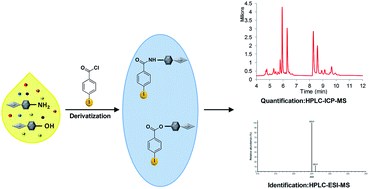
Chemical derivatization allows the introduction of an “ICP-MS accessible” element into pharmaceuticals and their metabolites, thus extending the application range of HPLC-ICP-MS in pharmaceutical applications. In this study, such a pre-column derivatization approach was developed with the aim of using HPLC-ICP-MS for the quantitative metabolite profiling of pharmaceutical drugs in human plasma samples. We targeted the amino and hydroxyl groups, two of the most abundant functional groups present in drugs, and used 4-aminopyridine and 3-hydroxy-4-aminopyridine as model compounds. 4-Iodobenzoyl chloride was used as a commercially available and multi-functional derivatization reagent to introduce iodine (I) as an element that can be quantified using ICP-MS with high sensitivity. This reagent reacts readily with the amino group present in 4-aminopyridine and the amino and hydroxyl groups present in its metabolite 3-hydroxy-4-aminopyridine. The reaction conditions were systematically optimized to guarantee quantitative formation of the target derivatives. Baseline separation of the target derivatives from one another and from also derivatized endogenous compounds was achieved using reversed phase UHPLC and gradient elution. Accuracy (recovery between 95 and 107%) and precision (repeatability ≤ 6.9% RSD) were fit-for-purpose for both 4-aminopyridine and 3-hydroxy-4-aminopyridine. The limit of quantification (LOQ) is 10 μg L?1 for I, corresponding to 7.5 μg L?1 of 4-aminopyridine and 5.8 μg L?1 of 3-hydroxy-4-aminopyridine, respectively.
Recommended Literature
- [1] Alternative donor substrates for inverting and retaining glycosyltransferases? Luke L. Lairson,Warren W. WakarchukChem. Commun., 2007, 365-367 10.1039/B614636H
- [2] An investigation into the origin of variations in photovoltaic performance using D–D–π–A and D–A–π–A triphenylimidazole dyes with a copper electrolyte? Govind ReddyMol. Syst. Des. Eng., 2021,6, 779-789 10.1039/D1ME00073J
- [3] An interplay between electronic and structural effects on the photoluminescence decay mechanisms in LaPO4·nH2O:Tb3+ and LaPO4:Tb3+ single-crystal nanorods? M. T. Colomer,S. Díaz-Moreno,A. Tamayo,A. L. OrtizJ. Mater. Chem. C, 2018,6, 12643-12651 10.1039/C8TC03187H
- [4] An autonomous self-optimizing flow machine for the synthesis of pyridine–oxazoline (PyOX) ligands? Eric Wimmer,Daniel Cortés-Borda,Solène Brochard,Elvina Barré,Charlotte Truchet,Fran?ois-Xavier FelpinReact. Chem. Eng., 2019,4, 1608-1615 10.1039/C9RE00096H
- [5] An approach towards the synthesis of novel fused nitrogen tricyclic heterocyclic scaffolds via GBB reaction? Sandip Gangadhar Balwe,Yeon Tae JeongOrg. Biomol. Chem., 2018,16, 1287-1296 10.1039/C7OB02933K
- [6] An all-solid-state asymmetric device based on a polyaniline hydrogel for a high energy flexible supercapacitor? Hamid Heydari,Mohammad B. GholivandNew J. Chem., 2017,41, 237-244 10.1039/C6NJ02266A
- [7] An integrated chip for immunofluorescence and its application to analyze lysosomal storage disorders Jie Shen,Ying Zhou,Tu Lu,Junya Peng,Zhixiang Lin,Yuhong Pang,Li YuLab Chip, 2012,12, 317-324 10.1039/C1LC20845D
- [8] An artificial CO-releasing metalloprotein built by histidine-selective metallation? Inês S. Albuquerque,Hélia F. Jeremias,Miguel Chaves-Ferreira,Dijana Matak-Vinkovic,Omar Boutureira,Carlos C. Rom?oChem. Commun., 2015,51, 3993-3996 10.1039/C4CC10204E
- [9] An approach to asymmetric synthesis of β-aryl alanines by Pd(0)-catalyzed cross-coupling and cyanate-to-isocyanate rearrangement? Piotr Szcze?niak,Sebastian SteckoRSC Adv., 2015,5, 30882-30888 10.1039/C5RA02818C
- [10] Acetyl group orientation modulates the electronic ground-state asymmetry of the special pair in purple bacterial reaction centers P. K. Wawrzyniak,M. T. P. Beerepoot,H. J. M. de Groot,F. BudaPhys. Chem. Chem. Phys., 2011,13, 10270-10279 10.1039/C1CP20213H

Journal Name:Journal of Analytical Atomic Spectrometry
research_products
-

CAS no.: 89640-58-4

![1,2,3,4,5,6-Hexahydro-[2,3]bipyridinyl-6-ol](https://ossimg.kuujia.com/scimg/1271000/1270529-38-8x500.png)


![N-(3-cyanothiolan-3-yl)-2-[(2,2,2-trifluoroethyl)sulfanyl]pyridine-4-carboxamide](https://ossimg.kuujia.com/scimg/1444500/1444113-98-7x500.png)

![2,2-Difluoro-3-[methyl(2-methylbutyl)amino]propanoic acid](https://ossimg.kuujia.com/scimg/2138500/2138166-62-6x500.png)

![2-(1H-indol-3-yl)-N-{[6-(thiophen-2-yl)-[1,2,4]triazolo[4,3-b]pyridazin-3-yl]methyl}acetamide](https://ossimg.kuujia.com/scimg/2034500/2034271-14-0x500.png)