Halogen type as a selectivity switch in catalysed alkane oxyhalogenation?
Catalysis Science & Technology Pub Date: 2018-04-03 DOI: 10.1039/C8CY00122G
Abstract
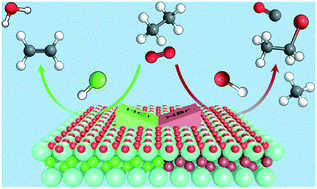
Catalysed alkane oxyhalogenation has recently been demonstrated as an attractive route for the selective functionalisation of natural gas into commodity chemicals such as alkyl halides or olefins. Herein, we assess the role of the hydrogen halide on the product distribution in ethane and propane oxyhalogenation over europium oxychloride and europium oxybromide catalysts. While olefins are the main reaction products in oxychlorination (selectivity ≥95%), the formation of alkyl bromides (selectivity ≤95%) is favoured in oxybromination, particularly at low conversion levels. At high conversion levels, olefins are also observed, although the selectivity is generally limited (≤60%) due to the formation of cracking and combustion products. A comprehensive kinetic analysis of the oxyhalogenation, halogenation, and oxidative dehydrogenation of the alkanes as well as of the dehydrohalogenation of the alkyl halides provide insights on the complex reaction network, which proceeds through alkyl halide formation followed by its conversion to olefins and/or halocarbons. The observed selectivity differences primarily originate from (i) the halide-dependent alkane activation path, which is surface-driven in oxychlorination, while it mostly occurs via gas-phase halogenation in oxybromination, along with (ii) the preferred tendency of alkyl chlorides towards catalytic dehydrochlorination pathways opposing alkyl bromides that undergo further bromination routes in the gas phase. Finally, detailed characterisation corroborated the above findings and revealed the higher structural stability of europium oxychloride compared to the analogous oxybromide phase under oxyhalogenation conditions. These results deepen the understanding of the alkane oxyhalogenation chemistry on catalyst surfaces for the manufacture of valuable commodities.
Recommended Literature
- [1] An atmosphere and light tuned highly diastereoselective synthesis of cyclobuta/penta[b]indoles from aniline-tethered alkylidenecyclopropanes with alkynes? Bo Cao,Yin WeiChem. Commun., 2018,54, 2870-2873 10.1039/C8CC00180D
- [2] An all-solid-state asymmetric device based on a polyaniline hydrogel for a high energy flexible supercapacitor? Hamid Heydari,Mohammad B. GholivandNew J. Chem., 2017,41, 237-244 10.1039/C6NJ02266A
- [3] An atomically efficient, highly stable and redox active Ce0.5Tb0.5Ox (3% mol.)/MgO catalyst for total oxidation of methane? Juan J. Sánchez,Miguel López-Haro,Juan C. Hernández-Garrido,Ginesa Blanco,Miguel A. Cauqui,José M. Rodríguez-Izquierdo,José A. Pérez-Omil,José J. Calvino,María P. YesteJ. Mater. Chem. A, 2019,7, 8993-9003 10.1039/C8TA11672E
- [4] An amphoteric reactivity of a mixed-valent bis(μ-oxo)dimanganese(iii,iv) complex acting as an electrophile and a nucleophile? Muniyandi Sankaralingam,So Hyun Jeon,Yong-Min Lee,Mi Sook Seo,Wonwoo NamDalton Trans., 2016,45, 376-383 10.1039/C5DT04292E
- [5] An integrated process of CO2 capture and in situ hydrogenation to formate using a tunable ethoxyl-functionalized amidine and Rh/bisphosphine system? Yu-Nong Li,Liang-Nian He,Xian-Dong Lang,Xiao-Fang Liu,Shuai ZhangRSC Adv., 2014,4, 49995-50002 10.1039/C4RA08740B
- [6] An air-stable organometallic polymer containing titanafluorene moieties obtained by the Sonogashira–Hagihara cross-coupling polycondensation? Alvin Tanudjaja,Shinsuke Inagi,Fusao Kitamura,Toshikazu Takata,Ikuyoshi TomitaDalton Trans., 2021,50, 3037-3043 10.1039/D0DT03663C
- [7] Acenaphthenic hopanoids, a novel series of aromatised Teresita Carrillo-Hernández,Philippe Schaeffer,Pierre AlbrechtChem. Commun., 2001, 1976-1977 10.1039/B105198A
- [8] Aluminium complexes with thio-phosphorus ligands: syntheses and characterisations of [Al2(CyPS3)2(CyPHS2)2] and [Al(S2PPh2)3]? Robert P. Davies,Maria A. Giménez,Laura Patel,Andrew J. P. WhiteDalton Trans., 2008, 5705-5707 10.1039/B813427H
- [9] An ion-gating multinanochannel system based on a copper-responsive self-cleaving DNAzyme? Yang Chen,Di Zhou,Zheyi Meng,Jin ZhaiChem. Commun., 2016,52, 10020-10023 10.1039/C6CC03943J
- [10] An artificial photosynthesis system comprising a covalent triazine framework as an electron relay facilitator for photochemical carbon dioxide reduction? Siquan Zhang,Shengyao Wang,Liping Guo,Hao Chen,Bien Tan,Shangbin JinJ. Mater. Chem. C, 2020,8, 192-200 10.1039/C9TC05297F

Journal Name:Catalysis Science & Technology
research_products
-

CAS no.: 89640-58-4


![N-(3-cyanothiolan-3-yl)-2-[(2,2,2-trifluoroethyl)sulfanyl]pyridine-4-carboxamide](https://ossimg.kuujia.com/scimg/1444500/1444113-98-7x500.png)

![1,2,3,4,5,6-Hexahydro-[2,3]bipyridinyl-6-ol](https://ossimg.kuujia.com/scimg/1271000/1270529-38-8x500.png)

![2,2-Difluoro-3-[methyl(2-methylbutyl)amino]propanoic acid](https://ossimg.kuujia.com/scimg/2138500/2138166-62-6x500.png)

![2-(1H-indol-3-yl)-N-{[6-(thiophen-2-yl)-[1,2,4]triazolo[4,3-b]pyridazin-3-yl]methyl}acetamide](https://ossimg.kuujia.com/scimg/2034500/2034271-14-0x500.png)