Low-energy electron interaction with 2-(trifluoromethyl)acrylic acid, a potential component for EUVL resist material?
Physical Chemistry Chemical Physics Pub Date: 2023-06-23 DOI: 10.1039/D3CP01860A
Abstract
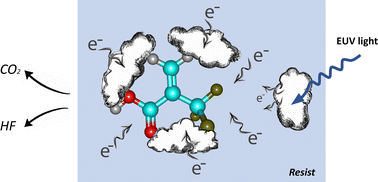
Motivated by the current introduction of extreme ultraviolet lithography (EUVL) into chip manufacturing processes, and thus the transition to electron-induced chemistry within the respective resist materials, we have studied low energy electron-induced fragmentation of 2-(trifluoromethyl)acrylic acid (TFMAA). This compound is chosen as a potential resist component, whereby fluorination enhances the EUV adsorption and may at the same time promote electron-induced dissociation. Dissociative ionization and dissociative electron attachment are studied, and to aid the interpretation of the observed fragmentation channels, the respective threshold values are calculated at the DFT and coupled cluster level of theory. Not surprisingly, we find significantly more extensive fragmentation in DI than in DEA and in fact, the only significant DEA fragmentation channel is the cleavage of HF from the parent molecule upon electron attachment. Rearrangement and new bond formation are substantial in DI and are, in fact, similar to DEA, mainly associated with HF formation. The observed fragmentation reactions are discussed in relation to the underlying reactions and potential implications for the suitability of TFMAA as a component of EUVL resist materials.
Recommended Literature
- [1] An insight into the origin of room-temperature ferromagnetism in SnO2 and Mn-doped SnO2 quantum dots: an experimental and DFT approach? Dhamodaran Manikandan,S. Amirthapandian,I. S. Zhidkov,A. I. Kukharenko,S. O. Cholakh,Ramaswamy MuruganPhys. Chem. Chem. Phys., 2018,20, 6500-6514 10.1039/C7CP07182E
- [2] Aggregation dynamics, structure, and mechanical properties of bigels L. Di Michele,D. Fiocco,F. Varrato,E. Eiser,G. FoffiSoft Matter, 2014,10, 3633-3648 10.1039/C3SM52558A
- [3] Aggregation-induced emission leading to two distinct emissive species in the solid-state structure of high-dipole organic chromophores? Felix Witte,Philipp Rietsch,Nithiya Nirmalananthan-Budau,Florian Weigert,Jan P. G?tze,Ute Resch-Genger,Siegfried Eigler,Beate PaulusPhys. Chem. Chem. Phys., 2021,23, 17521-17529 10.1039/D1CP02534A
- [4] Aluminium complexes with thio-phosphorus ligands: syntheses and characterisations of [Al2(CyPS3)2(CyPHS2)2] and [Al(S2PPh2)3]? Robert P. Davies,Maria A. Giménez,Laura Patel,Andrew J. P. WhiteDalton Trans., 2008, 5705-5707 10.1039/B813427H
- [5] An intermolecular C–H oxidizing strategy to access highly fused carbazole skeletons from simple naphthylamines? Christian K. Rank,Alexander W. Jones,Tatjana Wall,Patrick Di Martino-Fumo,Sarah Schr?ck,Markus Gerhards,Frederic W. PatureauChem. Commun., 2019,55, 13749-13752 10.1039/C9CC05240B
- [6] An approach to biodegradable star polymeric architectures using disulfide coupling? Jingquan Liu,Huiyun Liu,Zhongfan Jia,Volga Bulmus,Thomas P. DavisChem. Commun., 2008, 6582-6584 10.1039/B817037A
- [7] An amplified fluorescence detection of T4 polynucleotide kinase activity based on coupled exonuclease III reaction and a graphene oxide platform? Ni-Na Sun,Fengli Qu,Xiaobing Zhang,Shufang Zhang,Jinmao YouAnalyst, 2015,140, 1827-1831 10.1039/C4AN01953A
- [8] Aggregated-fluorescent detection of PFAS with a simple chip Cheng Fang,Jinjian Wu,Zahra Sobhani,Md. Al Amin,Youhong TangAnal. Methods, 2019,11, 163-170 10.1039/C8AY02382D
- [9] An ionic liquid loaded magnetically confined polymeric mesoporous adsorbent for extraction of parabens from environmental and cosmetic samples? Masrudin Md Yusoff,Muggundha Raoov,Noorfatimah Yahaya,Noorashikin Md SallehRSC Adv., 2017,7, 35832-35844 10.1039/C7RA06682A
- [10] Acenaphthenic hopanoids, a novel series of aromatised Teresita Carrillo-Hernández,Philippe Schaeffer,Pierre AlbrechtChem. Commun., 2001, 1976-1977 10.1039/B105198A

Journal Name:Physical Chemistry Chemical Physics
research_products
-

CAS no.: 89640-58-4

![1,2,3,4,5,6-Hexahydro-[2,3]bipyridinyl-6-ol](https://ossimg.kuujia.com/scimg/1271000/1270529-38-8x500.png)


![N-(3-cyanothiolan-3-yl)-2-[(2,2,2-trifluoroethyl)sulfanyl]pyridine-4-carboxamide](https://ossimg.kuujia.com/scimg/1444500/1444113-98-7x500.png)

![2,2-Difluoro-3-[methyl(2-methylbutyl)amino]propanoic acid](https://ossimg.kuujia.com/scimg/2138500/2138166-62-6x500.png)

![2-(1H-indol-3-yl)-N-{[6-(thiophen-2-yl)-[1,2,4]triazolo[4,3-b]pyridazin-3-yl]methyl}acetamide](https://ossimg.kuujia.com/scimg/2034500/2034271-14-0x500.png)