Multinuclear rhodium complexes supported by tetra-tert-butoxy disiloxide ligand: synthesis, structure, and reactivity?
New Journal of Chemistry Pub Date: 2022-07-26 DOI: 10.1039/D2NJ03095K
Abstract
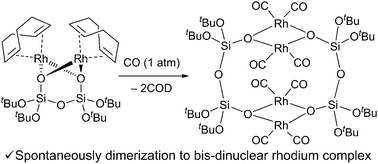
Rhodium siloxide complexes have been used as homogeneous catalysts and model compounds for silica-supported metal catalysts. However, rhodium complexes with multidentate siloxide ligands have rarely been prepared. In this study, a dinuclear rhodium complex supported by a bidentate tetra-tert-butoxy disiloxide ligand, {Rh(COD)}2{μ-(OSi(OtBu)2)2O} (3) (COD = cyclooctadiene), was synthesized and its basic reactivity was elucidated. When 3 reacted with carbon monoxide, a dinuclear rhodium carbonyl complex, {Rh(CO)2}2{μ-(OSi(OtBu)2)2O} (A), formed as an intermediate, which produced a bis-dinuclear rhodium carbonyl complex, [{Rh(CO)2}2{μ-(OSi(OtBu)2)2O}]2 (4), by spontaneous dimerization. The dimerization of A could be attributed to the relatively weak electron-donating ability of the tetra-tert-butoxy disiloxide ligand, suggesting that substituents on siloxide ligands exert a significantly large effect on the formation of rhodium siloxide complexes. In addition, the reaction of 3 with trimethylphosphine (PMe3) afforded different dinuclear rhodium complexes, {(PMe3)Rh(COD)}2{(OSi(OtBu)2)2O} (5), {(PMe3)2Rh}{Rh(COD)}{μ-(OSi(OtBu)2)2O} (6), and {Rh(PMe3)2}2{μ-(OSi(OtBu)2)2O} (7), depending on the reaction temperature and the equivalent of PMe3 used, indicating that the substitution reaction of COD by PMe3 proceeds in a stepwise manner. Understanding the basic reactivity of these rhodium siloxide complexes may contribute to the development of silica-supported metal catalysts.
Recommended Literature
- [1] Excimer emission and magnetoluminescence of radical-based zinc(ii) complexes doped in host crystals? Shojiro Kimura,Tetsuro KusamotoChem. Commun., 2020,56, 11195-11198 10.1039/D0CC04830E
- [2] Fatty acid eutectic mixtures and derivatives from non-edible animal fat as phase change materials? Pau Gallart-Sirvent,Marc Martín,Gemma Villorbina,Mercè Balcells,Aran Solé,Luisa F. Cabeza,Ramon Canela-GarayoaRSC Adv., 2017,7, 24133-24139 10.1039/C7RA03845C
- [3] Excellent mechanical performance and enhanced dielectric properties of OBC/SiO2 elastomeric nanocomposites: effect of dispersion of the SiO2 nanoparticles? Xing Zhao,Lu Bai,Rui-Ying Bao,Zheng-Ying Liu,Ming-Bo Yang,Wei YangRSC Adv., 2017,7, 46297-46305 10.1039/C7RA08074C
- [4] Evolution in surface coverage of CH3NH3PbI3?XClXvia heat assisted solvent vapour treatment and their effects on photovoltaic performance of devices Dhirendra K. Chaudhary,Pramendra Kumar,Lokendra KumarRSC Adv., 2016,6, 94731-94738 10.1039/C6RA18729C
- [5] Empowering microfluidics by micro-3D printing and solution-based mineral coating? Hongxia Li,Aikifa Raza,Qiaoyu Ge,Jin-You Lu,TieJun ZhangSoft Matter, 2020,16, 6841-6849 10.1039/D0SM00958J
- [6] Emergence of microfluidic wearable technologies Joo Chuan Yeo,KenryLab Chip, 2016,16, 4082-4090 10.1039/C6LC00926C
- [7] Emulsion soft templating of carbide-derived carbon nanospheres with controllable porosity for capacitive electrochemical energy storage? M. Zeiger,N. J?ckel,P. Strubel,L. Borchardt,R. Reinhold,W. Nickel,J. Eckert,V. Presser,S. KaskelJ. Mater. Chem. A, 2015,3, 17983-17990 10.1039/C5TA03730A
- [8] Excimer–monomer switch: a reaction-based approach for selective detection of fluoride? Qiao Song,Angela Bamesberger,Lingyun Yang,Haley Houtwed,Haishi CaoAnalyst, 2014,139, 3588-3592 10.1039/C4AN00522H
- [9] Excited state potential energy surfaces and their interactions in FeIVO active sites Shaun D. Wong,Edward I. SolomonDalton Trans., 2014,43, 17567-17577 10.1039/C4DT01366B
- [10] Excitable dynamics in the bromate–sulfite–ferrocyanide reaction J. Zagora,M. Vosla?,L. Schreiberová,I. SchreiberPhys. Chem. Chem. Phys., 2002,4, 1284-1291 10.1039/B110048C

Journal Name:New Journal of Chemistry
research_products
-

CAS no.: 89640-58-4


![N-(3-cyanothiolan-3-yl)-2-[(2,2,2-trifluoroethyl)sulfanyl]pyridine-4-carboxamide](https://ossimg.kuujia.com/scimg/1444500/1444113-98-7x500.png)

![1,2,3,4,5,6-Hexahydro-[2,3]bipyridinyl-6-ol](https://ossimg.kuujia.com/scimg/1271000/1270529-38-8x500.png)

![2,2-Difluoro-3-[methyl(2-methylbutyl)amino]propanoic acid](https://ossimg.kuujia.com/scimg/2138500/2138166-62-6x500.png)

![2-(1H-indol-3-yl)-N-{[6-(thiophen-2-yl)-[1,2,4]triazolo[4,3-b]pyridazin-3-yl]methyl}acetamide](https://ossimg.kuujia.com/scimg/2034500/2034271-14-0x500.png)