Microbial polyketides and their roles in insect virulence: from genomics to biological functions
Natural Product Reports Pub Date: 2022-07-13 DOI: 10.1039/D1NP00058F
Abstract
Covering: May 1966 up to January 2022
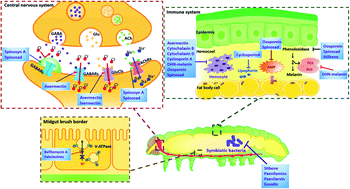
Entomopathogenic microorganisms have potential for biological control of insect pests. Their main secondary metabolites include polyketides, nonribosomal peptides, and polyketide–nonribosomal peptide (PK–NRP) hybrids. Among these secondary metabolites, polyketides have mainly been studied for structural identification, pathway engineering, and for their contributions to medicine. However, little is known about the function of polyketides in insect virulence. This review focuses on the role of bacterial and fungal polyketides, as well as PK–NRP hybrids in insect infection and killing. We also discuss gene distribution and evolutional relationships among different microbial species. Further, the role of microbial polyketides and the hybrids in modulating insect–microbial symbiosis is also explored. Understanding the mechanisms of polyketides in insect pathogenesis, how compounds moderate the host–fungus interaction, and the distribution of PKS genes across different fungi and bacteria will facilitate the discovery and development of novel polyketide-derived bio-insecticides.
Recommended Literature
- [1] Excitation energies from ground-state density-functionals by means of generator coordinates A. B. F. da Silva,K. CapellePhys. Chem. Chem. Phys., 2009,11, 4564-4569 10.1039/B902529D
- [2] Fate of single walled carbon nanotubes in wetland ecosystems? Joseph H. Bisesi,Tara Sabo-AttwoodEnviron. Sci.: Nano, 2014,1, 574-583 10.1039/C4EN00063C
- [3] Evolution and characterization of a benzylguanine-binding RNA aptamer? J. Xu,T. J. Carrocci,A. A. HoskinsChem. Commun., 2016,52, 549-552 10.1039/C5CC07605F
- [4] Enabling high-throughput single-animal gene-expression studies with molecular and micro-scale technologies Jason WanLab Chip, 2020,20, 4528-4538 10.1039/D0LC00881H
- [5] Dissociation of aryl sulfonyl phthalimide radical anions: relevance to the biological activity of arylsulfonyl amides? Abdelaziz Houmam,Emad M. HamedChem. Commun., 2012,48, 11328-11330 10.1039/C2CC36835H
- [6] Exchangeability of amino acid residues with similar physicochemical properties in coiled-coil interactions? Guiying Zhang,Maosheng Cheng,Yanni Li,Keliang Liu,Lifeng CaiChem. Commun., 2013,49, 11086-11088 10.1039/C3CC46560H
- [7] Esterase-responsive polymeric prodrug-based tumor targeting nanoparticles for improved anti-tumor performance against colon cancer? Gang Pan,Yi-jie Bao,Jie Xu,Tao Liu,Cheng Liu,Yan-yan Qiu,Xiao-jing Shi,Hui Yu,Ting-ting Jia,Xia Yuan,Ze-ting Yuan,Yi-jun CaoRSC Adv., 2016,6, 42109-42119 10.1039/C6RA05236C
- [8] Excimer and exciplex formation in a pair of bright phosphorescent isomers constructed from Cu3(pyrazolate)3 and Cu3I3 coordination luminophores? Shun-Ze Zhan,Mian Li,Xiao-Ping Zhou,Dan Li,Seik Weng NgRSC Adv., 2011,1, 1457-1459 10.1039/C1RA00566A
- [9] Evolution of calcium phosphate precipitation in hanging drop vapor diffusion by in situRaman microspectroscopy Gloria Belén Ramírez-Rodríguez,José Manuel Delgado-López,Jaime Gómez-MoralesCrystEngComm, 2013,15, 2206-2212 10.1039/C2CE26556G
- [10] Fast-Track to Research Data Management in Experimental Material Science-Setting the Ground for Research Group Level Materials Digitalization. LarsBanko,AlfredLudwig 10.1021/acscombsci.0c00057
Journal Name:Natural Product Reports
research_products
-

CAS no.: 89640-58-4

![1,2,3,4,5,6-Hexahydro-[2,3]bipyridinyl-6-ol](https://ossimg.kuujia.com/scimg/1271000/1270529-38-8x500.png)


![N-(3-cyanothiolan-3-yl)-2-[(2,2,2-trifluoroethyl)sulfanyl]pyridine-4-carboxamide](https://ossimg.kuujia.com/scimg/1444500/1444113-98-7x500.png)

![2,2-Difluoro-3-[methyl(2-methylbutyl)amino]propanoic acid](https://ossimg.kuujia.com/scimg/2138500/2138166-62-6x500.png)

![2-(1H-indol-3-yl)-N-{[6-(thiophen-2-yl)-[1,2,4]triazolo[4,3-b]pyridazin-3-yl]methyl}acetamide](https://ossimg.kuujia.com/scimg/2034500/2034271-14-0x500.png)