Jerusalem artichoke inulin supplementation ameliorates hepatic lipid metabolism in type 2 diabetes mellitus mice by modulating the gut microbiota and fecal metabolome?
Food & Function Pub Date: 2022-10-11 DOI: 10.1039/D2FO02051C
Abstract
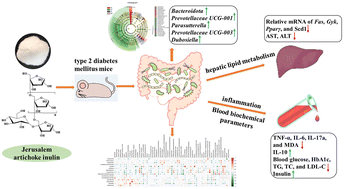
The main focus of this study was on the protection mechanism of Jerusalem artichoke inulin (DI) against type 2 diabetes mellitus (T2DM) associated with abnormal hepatic lipid metabolism and gut microbiota dysfunction in high-fat diet and streptozotocin-induced diabetic mice. It was determined that the consumption of DI significantly improved the biochemical parameters and physiological indices linked to T2DM, including the reduction in blood glucose, HbA1c, triglyceride, total cholesterol, and low-density lipoprotein cholesterol levels as well as the contents of serum pro-inflammatory cytokines. Supplementation with DI also ameliorated abnormal hepatic lipid metabolism by altering the expression of genes involved in the production and breakdown of lipids and cholesterol. Microbiological analysis showed that DI supplementation resulted in an enrichment of Prevotellaceae UCG-001, Parasutterella, Prevotellaceae UCG-003, and Dubosiella. Metabolomics revealed 89 differential metabolites closely related to DI intervention, and showed that DI supplementation regulated amino acid metabolism (e.g., indole), lipid metabolism (e.g., phosphocholine), cofactor and vitamin metabolism (e.g., cholecalciferol), nucleotide metabolism (e.g., thymine) and the digestive system (e.g., 7-ketolithocholic acid). Overall, Jerusalem artichoke inulin has a remarkable capacity to ameliorate abnormal hepatic lipid metabolism and gut microbiota dysfunction linked to T2DM.
Recommended Literature
- [1] Excellent mechanical performance and enhanced dielectric properties of OBC/SiO2 elastomeric nanocomposites: effect of dispersion of the SiO2 nanoparticles? Xing Zhao,Lu Bai,Rui-Ying Bao,Zheng-Ying Liu,Ming-Bo Yang,Wei YangRSC Adv., 2017,7, 46297-46305 10.1039/C7RA08074C
- [2] Dissociative electron attachment to HGaF4 Lewis–Br?nsted superacid Marcin Czapla,Jack SimonsPhys. Chem. Chem. Phys., 2018,20, 21739-21745 10.1039/C8CP04007A
- [3] Enabling non-flammable Li-metal batteries via electrolyte functionalization and interface engineering? Jing Yu,Yu-Qi Lyu,Jiapeng Liu,Mohammed B. Effat,Junxiong WuJ. Mater. Chem. A, 2019,7, 17995-18002 10.1039/C9TA03784E
- [4] Exceptional activity of sub-nm Pt clusters on CdS for photocatalytic hydrogen production: a combined experimental and first-principles study? Qiyuan Wu,Shangmin Xiong,Peichuan Shen,Shen Zhao,Alexander OrlovCatal. Sci. Technol., 2015,5, 2059-2064 10.1039/C4CY01563K
- [5] Fe3O4/FeS2 heterostructures enable efficient oxygen evolution reaction? Xingqun Zheng,Lele Song,Xin Feng,Li Li,Zidong WeiJ. Mater. Chem. A, 2020,8, 14145-14151 10.1039/C9TA13775K
- [6] Distinct impact of glycation towards the aggregation and toxicity of murine and human amyloid-β? Eunju Nam,Jiyeon Han,Sunhee Choi,Mi Hee LimChem. Commun., 2021,57, 7637-7640 10.1039/D1CC02695J
- [7] Emerging enantiomeric resolution materials with homochiral nano-fabrications Ji-Ping WeiNanoscale, 2015,7, 11815-11832 10.1039/C5NR03048J
- [8] Enantiocontrolled construction of sistodiolynne, an unusual polyketide from the wood-decay fungus Sistrema raduloides Chem. Commun., 1997, 767-768 10.1039/A700186J
- [9] Estimation of activation energy for electroporation and pore growth rate in liquid crystalline and gel phases of lipid bilayers using molecular dynamics simulations? Amit Kumar Majhi,Subbarao Kanchi,V. Venkataraman,K. G. Ayappa,Prabal K. MaitiSoft Matter, 2015,11, 8632-8640 10.1039/C5SM02029H
- [10] Excellent kinetics of single-phase Gd-doped ceria fuel electrodes in solid oxide cells? Andreas Nenning,Manuel Holzmann,Jürgen Fleig,Alexander K. OpitzMater. Adv., 2021,2, 5422-5431 10.1039/D1MA00202C

Journal Name:Food & Function
research_products
-

CAS no.: 89640-58-4


![N-(3-cyanothiolan-3-yl)-2-[(2,2,2-trifluoroethyl)sulfanyl]pyridine-4-carboxamide](https://ossimg.kuujia.com/scimg/1444500/1444113-98-7x500.png)

![1,2,3,4,5,6-Hexahydro-[2,3]bipyridinyl-6-ol](https://ossimg.kuujia.com/scimg/1271000/1270529-38-8x500.png)

![2,2-Difluoro-3-[methyl(2-methylbutyl)amino]propanoic acid](https://ossimg.kuujia.com/scimg/2138500/2138166-62-6x500.png)

![2-(1H-indol-3-yl)-N-{[6-(thiophen-2-yl)-[1,2,4]triazolo[4,3-b]pyridazin-3-yl]methyl}acetamide](https://ossimg.kuujia.com/scimg/2034500/2034271-14-0x500.png)