Ganoderic acid A from Ganoderma lucidum protects against alcoholic liver injury through ameliorating the lipid metabolism and modulating the intestinal microbial composition?
Food & Function Pub Date: 2022-03-24 DOI: 10.1039/D1FO03219D
Abstract
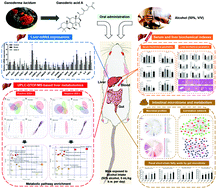
Alcoholic liver injury is mainly caused by long-term excessive alcohol consumption and has become a global public threat to human health. It is well known that Ganoderma lucidum has excellent beneficial effects on liver function and lipid metabolism. The object of this study was to investigate the hepatoprotective effects of ganoderic acid A (GAA, one of the main triterpenoids in G. lucidum) against alcohol-induced liver injury and reveal the underlying mechanisms of its protective effects. The results showed that oral administration of GAA significantly inhibited the abnormal elevation of the liver index, serum total triglyceride (TG), cholesterol (TC), low-density lipoprotein cholesterol (LDL-C), aspartate aminotransferase (AST) and alanine aminotransferase (ALT) in mice exposed to alcohol intake, and also significantly protected the liver against alcohol-induced excessive lipid accumulation and pathological changes. Besides, alcohol-induced oxidative stress in the liver was significantly ameliorated by the dietary intervention of GAA through decreasing the hepatic levels of lactate dehydrogenase (LDH) and malondialdehyde (MDA), and increasing hepatic activities of catalase (CAT), superoxide dismutase (SOD), alcohol dehydrogenase (ADH), aldehyde dehydrogenase (ALDH), and hepatic levels of glutathione (GSH). In addition, GAA intervention evidently ameliorated intestinal microbial disorder by markedly increasing the abundance of Muribaculaceae, Prevotellaceae, Jeotgalicoccus, Bilophila, Family_XIII_UCG_001, Aerococcus, Ruminococcaceae_UCG_005, Harryflintia, Christensenellaceae, Rumonpcpccaceae, Prevotelaceae_UCG_001, Clostridiales_vadinBB60_group, Parasutterella and Bifidobacterium, but decreasing the proportion of Lactobacillus, Burkholderia_Caballeroria_Paraburkholderia, Escherichia_Shigella and Erysipelatoclostridium. Furthermore, liver metabolomics based on UPLC-QTOF/MS demonstrated that oral administration of GAA had a significant regulatory effect on the composition of liver metabolites in mice exposed to alcohol intake, especially the levels of the biomarkers involved in the metabolic pathways of riboflavin metabolism, glycine, serine and threonine metabolism, pyruvate metabolism, glycolysis/gluconeogenesis, biosynthesis of unsaturated fatty acids, synthesis and degradation of ketone bodies, fructose and mannose metabolism. Moreover, dietary supplementation of GAA significantly regulated the hepatic mRNA levels of lipid metabolism and inflammatory response related genes. Conclusively, these findings demonstrate that GAA has beneficial effects on alleviating alcohol-induced liver injury and is expected to become a new functional food ingredient for the prevention of alcoholic liver injury.
Recommended Literature
- [1] Enabling shape memory and healable effects in a conjugated polymer by incorporating siloxane via dynamic imine bond? Yaling Zhang,Chunhui Dai,Shiwei Zhou,Bin LiuChem. Commun., 2018,54, 10092-10095 10.1039/C8CC05410J
- [2] Essential effect of the electrolyte on the mechanical and chemical degradation of LiNi0.8Co0.15Al0.05O2 cathodes upon long-term cycling?? Xiaoming Liu,Zachary D. Hood,Wangda Li,Donovan N. Leonard,Arumugam Manthiram,Miaofang ChiJ. Mater. Chem. A, 2021,9, 2111-2119 10.1039/D0TA07814J
- [3] Ester-directed orthogonal dual C–H activation and ortho aryl C–H alkenylation via distal weak coordination? Manickam Bakthadoss,Tadiparthi Thirupathi Reddy,Vishal Agarwal,Duddu S. SharadaChem. Commun., 2022,58, 1406-1409 10.1039/D1CC06097J
- [4] Enabling non-flammable Li-metal batteries via electrolyte functionalization and interface engineering? Jing Yu,Yu-Qi Lyu,Jiapeng Liu,Mohammed B. Effat,Junxiong WuJ. Mater. Chem. A, 2019,7, 17995-18002 10.1039/C9TA03784E
- [5] Exchanged ligands on the surface of a giant cluster: [(MoO3)176(H2O)63(CH3OH)17Hn](32 – n)– Chem. Commun., 1998, 1501-1502 10.1039/A801804I
- [6] Fast-pulsing NMR techniques for the detection of weak interactions: successful natural abundance probe of hydrogen bonds in peptides? Amandine Altmayer-Henzien,Valérie Declerck,David J. Aitken,Ewen Lescop,Denis Merlet,Jonathan FarjonOrg. Biomol. Chem., 2013,11, 7611-7615 10.1039/C3OB41876F
- [7] Excellent energy storage performance in NaNbO3-based relaxor antiferroeic ceramics under a low electric field XuxinCheng,XiaomingChen,PengyuanFan 10.1007/s10832-022-00283-w
- [8] Exciting clusters, what does off-resonance actually mean?? Goonay Yousefalizadeh,Shideh Ahmadi,Nicholas J. Mosey,Kevin G. StamplecoskieNanoscale, 2021,13, 242-252 10.1039/D0NR06493A
- [9] Estimation of activation energy for electroporation and pore growth rate in liquid crystalline and gel phases of lipid bilayers using molecular dynamics simulations? Amit Kumar Majhi,Subbarao Kanchi,V. Venkataraman,K. G. Ayappa,Prabal K. MaitiSoft Matter, 2015,11, 8632-8640 10.1039/C5SM02029H
- [10] Evolution of dealloying induced strain in nanoporous gold crystals? Ross Harder,David C. Dunand,Ian McNultyNanoscale, 2017,9, 5686-5693 10.1039/C6NR09635B
Journal Name:Food & Function
research_products
-

CAS no.: 89640-58-4


![N-(3-cyanothiolan-3-yl)-2-[(2,2,2-trifluoroethyl)sulfanyl]pyridine-4-carboxamide](https://ossimg.kuujia.com/scimg/1444500/1444113-98-7x500.png)

![1,2,3,4,5,6-Hexahydro-[2,3]bipyridinyl-6-ol](https://ossimg.kuujia.com/scimg/1271000/1270529-38-8x500.png)

![2,2-Difluoro-3-[methyl(2-methylbutyl)amino]propanoic acid](https://ossimg.kuujia.com/scimg/2138500/2138166-62-6x500.png)

![2-(1H-indol-3-yl)-N-{[6-(thiophen-2-yl)-[1,2,4]triazolo[4,3-b]pyridazin-3-yl]methyl}acetamide](https://ossimg.kuujia.com/scimg/2034500/2034271-14-0x500.png)