Development of a quantitative structure–activity relationship model for predicting quantum yield of hydroxyl radical generation from organic compounds?
Environmental Science: Processes & Impacts Pub Date: 2022-11-24 DOI: 10.1039/D2EM00396A
Abstract
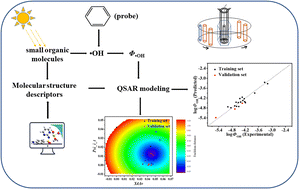
Organic compounds are capable of generating hydroxyl radicals (˙OH) through their excited triplet states in natural water. It is of significance to reveal the underlying mechanism of the generation and obtain the generation quantum yield of ˙OH from organic compounds for better understanding of its involvement in indirect photochemical processes in the environment. In this study, the ˙OH quantum yields (Φ˙OH) of 20 organic compounds were determined by photochemical experiments. The calculated Φ˙OH values for the selected organic compounds vary from (1.2 ± 0.39) × 10?5 to (7.2 ± 0.16) × 10?4. A quantitative structure–activity relationship (QSAR) model for log?Φ˙OH was developed and the established model was proven to have a proper goodness of fit, robustness, and predictive ability. The QSAR model was successfully used to predict the Φ˙OH value of organic pollutants. Mechanistic interpretation showed that the electron distribution and the electronegativity of organic compounds are the most important factors that determine the generation of ˙OH. The results are helpful for understanding the generation mechanism of ˙OH from organic compounds and also provide insights into the generation of ˙OH from dissolved organic matter in natural water.
Recommended Literature
- [1] Excellent energy storage performance in NaNbO3-based relaxor antiferroeic ceramics under a low electric field XuxinCheng,XiaomingChen,PengyuanFan 10.1007/s10832-022-00283-w
- [2] Evolution of dealloying induced strain in nanoporous gold crystals? Ross Harder,David C. Dunand,Ian McNultyNanoscale, 2017,9, 5686-5693 10.1039/C6NR09635B
- [3] Fe3O4 nanoparticle chains with N-doped carbon coating: magnetotactic bacteria assisted synthesis and high-rate lithium storage? Dan Yang,Yanping Zhou,Xianhong Rui,Jixin Zhu,Ziyang Lu,Eileen Fong,Qingyu YanRSC Adv., 2013,3, 14960-14962 10.1039/C3RA42116C
- [4] Distinct roles of SNARE-mimicking lipopeptides during initial steps of membrane fusion? Alena Koukalová,?árka Pokorná,Aimee L. Boyle,Nestor Lopez Mora,Alexander Kros,Martin Hof,Radek ?achlNanoscale, 2018,10, 19064-19073 10.1039/C8NR05730C
- [5] Excellent electrochemical performance of LiFe0.4Mn0.6PO4 microspheres produced using a double carbon coating process? Yong Ping Huang,Tao Tao,Zheng Chen,Wei Han,Ying Wu,Chunjiang Kuang,Shaoxiong Zhou,Ying ChenJ. Mater. Chem. A, 2014,2, 18831-18837 10.1039/C4TA03994G
- [6] Fe/Fe3C@C nanoparticles encapsulated in N-doped graphene–CNTs framework as an efficient bifunctional oxygen electrocatalyst for robust rechargeable Zn–air batteries? Zhiyan Chen,Nan Wu,Yaobing Wang,Bing Wang,Yingde WangJ. Mater. Chem. A, 2018,6, 516-526 10.1039/C7TA08423D
- [7] Enabling non-flammable Li-metal batteries via electrolyte functionalization and interface engineering? Jing Yu,Yu-Qi Lyu,Jiapeng Liu,Mohammed B. Effat,Junxiong WuJ. Mater. Chem. A, 2019,7, 17995-18002 10.1039/C9TA03784E
- [8] Emerging investigators Polym. Chem., 2015,6, 5501-5502 10.1039/C5PY90111A
- [9] Excimer and exciplex formation in a pair of bright phosphorescent isomers constructed from Cu3(pyrazolate)3 and Cu3I3 coordination luminophores? Shun-Ze Zhan,Mian Li,Xiao-Ping Zhou,Dan Li,Seik Weng NgRSC Adv., 2011,1, 1457-1459 10.1039/C1RA00566A
- [10] Fate of single walled carbon nanotubes in wetland ecosystems? Joseph H. Bisesi,Tara Sabo-AttwoodEnviron. Sci.: Nano, 2014,1, 574-583 10.1039/C4EN00063C

Journal Name:Environmental Science: Processes & Impacts
research_products
-

CAS no.: 89640-58-4


![N-(3-cyanothiolan-3-yl)-2-[(2,2,2-trifluoroethyl)sulfanyl]pyridine-4-carboxamide](https://ossimg.kuujia.com/scimg/1444500/1444113-98-7x500.png)

![1,2,3,4,5,6-Hexahydro-[2,3]bipyridinyl-6-ol](https://ossimg.kuujia.com/scimg/1271000/1270529-38-8x500.png)

![2,2-Difluoro-3-[methyl(2-methylbutyl)amino]propanoic acid](https://ossimg.kuujia.com/scimg/2138500/2138166-62-6x500.png)

![2-(1H-indol-3-yl)-N-{[6-(thiophen-2-yl)-[1,2,4]triazolo[4,3-b]pyridazin-3-yl]methyl}acetamide](https://ossimg.kuujia.com/scimg/2034500/2034271-14-0x500.png)