Self-propelled Janus magnetic micromotors as peroxidase-like nanozyme for colorimetric detection and removal of hydroquinone?
Environmental Science: Nano Pub Date: 2022-12-22 DOI: 10.1039/D2EN00990K
Abstract
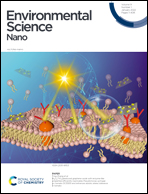
Micromotors, which combine nanotechnology with autonomous movement, have attracted extensive interest in the field of environmental monitoring and remediation. However, it is still a challenge to develop a facile method to prepare a multifunctional micromotor for simultaneously detecting and removing organic pollutants from water. Herein, we report a novel magnetically controllable Janus micromotor with peroxidase-like activity for simultaneous colorimetric detection and degradation of hydroquinone (HQ). Such polyethylene glycol (PEG) modified Janus micromotor was composed of calcined manganese(II) acetate modified Fe3O4@polyacrylic acid (PAA) and ferric oxide (Fe3O4) nanoparticles. The obtained Janus micromotors (P-FM JMMs) have a unique asymmetric structure and exhibit autonomous motion with a maximum speed of 95.2 ± 3.02 μm s?1 in the presence of 100 mM H2O2. Combining the advantages of autonomous motion and superior peroxidase-like activity, P-FM JMMs as effective micromotors were established for dynamic sensitive colorimetric detection of HQ with a detection limit of 0.0923 μM and rapid degradation of HQ via excellent Fenton-like activity in water. In addition, such Janus micromotors also could achieve effective magnetic recovery to reduce water pollution. The strategy provides a new insight for the future multifunctional task allocation of micromotors on demand.

Recommended Literature
- [1] Ester-directed orthogonal dual C–H activation and ortho aryl C–H alkenylation via distal weak coordination? Manickam Bakthadoss,Tadiparthi Thirupathi Reddy,Vishal Agarwal,Duddu S. SharadaChem. Commun., 2022,58, 1406-1409 10.1039/D1CC06097J
- [2] Exchangeability of amino acid residues with similar physicochemical properties in coiled-coil interactions? Guiying Zhang,Maosheng Cheng,Yanni Li,Keliang Liu,Lifeng CaiChem. Commun., 2013,49, 11086-11088 10.1039/C3CC46560H
- [3] Excimer formation effects and trap-assisted charge recombination loss channels in organic solar cells of perylene diimide dimer acceptors? Min Kim,Jae-Joon Lee,Tengling Ye,Panagiotis E. Keivanidis,Kilwon ChoJ. Mater. Chem. C, 2020,8, 1686-1696 10.1039/C9TC04955J
- [4] Emergence of microfluidic wearable technologies Joo Chuan Yeo,KenryLab Chip, 2016,16, 4082-4090 10.1039/C6LC00926C
- [5] Fatty acid positional distribution in colostrum and mature milk of women living in Inner Mongolia, North Jiangsu and Guangxi of China? Long Deng,Qian Zou,Biao Liu,Wenhui Ye,Chengfei Zhuo,Li Chen,Ze-Yuan Deng,Ya-Wei Fan,Jing LiFood Funct., 2018,9, 4234-4245 10.1039/C8FO00787J
- [6] Excellent humidity sensor based on ultrathin HKUST-1 nanosheets? Qiaoe Wang,Meiling Lian,Xiaowen Zhu,Xu ChenRSC Adv., 2021,11, 192-197 10.1039/D0RA08354B
- [7] Excellent peroxidase mimicking property of CuO/Pt nanocomposites and their application as an ascorbic acid sensor? Xinhuan Wang,Shuangfei Cai,Cui QiAnalyst, 2017,142, 2500-2506 10.1039/C7AN00589J
- [8] Evolution study of photo-synthesized gold nanoparticles by spectral deconvolution model: a quantitative approach Chung-Sung Yang,Mong-Shian Shih,Fang-Yi ChangNew J. Chem., 2006,30, 729-735 10.1039/B516465F
- [9] Fate of single walled carbon nanotubes in wetland ecosystems? Joseph H. Bisesi,Tara Sabo-AttwoodEnviron. Sci.: Nano, 2014,1, 574-583 10.1039/C4EN00063C
- [10] Evolutionary de novo design of phenothiazine derivatives for dye-sensitized solar cells? Vishwesh Venkatraman,Marco Foscato,Vidar R. Jensen,Bj?rn K?re AlsbergJ. Mater. Chem. A, 2015,3, 9851-9860 10.1039/C5TA00625B
Journal Name:Environmental Science: Nano
research_products
-

CAS no.: 89640-58-4

![1,2,3,4,5,6-Hexahydro-[2,3]bipyridinyl-6-ol](https://ossimg.kuujia.com/scimg/1271000/1270529-38-8x500.png)


![N-(3-cyanothiolan-3-yl)-2-[(2,2,2-trifluoroethyl)sulfanyl]pyridine-4-carboxamide](https://ossimg.kuujia.com/scimg/1444500/1444113-98-7x500.png)

![2,2-Difluoro-3-[methyl(2-methylbutyl)amino]propanoic acid](https://ossimg.kuujia.com/scimg/2138500/2138166-62-6x500.png)

![2-(1H-indol-3-yl)-N-{[6-(thiophen-2-yl)-[1,2,4]triazolo[4,3-b]pyridazin-3-yl]methyl}acetamide](https://ossimg.kuujia.com/scimg/2034500/2034271-14-0x500.png)