Discovery of CRBN as a target of thalidomide: a breakthrough for progress in the development of protein degraders
Chemical Society Reviews Pub Date: 2022-07-07 DOI: 10.1039/D2CS00116K
Abstract
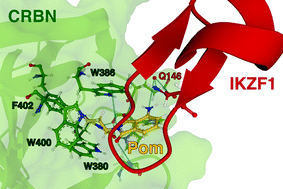
Progress in strategies aimed at breaking down therapeutic target proteins has led to a paradigm shift in drug discovery. Thalidomide and its derivatives are the only protein degraders currently used in clinical practice. Our understanding of the molecular mechanism of action of thalidomide and its derivatives has advanced dramatically since the identification of cereblon (CRBN) as their direct target. The binding of thalidomide derivatives to CRBN, a substrate recognition receptor for Cullin 4 RING E3 ubiquitin ligase (CRL4), induces the recruitment of non-native substrates to CRL4CRBN and their subsequent degradation. This discovery was a breakthrough in the current rapid development of protein-degrading agents because clarification of the mechanism of action of thalidomide derivatives has demonstrated the clinical value of these compounds. This review provides an overview of the mechanism of action of thalidomide and its derivatives and describes perspectives for protein degraders.
Recommended Literature
- [1] An approach towards the synthesis of novel fused nitrogen tricyclic heterocyclic scaffolds via GBB reaction? Sandip Gangadhar Balwe,Yeon Tae JeongOrg. Biomol. Chem., 2018,16, 1287-1296 10.1039/C7OB02933K
- [2] An artificial photosynthetic system for photoaccumulation of two electrons on a fused dipyridophenazine (dppz)–pyridoquinolinone ligand? Philipp Traber,Stephan Kupfer,Stefanie Gr?fe,Isabelle Baussanne,Martine Demeunynck,Jean-Marie Mouesca,Serge Gambarelli,Vincent Artero,Murielle Chavarot-KerlidouChem. Sci., 2018,9, 4152-4159 10.1039/C7SC04348A
- [3] An approach to C–N activation: coupling of arenesulfonyl hydrazides and arenesulfonyl chlorides with tert-amines via a metal-, oxidant- and halogen-free anodic oxidation?? M. Sheykhan,S. Khani,S. Shaabanzadeh,M. JoafshanGreen Chem., 2017,19, 5940-5948 10.1039/C7GC03141F
- [4] Acetylcholinesterase amperometric detection system based on a cobalt(II) tetraphenylporphyrin-modified electrode Analyst, 1996,121, 1123-1126 10.1039/AN9962101123
- [5] An integrated microfluidic 3D tumor system for parallel and high-throughput chemotherapy evaluation? Dan Liu,Rui Hu,Zhongchao Huang,Meilin Sun,Kai HanAnalyst, 2020,145, 6447-6455 10.1039/D0AN01229G
- [6] An all-solid-state imprinted polymer-based potentiometric sensor for determination of bisphenol S? Rongning Liang,Tanji Yin,Ruiqing Yao,Wei QinRSC Adv., 2016,6, 73308-73312 10.1039/C6RA14461F
- [7] Acentric and chiral heterometallic inorganic–organic hybrid frameworks mediated by alkali or alkaline earth ions: synthesis and NLO properties Huabin Zhang,Shaowu DuCrystEngComm, 2014,16, 4059-4068 10.1039/C3CE42419G
- [8] An Aptamer Bio-barCode (ABC) assay using SPR, RNase H, and probes with RNA and gold-nanorods for anti-cancer drug screening Chengbin Yang,Hing Lun Tsang,Pui Man Lau,Ken-Tye Yong,Ho Pui Ho,Siu Kai KongAnalyst, 2017,142, 3579-3587 10.1039/C7AN01026E
- [9] An algal process treatment combined with the Fenton reaction for high concentrations of amoxicillin and cefradine Haitao Li,Yu Pan,Zhizhi Wang,Shan Chen,Ruixin Guo,Jianqiu ChenRSC Adv., 2015,5, 100775-100782 10.1039/C5RA21508K
- [10] An assessment of strategies for the development of solid-state adsorbents for vehicular hydrogen storage Mark D. Allendorf,Alauddin Ahmed,Tom Autrey,Jeffrey Camp,Eun Seon Cho,Maciej Haranczyk,Abhi Karkamkar,Di-Jia Liu,Katie R. Meihaus,Iffat H. Nayyar,Roman Nazarov,Donald J. Siegel,Vitalie Stavila,Jeffrey J. Urban,Srimukh Prasad Veccham,Brandon C. WoodEnergy Environ. Sci., 2018,11, 2784-2812 10.1039/C8EE01085D

Journal Name:Chemical Society Reviews
research_products
-

CAS no.: 89640-58-4


![N-(3-cyanothiolan-3-yl)-2-[(2,2,2-trifluoroethyl)sulfanyl]pyridine-4-carboxamide](https://ossimg.kuujia.com/scimg/1444500/1444113-98-7x500.png)

![1,2,3,4,5,6-Hexahydro-[2,3]bipyridinyl-6-ol](https://ossimg.kuujia.com/scimg/1271000/1270529-38-8x500.png)

![2,2-Difluoro-3-[methyl(2-methylbutyl)amino]propanoic acid](https://ossimg.kuujia.com/scimg/2138500/2138166-62-6x500.png)

![2-(1H-indol-3-yl)-N-{[6-(thiophen-2-yl)-[1,2,4]triazolo[4,3-b]pyridazin-3-yl]methyl}acetamide](https://ossimg.kuujia.com/scimg/2034500/2034271-14-0x500.png)