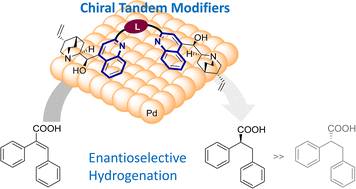
Chiral tandem modifiers: highly efficient cinchonidine-derivative modifiers at low concentrations for the enantioselective hydrogenation of (E)-2,3-diphenylpropenoic acid over Pd/C?
Catalysis Science & Technology Pub Date: 2022-10-14 DOI: 10.1039/D2CY01695H
Abstract
A novel group of chiral modifiers is successfully developed to achieve high enantioselectivity in the asymmetric hydrogenation of (E)-2,3-diphenylpropenoic acid (PCA) over Pd/C at a low modifier concentration. It is found that the tandem modifiers synthesized by linking two or three cinchonidine (CD) molecules with alkyl or aromatic linkers at the 2′-position of the quinoline ring show higher selectivity than the monomeric parent CD at ca. one order of magnitude lower concentrations. However, the tandem modifiers linking two or three CD molecules at the 11-position of the quinuclidine moiety are not very effective for the PCA hydrogenation. The enantioselectivity was analyzed from kinetic points of view. It is concluded that the adsorption equilibrium constants of the tandem modifiers are considerably increased by linking CD molecules via the quinoline ring. It is strongly suggested that the CD moieties of these tandem modifiers are synchronized and simultaneously adsorbed on the palladium metal surface together with the intervening aromatic group, resulting in enhanced adsorption strength. In sharp contrast, the tandem modifiers linked with alkyl groups at the 11-position of the quinuclidine moiety behave as independent, free CD molecules in spite of being linked.
Recommended Literature
- [1] Evidence of CO2 molecule acting as an electron acceptor on a nanoporous metal–organic-framework MIL-53 or Cr3+(OH)(O2C–C6H4–CO2)? Alexandre Vimont,Arnaud Travert,Philippe Bazin,Jean-Claude Lavalley,Marco Daturi,Christian Serre,Gérard Férey,Sandrine Bourrelly,Philip L. LlewellynChem. Commun., 2007, 3291-3293 10.1039/B703468G
- [2] Fate of nitrogen-15 in the subsequent growing season of greenhouse tomato plants (Lycopersicon esculentum Mill) as influenced by alternate partial root-zone irrigation Maomao Hou,Fenglin Zhong,Qiu Jin,Enjiang Liu,Jie Feng,Tengyun Wang,Yue GaoRSC Adv., 2017,7, 34392-34400 10.1039/C7RA05271E
- [3] Evolution of hierarchical porous structures in supramolecular guest–host hydrogels? Christopher B. Rodell,Christopher B. Highley,Minna H. Chen,Neville N. Dusaj,Chao Wang,Lin Han,Jason A. BurdickSoft Matter, 2016,12, 7839-7847 10.1039/C6SM01395C
- [4] Establishing the accuracy of position-specific carbon isotope analysis of propane by GC-pyrolysis-GC-IRMS ChangjieLiu,PengLiu,XiaofengWang,XiaoqiangLi,JuskeHorita 10.1002/rcm.9494
- [5] Dissociative dynamics of O2 on Ag(110)? Ivor Lon?ari?Phys. Chem. Chem. Phys., 2015,17, 9436-9445 10.1039/C4CP05900J
- [6] Exchangeability of amino acid residues with similar physicochemical properties in coiled-coil interactions? Guiying Zhang,Maosheng Cheng,Yanni Li,Keliang Liu,Lifeng CaiChem. Commun., 2013,49, 11086-11088 10.1039/C3CC46560H
- [7] Emulsifier-free, organotellurium-mediated living radical emulsion polymerization (emulsion TERP) of styrene: poly(dimethylaminoethyl methacrylate) macro-TERP agent? Yukiya KitayamaPolym. Chem., 2014,5, 2784-2792 10.1039/C3PY01539D
- [8] Exceptional activity of sub-nm Pt clusters on CdS for photocatalytic hydrogen production: a combined experimental and first-principles study? Qiyuan Wu,Shangmin Xiong,Peichuan Shen,Shen Zhao,Alexander OrlovCatal. Sci. Technol., 2015,5, 2059-2064 10.1039/C4CY01563K
- [9] Empowering microfluidics by micro-3D printing and solution-based mineral coating? Hongxia Li,Aikifa Raza,Qiaoyu Ge,Jin-You Lu,TieJun ZhangSoft Matter, 2020,16, 6841-6849 10.1039/D0SM00958J
- [10] Excess electrons in lithium–ethylamine solutions—density, electrical conductivity and EPR studies Phys. Chem. Chem. Phys., 1999,1, 3561-3565 10.1039/A900683D

Journal Name:Catalysis Science & Technology
research_products
-

CAS no.: 89640-58-4


![N-(3-cyanothiolan-3-yl)-2-[(2,2,2-trifluoroethyl)sulfanyl]pyridine-4-carboxamide](https://ossimg.kuujia.com/scimg/1444500/1444113-98-7x500.png)

![1,2,3,4,5,6-Hexahydro-[2,3]bipyridinyl-6-ol](https://ossimg.kuujia.com/scimg/1271000/1270529-38-8x500.png)

![2,2-Difluoro-3-[methyl(2-methylbutyl)amino]propanoic acid](https://ossimg.kuujia.com/scimg/2138500/2138166-62-6x500.png)

![2-(1H-indol-3-yl)-N-{[6-(thiophen-2-yl)-[1,2,4]triazolo[4,3-b]pyridazin-3-yl]methyl}acetamide](https://ossimg.kuujia.com/scimg/2034500/2034271-14-0x500.png)