An overview on enhancing the stability of lead halide perovskite quantum dots and their applications in phosphor-converted LEDs
Chemical Society Reviews Pub Date: 2018-11-22 DOI: 10.1039/C8CS00740C
Abstract
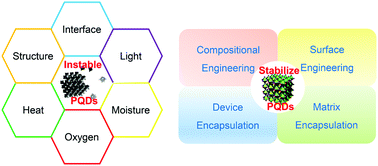
Beyond the unprecedented success achieved in photovoltaics (PVs), lead halide perovskites (LHPs) have shown great potential in other optoelectronic devices. Among them, nanometer-scale perovskite quantum dots (PQDs) with fascinating optical properties including high brightness, tunable emission wavelength, high color purity, and high defect tolerance have been regarded as promising alternative down-conversion materials in phosphor-converted light-emitting diodes (pc-LEDs) for lighting and next-generation of display technology. Despite the promising applications of perovskite materials in various fields, they have received strong criticism for the lack of stability. The poor stability has also attracted much attention. Within a few years, numerous strategies towards enhancing the stability have been developed. This review summarizes the mechanisms of intrinsic- and extrinsic-environment-induced decomposition of PQDs. Simultaneously, the strategies for improving the stability of PQDs are reviewed in detail, which can be classified into four types: (1) compositional engineering; (2) surface engineering; (3) matrix encapsulation; (4) device encapsulation. Finally, the challenges for applying PQDs in pc-LEDs are highlighted, and some possible solutions to improve the stability of PQDs together with suggestions for further improving the performance of pc-LEDs as well as the device lifetime are provided.
Recommended Literature
- [1] Emerging investigator series: heterogeneous reactions of sulfur dioxide on mineral dust nanoparticles: from single component to mixed components? Tao Wang,Yangyang Liu,Yue Deng,Hongbo Fu,Jianmin ChenEnviron. Sci.: Nano, 2018,5, 1821-1833 10.1039/C8EN00376A
- [2] Evolutionary approaches in protein engineering towards biomaterial construction Brindha J.,Balamurali M. M.,Kaushik ChandaRSC Adv., 2019,9, 34720-34734 10.1039/C9RA06807D
- [3] Estimating and correcting interference fringes in infrared spectra in infrared hyperspectral imaging Ghazal Azarfar,Ebrahim Aboualizadeh,Nicholas M. Walter,Simona Ratti,Camilla Olivieri,Alessandra Norici,Michael Nasse,Achim Kohler,Mario GiordanoAnalyst, 2018,143, 4674-4683 10.1039/C8AN00093J
- [4] Establishing plasmon contribution to chemical reactions: alkoxyamines as a thermal probe? Olga Guselnikova,Gérard Audran,Jean-Patrick Joly,Andrii Trelin,Evgeny V. Tretyakov,Vaclav Svorcik,Oleksiy Lyutakov,Sylvain R. A. MarqueChem. Sci., 2021,12, 4154-4161 10.1039/D0SC06470J
- [5] Enabling non-flammable Li-metal batteries via electrolyte functionalization and interface engineering? Jing Yu,Yu-Qi Lyu,Jiapeng Liu,Mohammed B. Effat,Junxiong WuJ. Mater. Chem. A, 2019,7, 17995-18002 10.1039/C9TA03784E
- [6] Fate of Sb(v) and Sb(iii) species along a gradient of pH and oxygen concentration in the Carnoulès mine waters (Southern France) Eléonore Resongles,Corinne Casiot,Fran?oise Elbaz-Poulichet,Rémi Freydier,Odile Bruneel,Christine Piot,Sophie Delpoux,Aurélie Volant,Angélique DesoeuvreEnviron. Sci.: Processes Impacts, 2013,15, 1536-1544 10.1039/C3EM00215B
- [7] Excimer formation effects and trap-assisted charge recombination loss channels in organic solar cells of perylene diimide dimer acceptors? Min Kim,Jae-Joon Lee,Tengling Ye,Panagiotis E. Keivanidis,Kilwon ChoJ. Mater. Chem. C, 2020,8, 1686-1696 10.1039/C9TC04955J
- [8] Dissolution of cork biopolymers in biocompatible ionic liquids Helga Garcia,Rui Ferreira,Marija Petkovic,Jamie L. Ferguson,Maria C. Leit?o,H. Q. Nimal Gunaratne,Luís Paulo N. RebeloGreen Chem., 2010,12, 367-369 10.1039/B922553F
- [9] Evolution and characterization of a benzylguanine-binding RNA aptamer? J. Xu,T. J. Carrocci,A. A. HoskinsChem. Commun., 2016,52, 549-552 10.1039/C5CC07605F
- [10] Dissolved oxygen sensor based on fluorescence quenching of oxygen-sensitive ruthenium complexes immobilized in sol–gel-derived porous silica coatings Analyst, 1996,121, 785-788 10.1039/AN9962100785

Journal Name:Chemical Society Reviews
research_products
-

CAS no.: 89640-58-4


![N-(3-cyanothiolan-3-yl)-2-[(2,2,2-trifluoroethyl)sulfanyl]pyridine-4-carboxamide](https://ossimg.kuujia.com/scimg/1444500/1444113-98-7x500.png)

![1,2,3,4,5,6-Hexahydro-[2,3]bipyridinyl-6-ol](https://ossimg.kuujia.com/scimg/1271000/1270529-38-8x500.png)

![2,2-Difluoro-3-[methyl(2-methylbutyl)amino]propanoic acid](https://ossimg.kuujia.com/scimg/2138500/2138166-62-6x500.png)

![2-(1H-indol-3-yl)-N-{[6-(thiophen-2-yl)-[1,2,4]triazolo[4,3-b]pyridazin-3-yl]methyl}acetamide](https://ossimg.kuujia.com/scimg/2034500/2034271-14-0x500.png)