Photoluminescence tuning in carbon dots: surface passivation or/and functionalization, heteroatom doping
Journal of Materials Chemistry C Pub Date: 2018-06-22 DOI: 10.1039/C7TC05878K
Abstract
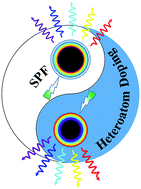
Carbon dots (CDs) are an emerging fluorescent subclass of the carbon nanomaterial family that have been perceived as a versatile new platform in an extensive range of applications. Among this state-of-the-art work, photoluminescence (PL) correlative applications play a leading role by virtue of the benign biocompatibility, low cost and high chemical scalability of CDs. In this review article we first emphasize the functions of the surface passivation and/or functionalization process during synthesis, which is one of the fundamental methods used to control the fluorescent properties during the early stages of the synthesis of CDs by changing the surface emissive sites (surface states), especially in some inert raw CDs. More importantly, the doping approach is another critical factor that paves an avenue to efficiently tune the intrinsic PL properties of CDs. Second, we highlight a series of the latest relative PL tuning mechanisms that provide new insight in this review into modified synthesis strategies for CDs that focus on the essential factors (i.e., physical, chemical and electronic structures) needed to enhance the PL properties of CDs. This review and further research is expected to facilitate understanding of the relationship between synthetic methods and PL tuning.
Recommended Literature
- [1] An aptamer-based keypad lock system? Yaqing Liu,Jiangtao Ren,Jing Li,Jiyang Liu,Erkang WangChem. Commun., 2012,48, 802-804 10.1039/C1CC15979H
- [2] An amorphous Cu–In–S nanoparticle-based precursor ink with improved atom economy for CuInSe2 solar cells with 10.85% efficiency? Green Chem., 2017,19, 1268-1277 10.1039/C6GC03280J
- [3] Acetyl protected thiol methacrylic polymers as effective ligands to keep quantum dots in luminescent standby mode? Marta Liras,Isabel Quijada-Garrido,Marta Palacios-Cuesta,Sonia Mu?oz-Durieux,Olga GarcíaPolym. Chem., 2014,5, 433-442 10.1039/C3PY00987D
- [4] An inter-tangled network of redox-active and conducting polymers as a cathode for ultrafast rechargeable batteries Jieun Kim,Han-Saem Park,Tae-Hee Kim,Sung Yeol Kim,Hyun-Kon SongPhys. Chem. Chem. Phys., 2014,16, 5295-5300 10.1039/C3CP54624A
- [5] An integrated digital microfluidic chip for multiplexed proteomic sample preparation and analysis by MALDI-MS? Hyejin Moon,Aaron R. Wheeler,Robin L. Garrell,Chang-Jin “CJ” KimLab Chip, 2006,6, 1213-1219 10.1039/B601954D
- [6] Alternative donor substrates for inverting and retaining glycosyltransferases? Luke L. Lairson,Warren W. WakarchukChem. Commun., 2007, 365-367 10.1039/B614636H
- [7] Aggregation of biologically important peptides and proteins: inhibition or acceleration depending on protein and metal ion concentrations Benjamin Gabriel Poulson,Kacper Szczepski,Joanna Izabela Lachowicz,Lukasz Jaremko,Abdul-Hamid Emwas,Mariusz JaremkoRSC Adv., 2020,10, 215-227 10.1039/C9RA09350H
- [8] An integrated system for field analysis of Cd(ii) and Pb(ii) via preconcentration using nano-TiO2/cellulose paper composite and subsequent detection with a portable X-ray fluorescence spectrometer? Xiaofeng LinRSC Adv., 2016,6, 9002-9006 10.1039/C5RA25693C
- [9] An artificial enzyme cascade amplification strategy for highly sensitive and specific detection of breast cancer-derived exosomes? Huiying Xu,Lu Zheng,Yu Zhou,Bang-Ce YeAnalyst, 2021,146, 5542-5549 10.1039/D1AN01071A
- [10] Acetyl group orientation modulates the electronic ground-state asymmetry of the special pair in purple bacterial reaction centers P. K. Wawrzyniak,M. T. P. Beerepoot,H. J. M. de Groot,F. BudaPhys. Chem. Chem. Phys., 2011,13, 10270-10279 10.1039/C1CP20213H

Journal Name:Journal of Materials Chemistry C
research_products
-

CAS no.: 89640-58-4


![N-(3-cyanothiolan-3-yl)-2-[(2,2,2-trifluoroethyl)sulfanyl]pyridine-4-carboxamide](https://ossimg.kuujia.com/scimg/1444500/1444113-98-7x500.png)

![1,2,3,4,5,6-Hexahydro-[2,3]bipyridinyl-6-ol](https://ossimg.kuujia.com/scimg/1271000/1270529-38-8x500.png)

![2,2-Difluoro-3-[methyl(2-methylbutyl)amino]propanoic acid](https://ossimg.kuujia.com/scimg/2138500/2138166-62-6x500.png)

![2-(1H-indol-3-yl)-N-{[6-(thiophen-2-yl)-[1,2,4]triazolo[4,3-b]pyridazin-3-yl]methyl}acetamide](https://ossimg.kuujia.com/scimg/2034500/2034271-14-0x500.png)