Activity and conformation of lysozyme in molecular solvents, protic ionic liquids (PILs) and salt–water systems?
Physical Chemistry Chemical Physics Pub Date: 2016-08-31 DOI: 10.1039/C6CP03334B
Abstract
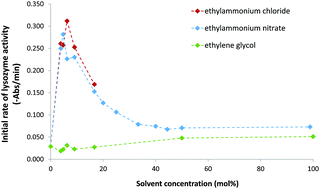
Improving protein stabilisation is important for the further development of many applications in the pharmaceutical, specialty chemical, consumer product and agricultural sectors. However, protein stabilization is highly dependent on the solvent environment and, hence, it is very complex to tailor protein–solvent combinations for stable protein maintenance. Understanding solvent features that govern protein stabilization will enable selection or design of suitable media with favourable solution environments to retain protein native conformation. In this work the structural conformation and activity of lysozyme in 29 solvent systems were investigated to determine the role of various solvent features on the stability of the enzyme. The solvent systems consisted of 19 low molecular weight polar solvents and 4 protic ionic liquids (PILs), both at different water content levels, and 6 aqueous salt solutions. Small angle X-ray scattering, Fourier transform infrared spectroscopy and UV-vis spectroscopy were used to investigate the tertiary and secondary structure of lysozyme along with the corresponding activity in various solvation systems. At low non-aqueous solvent concentrations (high water content), the presence of solvents and salts generally maintained lysozyme in its native structure and enhanced its activity. Due to the presence of a net surface charge on lysozyme, electrostatic interactions in PIL–water systems and salt solutions enhanced lysozyme activity more than the specific hydrogen-bond interactions present in non-ionic molecular solvents. At higher solvent concentrations (lower water content), solvents with a propensity to exhibit the solvophobic effect, analogous to the hydrophobic effect in water, retained lysozyme native conformation and activity. This solvophobic effect was observed particularly for solvents which contained hydroxyl moieties. Preferential solvophobic effects along with bulky chemical structures were postulated to result in less competition with water at the specific hydration layer around the protein, thus reducing protein–solvent interactions and retaining lysozyme's native conformation. The structure–property links established in this study are considered to be applicable to other proteins.
Recommended Literature
- [1] An approach to C–N activation: coupling of arenesulfonyl hydrazides and arenesulfonyl chlorides with tert-amines via a metal-, oxidant- and halogen-free anodic oxidation?? M. Sheykhan,S. Khani,S. Shaabanzadeh,M. JoafshanGreen Chem., 2017,19, 5940-5948 10.1039/C7GC03141F
- [2] An assay for the enzyme N-acetyl-β-d-glucosaminidase (NAGase) based on electrochemical detection using screen-printed carbon electrodes (SPCEs) R. M. Pemberton,J. P. Hart,T. T. MottramAnalyst, 2001,126, 1866-1871 10.1039/B104874K
- [3] An anti-ultrasonic-stripping effect in confined micro/nanoscale cavities and its applications for efficient multiscale metallic patterning? Quan Xiang,Yiqin Chen,Zhiqin Li,Kaixi Bi,Guanhua Zhang,Huigao DuanNanoscale, 2016,8, 19541-19550 10.1039/C6NR07585A
- [4] An aquatic host–guest complex between a supramolecular G-quadruplex and the anticancer drug doxorubicin? José M. Rivera,Mariana Martín-Hidalgo,Jean C. Rivera-RíosOrg. Biomol. Chem., 2012,10, 7562-7565 10.1039/C2OB25913C
- [5] Aggregated-fluorescent detection of PFAS with a simple chip Cheng Fang,Jinjian Wu,Zahra Sobhani,Md. Al Amin,Youhong TangAnal. Methods, 2019,11, 163-170 10.1039/C8AY02382D
- [6] An automatic determination of thoria in thoria-urania mixtures Analyst, 1966,91, 208-210 10.1039/AN9669100208
- [7] Acentric and chiral heterometallic inorganic–organic hybrid frameworks mediated by alkali or alkaline earth ions: synthesis and NLO properties Huabin Zhang,Shaowu DuCrystEngComm, 2014,16, 4059-4068 10.1039/C3CE42419G
- [8] An aptasensor for detection of potassium ions based on RecJf exonuclease mediated signal amplification Bidou Wang,Xifeng ChenAnalyst, 2014,139, 5695-5699 10.1039/C4AN01350F
- [9] An interplay between electronic and structural effects on the photoluminescence decay mechanisms in LaPO4·nH2O:Tb3+ and LaPO4:Tb3+ single-crystal nanorods? M. T. Colomer,S. Díaz-Moreno,A. Tamayo,A. L. OrtizJ. Mater. Chem. C, 2018,6, 12643-12651 10.1039/C8TC03187H
- [10] An aptasensor for the detection of ampicillin in milk using a personal glucose meter Xixi Li,Nanwei Zhu,Ruohan Li,Qinpu ZhangAnal. Methods, 2020,12, 3376-3381 10.1039/D0AY00256A

Journal Name:Physical Chemistry Chemical Physics
research_products
-

CAS no.: 89640-58-4

![1,2,3,4,5,6-Hexahydro-[2,3]bipyridinyl-6-ol](https://ossimg.kuujia.com/scimg/1271000/1270529-38-8x500.png)


![N-(3-cyanothiolan-3-yl)-2-[(2,2,2-trifluoroethyl)sulfanyl]pyridine-4-carboxamide](https://ossimg.kuujia.com/scimg/1444500/1444113-98-7x500.png)

![2,2-Difluoro-3-[methyl(2-methylbutyl)amino]propanoic acid](https://ossimg.kuujia.com/scimg/2138500/2138166-62-6x500.png)

![2-(1H-indol-3-yl)-N-{[6-(thiophen-2-yl)-[1,2,4]triazolo[4,3-b]pyridazin-3-yl]methyl}acetamide](https://ossimg.kuujia.com/scimg/2034500/2034271-14-0x500.png)