Influence of multiple environmental factors on the quality and flavor of watermelon juice
RSC Advances Pub Date: 2019-05-16 DOI: 10.1039/C9RA01533G
Abstract
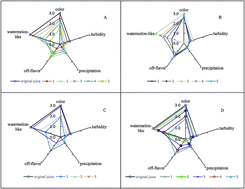
Environmental factors (heat, pH, oxygen, light) can induce significant quality changes in watermelon juice during processing. To ascertain the effect of such factors on the quality of watermelon juice, the total soluble solids (TSSs), turbidity, lycopene content, color, and flavor were evaluated during different treatments. The pH had a slight impact on the content of lycopene, but had an obvious impact on turbidity. Heat, oxygen, and illumination had considerable effects on the color of watermelon juice, and the results were visible. The content of aldehydes [hexanal, nonanal, (E)-2-noneal, (Z)-6-nonenal] and ketones (6-methyl-5-hepten-2-one, geranylacetone, β-ionone) decreased in treated watermelon juices, while those of 1-nonanol, (Z)-3-nonen-1-ol and (E,Z)-3,6-nonadien-ol increased during illumination. The order of influence of environmental factors on watermelon-juice quality was light > pH > oxygen > heat.
Recommended Literature
- [1] Fast synthesis of copper nanoclusters through the use of hydrogen peroxide additive and their application for the fluorescence detection of Hg2+ in water samples? Liao Xiaoqing,Li Ruiyi,Li Zaijun,Sun Xiulan,Wang Zhouping,Liu JunkangNew J. Chem., 2015,39, 5240-5248 10.1039/C5NJ00831J
- [2] Evolved polymerases facilitate selection of fully 2′-OMe-modified aptamers? Zhixia Liu,Tingjian Chen,Floyd E. RomesbergChem. Sci., 2017,8, 8179-8182 10.1039/C7SC03747C
- [3] Fe(ii)-Assisted one-pot synthesis of ultra-small core–shell Au–Pt nanoparticles as superior catalysts towards the HER and ORR? Yi Cao,Yujiao Xiahou,Lixiang Xing,Xiang Zhang,Hong Li,ChenShou Wu,Haibing XiaNanoscale, 2020,12, 20456-20466 10.1039/D0NR04995F
- [4] Exchangeability of amino acid residues with similar physicochemical properties in coiled-coil interactions? Guiying Zhang,Maosheng Cheng,Yanni Li,Keliang Liu,Lifeng CaiChem. Commun., 2013,49, 11086-11088 10.1039/C3CC46560H
- [5] Dissociative electron attachment to HGaF4 Lewis–Br?nsted superacid Marcin Czapla,Jack SimonsPhys. Chem. Chem. Phys., 2018,20, 21739-21745 10.1039/C8CP04007A
- [6] Excess electrons in lithium–ethylamine solutions—density, electrical conductivity and EPR studies Phys. Chem. Chem. Phys., 1999,1, 3561-3565 10.1039/A900683D
- [7] Excitation energies from ground-state density-functionals by means of generator coordinates A. B. F. da Silva,K. CapellePhys. Chem. Chem. Phys., 2009,11, 4564-4569 10.1039/B902529D
- [8] Evolution of dealloying induced strain in nanoporous gold crystals? Ross Harder,David C. Dunand,Ian McNultyNanoscale, 2017,9, 5686-5693 10.1039/C6NR09635B
- [9] Fe3O4 nanosphere@microporous organic networks: enhanced anode performances in lithium ion batteries through carbonization? Byungho Lim,Jaewon Jin,Jin Yoo,Seung Yong Han,Kyeongyeol Kim,Sungah Kang,Nojin Park,Sang Moon Lee,Hae Jin Kim,Seung Uk SonChem. Commun., 2014,50, 7723-7726 10.1039/C4CC02068E
- [10] Fe(iii)-mediated isomerization of α,α-diarylallylic alcohols to ketones via radical 1,2-aryl migration? Ziyang Deng,Changwei Chen,Sunliang CuiRSC Adv., 2016,6, 93753-93755 10.1039/C6RA20007A

Journal Name:RSC Advances
research_products
-

CAS no.: 89640-58-4


![N-(3-cyanothiolan-3-yl)-2-[(2,2,2-trifluoroethyl)sulfanyl]pyridine-4-carboxamide](https://ossimg.kuujia.com/scimg/1444500/1444113-98-7x500.png)

![1,2,3,4,5,6-Hexahydro-[2,3]bipyridinyl-6-ol](https://ossimg.kuujia.com/scimg/1271000/1270529-38-8x500.png)

![2,2-Difluoro-3-[methyl(2-methylbutyl)amino]propanoic acid](https://ossimg.kuujia.com/scimg/2138500/2138166-62-6x500.png)

![2-(1H-indol-3-yl)-N-{[6-(thiophen-2-yl)-[1,2,4]triazolo[4,3-b]pyridazin-3-yl]methyl}acetamide](https://ossimg.kuujia.com/scimg/2034500/2034271-14-0x500.png)