Facile synthesis of oligo anilines as permanent hair dyes: how chemical modifications impart colour and avoid toxicity?
New Journal of Chemistry Pub Date: 2019-09-11 DOI: 10.1039/C9NJ03362A
Abstract
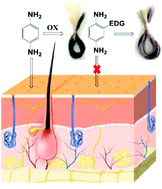
Many dyes for long-lasting hair coloring contain aromatic amines that undergo oxidative polymerizations, resulting in allergic contact dermatitis, with the potential to develop serious toxic effects. Among these amines, para-phenylenediamine (PPD) is a small molecule form of aniline commonly used in beauty products despite being a known allergen to humans. Hence, in this study we designed and synthesized safer PPD analogues through the synthesis of oligomeric PPD and the introduction of bulky side chains on PPD to overcome the PPD dye's toxicity. We hypothesized that (a) an increase in the molecular size of PPD by addition of the PPD monomer unit on free amines and (b) strategic functionalizations at the ortho position of PPD with strong electron-donating bulky groups are able to maintain the hair coloring properties, and increase the resistance to binding to skin proteins and therefore decrease the chance of skin sensitization. 13 oligomers were synthesized, with the aim to produce safer hair dyes while minimising eventual toxicity to humans. In particular, oligomers with bulky sidechains, PPD 6 (13), PPD 7 (14) and PPD 8 (15), displayed weak-to-moderate (27.1%, 24.1% and 34.0%) sensitization potential. The results confirmed the importance of having bulky and strong electron donating O-alkyl substituents in order to decrease the reactivity of PPD analogues towards skin proteins, thus preventing the interaction with immune cells and providing safer hair dyes.
Recommended Literature
- [1] Fe(iii)-mediated isomerization of α,α-diarylallylic alcohols to ketones via radical 1,2-aryl migration? Ziyang Deng,Changwei Chen,Sunliang CuiRSC Adv., 2016,6, 93753-93755 10.1039/C6RA20007A
- [2] Establishment and implications of a characterization method for magnetic nanoparticle using cell tracking velocimetry and magnetic susceptibility modified solutions Huading Zhang,Lee R. Moore,Maciej Zborowski,P. Stephen Williams,Shlomo Margel,Jeffrey J. ChalmersAnalyst, 2005,130, 514-527 10.1039/B412723D
- [3] Dissociative electron attachment to HGaF4 Lewis–Br?nsted superacid Marcin Czapla,Jack SimonsPhys. Chem. Chem. Phys., 2018,20, 21739-21745 10.1039/C8CP04007A
- [4] Excess electrons in lithium–ethylamine solutions—density, electrical conductivity and EPR studies Phys. Chem. Chem. Phys., 1999,1, 3561-3565 10.1039/A900683D
- [5] Excellent humidity sensor based on ultrathin HKUST-1 nanosheets? Qiaoe Wang,Meiling Lian,Xiaowen Zhu,Xu ChenRSC Adv., 2021,11, 192-197 10.1039/D0RA08354B
- [6] Fe3O4 nanosphere@microporous organic networks: enhanced anode performances in lithium ion batteries through carbonization? Byungho Lim,Jaewon Jin,Jin Yoo,Seung Yong Han,Kyeongyeol Kim,Sungah Kang,Nojin Park,Sang Moon Lee,Hae Jin Kim,Seung Uk SonChem. Commun., 2014,50, 7723-7726 10.1039/C4CC02068E
- [7] Exciplex emission from the mixed dimer of naphthalene and 2-cyanonaphthalene in a supersonic jet Aloke Das,K. K. Mahato,Chayan K. Nandi,Tapas Chakraborty,Shridhar R. Gadre,Nikhil A. GokhalePhys. Chem. Chem. Phys., 2002,4, 2162-2168 10.1039/B200124C
- [8] Emerging investigator series: bacteriophages as nano engineering tools for quality monitoring and pathogen detection in water and wastewater Fereshteh BayatEnviron. Sci.: Nano, 2021,8, 367-389 10.1039/D0EN00962H
- [9] Fc microparticles can modulate the physical extent and magnitude of complement activity? David White,Sean R. StowellBiomater. Sci., 2017,5, 463-474 10.1039/C6BM00608F
- [10] Evidence of field induced slow magnetic relaxation in cis-[Co(hfac)2(H2O)2] exhibiting tri-axial anisotropy with a negative axial component? Denis V. Korchagin,Elena A. Yureva,Alexander V. Akimov,Eugenii Ya. Misochko,Gennady V. Shilov,Artem D. Talantsev,Roman B. Morgunov,Alexander A. Shakin,Sergey M. Aldoshin,Boris S. TsukerblatDalton Trans., 2017,46, 7540-7548 10.1039/C7DT01236E

Journal Name:New Journal of Chemistry
research_products
-

CAS no.: 89640-58-4


![N-(3-cyanothiolan-3-yl)-2-[(2,2,2-trifluoroethyl)sulfanyl]pyridine-4-carboxamide](https://ossimg.kuujia.com/scimg/1444500/1444113-98-7x500.png)

![1,2,3,4,5,6-Hexahydro-[2,3]bipyridinyl-6-ol](https://ossimg.kuujia.com/scimg/1271000/1270529-38-8x500.png)

![2,2-Difluoro-3-[methyl(2-methylbutyl)amino]propanoic acid](https://ossimg.kuujia.com/scimg/2138500/2138166-62-6x500.png)

![2-(1H-indol-3-yl)-N-{[6-(thiophen-2-yl)-[1,2,4]triazolo[4,3-b]pyridazin-3-yl]methyl}acetamide](https://ossimg.kuujia.com/scimg/2034500/2034271-14-0x500.png)