Facile synthesis of GalNAc monomers and block polycations for hepatocyte gene delivery?
Polymer Chemistry Pub Date: 2021-06-29 DOI: 10.1039/D1PY00250C
Abstract
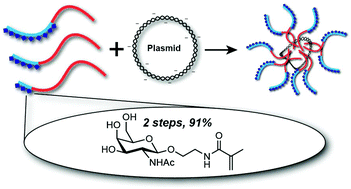
The ability to design liver-targeted polymers for nucleic acid delivery vehicles is plagued with difficulties ranging from polymer-mediated cellular toxicity to challenges in synthesizing monomers that enable facile cell-specific polymeric gene delivery vehicles. Herein is presented an improved synthetic route to a N-acetyl-D-galactosamine (GalNAc)-derived monomer (two steps, 91% overall yield) and its incorporation into a library of nine diblock co-polymers with 2-aminoethylmethacrylamide (AEMA) and two end-group functionalized AEMA homopolymers. These polymers were complexed with plasmid DNA (pDNA) into polyplexes and evaluated for the toxicity, uptake and transfection efficiency against cultured hepatocytes (HepG2) at N/P ratios of 2.5, 5, and 10. All polyplexes showed a range of cell survivability between 60–90%, an improvement over JetPEI, a commercial transfection reagent, when dosed at standard concentrations. Although GalNAc block length does not play a significant role in cellular uptake of Cy-5 labeled pDNA, it has a heavy influence on the transfection efficiency of luciferase-encoded pDNA where longer GalNAc block lengths give rise to higher transfection efficiencies. Overall, this work demonstrates a greatly improved route to GalNAc monomer synthesis, which that can be incorporated into polymers that target hepatocytes.
Recommended Literature
- [1] Evolution in surface coverage of CH3NH3PbI3?XClXvia heat assisted solvent vapour treatment and their effects on photovoltaic performance of devices Dhirendra K. Chaudhary,Pramendra Kumar,Lokendra KumarRSC Adv., 2016,6, 94731-94738 10.1039/C6RA18729C
- [2] Fate of single walled carbon nanotubes in wetland ecosystems? Joseph H. Bisesi,Tara Sabo-AttwoodEnviron. Sci.: Nano, 2014,1, 574-583 10.1039/C4EN00063C
- [3] Elusive 2-aminofuran Diels–Alder substrates for a straightforward synthesis of polysubstituted anilines? Ana G. Neo,Ana Bornadiego,Jesús Díaz,Stefano Marcaccini,Carlos F. MarcosOrg. Biomol. Chem., 2013,11, 6546-6555 10.1039/C3OB41411F
- [4] Enabling high-throughput single-animal gene-expression studies with molecular and micro-scale technologies Jason WanLab Chip, 2020,20, 4528-4538 10.1039/D0LC00881H
- [5] Fast-Track to Research Data Management in Experimental Material Science-Setting the Ground for Research Group Level Materials Digitalization. LarsBanko,AlfredLudwig 10.1021/acscombsci.0c00057
- [6] Exchangeability of amino acid residues with similar physicochemical properties in coiled-coil interactions? Guiying Zhang,Maosheng Cheng,Yanni Li,Keliang Liu,Lifeng CaiChem. Commun., 2013,49, 11086-11088 10.1039/C3CC46560H
- [7] Evolution of cellulose into flexible conductive green electronics: a smart strategy to fabricate sustainable electrodes for supercapacitors Tengfei Yu,Yuehan Wu,Wei Li,Bin LiRSC Adv., 2014,4, 34134-34143 10.1039/C4RA07017H
- [8] Exciplex emission from the mixed dimer of naphthalene and 2-cyanonaphthalene in a supersonic jet Aloke Das,K. K. Mahato,Chayan K. Nandi,Tapas Chakraborty,Shridhar R. Gadre,Nikhil A. GokhalePhys. Chem. Chem. Phys., 2002,4, 2162-2168 10.1039/B200124C
- [9] Evolutionary de novo design of phenothiazine derivatives for dye-sensitized solar cells? Vishwesh Venkatraman,Marco Foscato,Vidar R. Jensen,Bj?rn K?re AlsbergJ. Mater. Chem. A, 2015,3, 9851-9860 10.1039/C5TA00625B
- [10] Excitation energies from ground-state density-functionals by means of generator coordinates A. B. F. da Silva,K. CapellePhys. Chem. Chem. Phys., 2009,11, 4564-4569 10.1039/B902529D

Journal Name:Polymer Chemistry
research_products
-

CAS no.: 89640-58-4

![1,2,3,4,5,6-Hexahydro-[2,3]bipyridinyl-6-ol](https://ossimg.kuujia.com/scimg/1271000/1270529-38-8x500.png)


![N-(3-cyanothiolan-3-yl)-2-[(2,2,2-trifluoroethyl)sulfanyl]pyridine-4-carboxamide](https://ossimg.kuujia.com/scimg/1444500/1444113-98-7x500.png)

![2,2-Difluoro-3-[methyl(2-methylbutyl)amino]propanoic acid](https://ossimg.kuujia.com/scimg/2138500/2138166-62-6x500.png)

![2-(1H-indol-3-yl)-N-{[6-(thiophen-2-yl)-[1,2,4]triazolo[4,3-b]pyridazin-3-yl]methyl}acetamide](https://ossimg.kuujia.com/scimg/2034500/2034271-14-0x500.png)