Facile construction of reduced graphene oxide–carbon dot complex embedded molecularly imprinted polymers for dual-amplification and selective electrochemical sensing of rutoside?
New Journal of Chemistry Pub Date: 2017-08-07 DOI: 10.1039/C7NJ02103H
Abstract
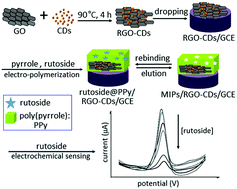
In this article, reduced graphene oxide–carbon dots (RGO–CDs) were deposited on the surface of a glassy carbon electrode (GCE). RGO–CDs and rutoside were facilely embedded into poly(pyrrole) through electrochemical polymerization. After elution of rutoside, a novel sensing system of molecularly imprinted polymers (MIPs) was developed and used for rutoside detection. The use of RGO–CDs markedly improved the electrochemical signal responses to electroactive rutoside, which thus facilitated the sensitive electrochemical sensing of rutoside. The as-synthesized MIPs/RGO–CDs/GCE sensing system was characterized by scanning electron microscopy (SEM), cyclic voltammetry (CV) and differential pulse voltammetry (DPV). The electrochemical responses of the sensing system were studied and optimized. Under optimal conditions, MIPs/RGO–CDs/GCE showed a nearly linear relationship between the change in peak current intensities and the rutoside concentration in the 0.01–6.5 μM range (R2 = 0.9932), with a low limit of detection of 3 nM. Moreover, the sensing system exhibited a highly selective and sensitive electrochemical response to rutoside, over potential interferents. In real human serum samples, the sensing system exhibited superior performance for rutoside detection, accompanied by high detection stability and recovery. These results proved the significant potential of MIPs/RGO–CDs/GCE for efficient determination of rutoside in real samples.
Recommended Literature
- [1] Acetyl protected thiol methacrylic polymers as effective ligands to keep quantum dots in luminescent standby mode? Marta Liras,Isabel Quijada-Garrido,Marta Palacios-Cuesta,Sonia Mu?oz-Durieux,Olga GarcíaPolym. Chem., 2014,5, 433-442 10.1039/C3PY00987D
- [2] An autonomous self-optimizing flow machine for the synthesis of pyridine–oxazoline (PyOX) ligands? Eric Wimmer,Daniel Cortés-Borda,Solène Brochard,Elvina Barré,Charlotte Truchet,Fran?ois-Xavier FelpinReact. Chem. Eng., 2019,4, 1608-1615 10.1039/C9RE00096H
- [3] An insight into the role of side chains in the microstructure and carrier mobility of high-performance conjugated polymers? Jianyao Huang,Dong Gao,Zhihui Chen,Weifeng ZhangPolym. Chem., 2021,12, 2471-2480 10.1039/D1PY00105A
- [4] An anti-leakage liquid metal thermal interface material Kaiyuan Huang,Wangkang Qiu,Meilian Ou,Xiaorui Liu,Zenan Liao,Sheng ChuRSC Adv., 2020,10, 18824-18829 10.1039/D0RA02351E
- [5] An artificial photosynthetic system for photoaccumulation of two electrons on a fused dipyridophenazine (dppz)–pyridoquinolinone ligand? Philipp Traber,Stephan Kupfer,Stefanie Gr?fe,Isabelle Baussanne,Martine Demeunynck,Jean-Marie Mouesca,Serge Gambarelli,Vincent Artero,Murielle Chavarot-KerlidouChem. Sci., 2018,9, 4152-4159 10.1039/C7SC04348A
- [6] An atmosphere and light tuned highly diastereoselective synthesis of cyclobuta/penta[b]indoles from aniline-tethered alkylidenecyclopropanes with alkynes? Bo Cao,Yin WeiChem. Commun., 2018,54, 2870-2873 10.1039/C8CC00180D
- [7] An aptasensor for the detection of ampicillin in milk using a personal glucose meter Xixi Li,Nanwei Zhu,Ruohan Li,Qinpu ZhangAnal. Methods, 2020,12, 3376-3381 10.1039/D0AY00256A
- [8] An Assessment of the Laminar Hypersonic Double-Cone Experiments in the LENS-XX Tunnel JaideepRay,PatrickBlonigan,EricT.Phipps,KathrynMaupin 10.2514/1.j062802
- [9] Aggregation dynamics, structure, and mechanical properties of bigels L. Di Michele,D. Fiocco,F. Varrato,E. Eiser,G. FoffiSoft Matter, 2014,10, 3633-3648 10.1039/C3SM52558A
- [10] An analysis of the WTC fires using CIB correlations and simple modeling JGQuintiere 10.1177/0734904121989670

Journal Name:New Journal of Chemistry
research_products
-

CAS no.: 89640-58-4

![1,2,3,4,5,6-Hexahydro-[2,3]bipyridinyl-6-ol](https://ossimg.kuujia.com/scimg/1271000/1270529-38-8x500.png)


![N-(3-cyanothiolan-3-yl)-2-[(2,2,2-trifluoroethyl)sulfanyl]pyridine-4-carboxamide](https://ossimg.kuujia.com/scimg/1444500/1444113-98-7x500.png)

![2,2-Difluoro-3-[methyl(2-methylbutyl)amino]propanoic acid](https://ossimg.kuujia.com/scimg/2138500/2138166-62-6x500.png)

![2-(1H-indol-3-yl)-N-{[6-(thiophen-2-yl)-[1,2,4]triazolo[4,3-b]pyridazin-3-yl]methyl}acetamide](https://ossimg.kuujia.com/scimg/2034500/2034271-14-0x500.png)