Unveiling the active isomer of cycloalanopine, a cyclic opine from Lactobacillus rhamnosus LS8, through synthesis and analog production?
RSC Medicinal Chemistry Pub Date: 2020-04-06 DOI: 10.1039/D0MD00033G
Abstract
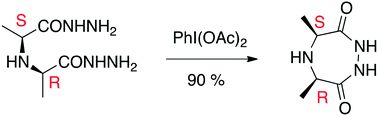
Opines are widely distributed natural products formed by the reductive condensation of amino acids with α-keto acids or carbonyls of carbohydrates. They have important biological roles in bacteria, higher plants, fungi, invertebrates and mammals, including humans. An unusual cyclic opine of undefined stereochemistry, cycloalanopine, was previously isolated from Lactobacillus rhamnosus LS8 and reported to have antimicrobial activity against both Gram-negative and Gram-positive bacteria. In this work, we report a three-step strategy to synthetically access pure isomers of this cyclic compound and analogs thereof. In the key step, acyclic bis-hydrazides can be oxidized with (diacetoxyiodo) benzene to corresponding cyclic N,N′-diacylhydrazides. The three cycloalanopine isomers, along with several analogs, were synthesized and tested against a panel of Gram-positive and Gram-negative bacteria. We identified the active isomer as the meso compound: (4R,6S)-4,6-dimethyl-1,2,5-triazepan-3,7-dione. Additionally, a glycine derivative, (R)-4-methyl-1,2,5-triazepan-3,7-dione, was ascertained to be more potent. This compound was active against both Gram-positive and Gram-negative organisms with the strongest potency against Escherichia coli and Acinetobacter baumannii, an opportunistic pathogen found in hospital-derived infections.
Recommended Literature
- [1] An atomistic mechanism for the degradation of perovskite solar cells by trapped charge? Eunhak Lim,Jiyoung Heo,Seong Keun KimNanoscale, 2019,11, 11369-11378 10.1039/C9NR02193K
- [2] An Aptamer Bio-barCode (ABC) assay using SPR, RNase H, and probes with RNA and gold-nanorods for anti-cancer drug screening Chengbin Yang,Hing Lun Tsang,Pui Man Lau,Ken-Tye Yong,Ho Pui Ho,Siu Kai KongAnalyst, 2017,142, 3579-3587 10.1039/C7AN01026E
- [3] Achieving crystal-induced room temperature phosphorescence and reversible photochromic properties by strong intermolecular interactions? Fuming Xiao,Mengzhu Wang,Yunxiang Lei,Wenbo Dai,Yunbing Zhou,Miaochang Liu,Wenxia Gao,Xiaobo Huang,Huayue WuJ. Mater. Chem. C, 2020,8, 17410-17416 10.1039/D0TC03980B
- [4] Achieving excellent anti-corrosion and tribological performance by tailoring the surface morphology and chemical composition of aluminum alloys Wenjie Zhao,Hua Hou,Yuchun Jin,Zhixiang Zeng,Xuedong Wu,Qunji XueRSC Adv., 2014,4, 60307-60315 10.1039/C4RA10112J
- [5] An ionic liquid-based synergistic extraction strategy for rare earths? Yingbo Li,Nada Mehio,Huizhou Liu,Sheng DaiGreen Chem., 2015,17, 2981-2993 10.1039/C5GC00360A
- [6] An atmosphere and light tuned highly diastereoselective synthesis of cyclobuta/penta[b]indoles from aniline-tethered alkylidenecyclopropanes with alkynes? Bo Cao,Yin WeiChem. Commun., 2018,54, 2870-2873 10.1039/C8CC00180D
- [7] An insight into the role of side chains in the microstructure and carrier mobility of high-performance conjugated polymers? Jianyao Huang,Dong Gao,Zhihui Chen,Weifeng ZhangPolym. Chem., 2021,12, 2471-2480 10.1039/D1PY00105A
- [8] An AuNPs-functionalized AlGaN/GaN high electron mobility transistor sensor for ultrasensitive detection of TNT? Ying Li,Weirong Yao,Yunfei Xie,Renjun PeiRSC Adv., 2015,5, 98724-98729 10.1039/C5RA16704C
- [9] An aquatic host–guest complex between a supramolecular G-quadruplex and the anticancer drug doxorubicin? José M. Rivera,Mariana Martín-Hidalgo,Jean C. Rivera-RíosOrg. Biomol. Chem., 2012,10, 7562-7565 10.1039/C2OB25913C
- [10] An interplay between electronic and structural effects on the photoluminescence decay mechanisms in LaPO4·nH2O:Tb3+ and LaPO4:Tb3+ single-crystal nanorods? M. T. Colomer,S. Díaz-Moreno,A. Tamayo,A. L. OrtizJ. Mater. Chem. C, 2018,6, 12643-12651 10.1039/C8TC03187H

Journal Name:RSC Medicinal Chemistry
research_products
-

CAS no.: 89640-58-4


![N-(3-cyanothiolan-3-yl)-2-[(2,2,2-trifluoroethyl)sulfanyl]pyridine-4-carboxamide](https://ossimg.kuujia.com/scimg/1444500/1444113-98-7x500.png)

![1,2,3,4,5,6-Hexahydro-[2,3]bipyridinyl-6-ol](https://ossimg.kuujia.com/scimg/1271000/1270529-38-8x500.png)

![2,2-Difluoro-3-[methyl(2-methylbutyl)amino]propanoic acid](https://ossimg.kuujia.com/scimg/2138500/2138166-62-6x500.png)

![2-(1H-indol-3-yl)-N-{[6-(thiophen-2-yl)-[1,2,4]triazolo[4,3-b]pyridazin-3-yl]methyl}acetamide](https://ossimg.kuujia.com/scimg/2034500/2034271-14-0x500.png)