Semi-synthesis as a tool for broadening the health applications of bioactive olive secoiridoids: a critical review
Natural Product Reports Pub Date: 2020-12-10 DOI: 10.1039/D0NP00084A
Abstract
Covering: 2005 up to 2020
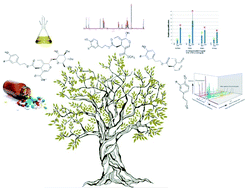
Olive bioactive secoiridoids are recognized as natural antioxidants with multiple beneficial effects on human health. Nevertheless, the study of their biological activity has also disclosed some critical aspects associated with their application. Firstly, only a few of them can be extracted in large amounts from their natural matrix, namely olive leaves, drupes, oil and olive mill wastewater. Secondly, their application as preventive agents and drugs is limited by their low membrane permeability. Thirdly, the study of their biological fate after administration is complicated by the absence of pure analytical standards. Accordingly, efficient synthetic methods to obtain natural and non-natural bioactive phenol derivatives have been developed. Among them, semi-synthetic protocols represent efficient and economical alternatives to total synthesis, combining efficient extraction protocols with efficient catalytic conversions to achieve reasonable amounts of active molecules. The aim of this review is to summarize the semi-synthetic protocols published in the last fifteen years, covering 2005 up to 2020, which can produce natural olive bioactive phenols scarcely available by extractive procedures, and new biophenol derivatives with enhanced biological activity. Moreover, the semi-synthetic protocols to produce olive bioactive phenol derivatives as analytical standards are also discussed. A critical analysis of the advantages offered by semi-synthesis compared to classical extraction methods or total synthesis protocols is also performed.
Recommended Literature
- [1] An asymmetric supercapacitor based on controllable WO3 nanorod bundle and alfalfa-derived porous carbon? Kanjun Sun,Fengting Hua,Shuzhen Cui,Yanrong Zhu,Hui Peng,Guofu MaRSC Adv., 2021,11, 37631-37642 10.1039/D1RA04788D
- [2] Aggregated-fluorescent detection of PFAS with a simple chip Cheng Fang,Jinjian Wu,Zahra Sobhani,Md. Al Amin,Youhong TangAnal. Methods, 2019,11, 163-170 10.1039/C8AY02382D
- [3] An approach for correlating the structural and electrical properties of Zr4+-modified SrBi4Ti4O15/SBT ceramic Priyambada Nayak,Tanmaya Badapanda,Anil Kumar Singh,Simanchalo PanigrahiRSC Adv., 2017,7, 16319-16331 10.1039/C7RA00366H
- [4] An integrated system for field analysis of Cd(ii) and Pb(ii) via preconcentration using nano-TiO2/cellulose paper composite and subsequent detection with a portable X-ray fluorescence spectrometer? Xiaofeng LinRSC Adv., 2016,6, 9002-9006 10.1039/C5RA25693C
- [5] An approach to biodegradable star polymeric architectures using disulfide coupling? Jingquan Liu,Huiyun Liu,Zhongfan Jia,Volga Bulmus,Thomas P. DavisChem. Commun., 2008, 6582-6584 10.1039/B817037A
- [6] Alternative donor substrates for inverting and retaining glycosyltransferases? Luke L. Lairson,Warren W. WakarchukChem. Commun., 2007, 365-367 10.1039/B614636H
- [7] An apparatus for testing water by measurement of its electrical conductivity Analyst, 1912,37, 538-543 10.1039/AN9123700538
- [8] An artificial CO-releasing metalloprotein built by histidine-selective metallation? Inês S. Albuquerque,Hélia F. Jeremias,Miguel Chaves-Ferreira,Dijana Matak-Vinkovic,Omar Boutureira,Carlos C. Rom?oChem. Commun., 2015,51, 3993-3996 10.1039/C4CC10204E
- [9] An aptasensor for detection of potassium ions based on RecJf exonuclease mediated signal amplification Bidou Wang,Xifeng ChenAnalyst, 2014,139, 5695-5699 10.1039/C4AN01350F
- [10] An artificial blood vessel implanted three-dimensional microsystem for modeling transvascular migration of tumor cells? Xue-Ying Wang,Ying Pei,Min Xie,Zi-He Jin,Ya-Shi Xiao,Yang Wang,Li-Na Zhang,Yan Li,Wei-Hua HuangLab Chip, 2015,15, 1178-1187 10.1039/C4LC00973H
Journal Name:Natural Product Reports
research_products
-

CAS no.: 89640-58-4

![1,2,3,4,5,6-Hexahydro-[2,3]bipyridinyl-6-ol](https://ossimg.kuujia.com/scimg/1271000/1270529-38-8x500.png)


![N-(3-cyanothiolan-3-yl)-2-[(2,2,2-trifluoroethyl)sulfanyl]pyridine-4-carboxamide](https://ossimg.kuujia.com/scimg/1444500/1444113-98-7x500.png)

![2,2-Difluoro-3-[methyl(2-methylbutyl)amino]propanoic acid](https://ossimg.kuujia.com/scimg/2138500/2138166-62-6x500.png)

![2-(1H-indol-3-yl)-N-{[6-(thiophen-2-yl)-[1,2,4]triazolo[4,3-b]pyridazin-3-yl]methyl}acetamide](https://ossimg.kuujia.com/scimg/2034500/2034271-14-0x500.png)