Adsorption of short-chain perfluoroalkyl acids (PFAAs) from water/wastewater
Environmental Science: Water Research & Technology Pub Date: 2020-09-29 DOI: 10.1039/D0EW00468E
Abstract
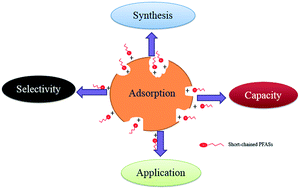
Since the regulations for the manufacture and use of long-chain PFAAs have become increasingly stringent, there is a tendency to replace them with short-chain homologs. Adsorption is considered the most cost-effective treatment for thermally, chemically, and biologically stable PFAAs. Many types of adsorbents have been synthesized for the removal of short-chain PFAAs. This review therefore provides a summary of adsorbents (synthesis, capacity, and kinetics), mechanisms (uptake mechanisms and influencing factors), and applications, including large-scale setups and point-of-use/point-of-entry (POU/POE) units, for the removal of short-chain PFAAs. Although short-chain PFAAs with their relatively high intraparticle diffusion rates can be more easily removed at the initial stage than the long-chain ones, their low hydrophobicity makes it difficult for them to compete in the long-term with the more hydrophobic organics in the solution (including the long-chain compounds) for binding sites, not to mention the fact that the already adsorbed short-chain PFAAs can be replaced by the long-chain ones. The most commonly applied adsorbents for PFAA removal have been carbonaceous adsorbents. Yet, significant changes are required to alter or modify the main adsorptive mechanism of hydrophobic interaction of carbonaceous adsorbents in order to improve their low removal capacity for short-chain PFAAs in the presence of long-chain compounds. Also, polymeric adsorbents, particularly amine-functionalized ones, are of limitless tunability for selective PFAA removal, which makes them promising for future applications. Future research should also focus on innovative treatment strategies for simultaneous long-chain and short-chain PFAA removal, development of novel adsorbents with better selectivity for short-chain PFAAs, and evaluation under environmentally-relevant conditions.
Recommended Literature
- [1] An algal process treatment combined with the Fenton reaction for high concentrations of amoxicillin and cefradine Haitao Li,Yu Pan,Zhizhi Wang,Shan Chen,Ruixin Guo,Jianqiu ChenRSC Adv., 2015,5, 100775-100782 10.1039/C5RA21508K
- [2] An intramolecular tryptophan-condensation approach for peptide stapling? Eunice Y.-L. Hui,Bhimsen Rout,Yaw Sing Tan,Kok-Ping Chan,Charles W. JohannesOrg. Biomol. Chem., 2018,16, 389-392 10.1039/C7OB02667F
- [3] An artificial blood vessel implanted three-dimensional microsystem for modeling transvascular migration of tumor cells? Xue-Ying Wang,Ying Pei,Min Xie,Zi-He Jin,Ya-Shi Xiao,Yang Wang,Li-Na Zhang,Yan Li,Wei-Hua HuangLab Chip, 2015,15, 1178-1187 10.1039/C4LC00973H
- [4] An antioxidative galactomannan extracted from Chinese Sesbania cannabina enhances immune activation of macrophage cells? Chongyang Zhu,Xiaojia Bian,Xin Jia,Ning Tang,Yongqiang ChengFood Funct., 2020,11, 10635-10644 10.1039/D0FO02131H
- [5] Acetylcholinesterase amperometric detection system based on a cobalt(II) tetraphenylporphyrin-modified electrode Analyst, 1996,121, 1123-1126 10.1039/AN9962101123
- [6] Alternative mixtures to R-600a. Theoretical assessment and experimental energy evaluation of binary mixtures in a commercial cooler: Mélanges alternatifs au R-600a. évaluation théorique et évaluation énergétique expérimentale de mélanges binaires dans un refroidisseur commercial. DanielCalleja-Anta,DanielSánchez,LauraNebot-Andres,RamónCabello,RodrigoLlopis 10.1016/j.ijrefrig.2023.05.009
- [7] An alternative biorefinery approach to address microalgal seasonality: blending with spent coffee grounds Andre Prates Pereira,Tao Dong,Eric P. Knoshaug,Nick Nagle,Ryan Spiller,Bonnie Panczak,Christopher J. Chuck,Philip T. PienkosSustainable Energy Fuels, 2020,4, 3400-3408 10.1039/D0SE00164C
- [8] An anti-ultrasonic-stripping effect in confined micro/nanoscale cavities and its applications for efficient multiscale metallic patterning? Quan Xiang,Yiqin Chen,Zhiqin Li,Kaixi Bi,Guanhua Zhang,Huigao DuanNanoscale, 2016,8, 19541-19550 10.1039/C6NR07585A
- [9] An investigation into the origin of variations in photovoltaic performance using D–D–π–A and D–A–π–A triphenylimidazole dyes with a copper electrolyte? Govind ReddyMol. Syst. Des. Eng., 2021,6, 779-789 10.1039/D1ME00073J
- [10] An atom efficient route to N-aryl and N-alkyl pyrrolines by transition metal catalysis? Supaporn Sawadjoon,Joseph S. M. SamecOrg. Biomol. Chem., 2011,9, 2548-2554 10.1039/C0OB00383B
Journal Name:Environmental Science: Water Research & Technology
research_products
-

CAS no.: 89640-58-4


![N-(3-cyanothiolan-3-yl)-2-[(2,2,2-trifluoroethyl)sulfanyl]pyridine-4-carboxamide](https://ossimg.kuujia.com/scimg/1444500/1444113-98-7x500.png)

![1,2,3,4,5,6-Hexahydro-[2,3]bipyridinyl-6-ol](https://ossimg.kuujia.com/scimg/1271000/1270529-38-8x500.png)

![2,2-Difluoro-3-[methyl(2-methylbutyl)amino]propanoic acid](https://ossimg.kuujia.com/scimg/2138500/2138166-62-6x500.png)

![2-(1H-indol-3-yl)-N-{[6-(thiophen-2-yl)-[1,2,4]triazolo[4,3-b]pyridazin-3-yl]methyl}acetamide](https://ossimg.kuujia.com/scimg/2034500/2034271-14-0x500.png)