Quantum spin liquid: design of a quantum spin liquid next to a superconducting state based on a dimer-type ET Mott insulator?
Journal of Materials Chemistry C Pub Date: 2014-12-08 DOI: 10.1039/C4TC01701C
Abstract
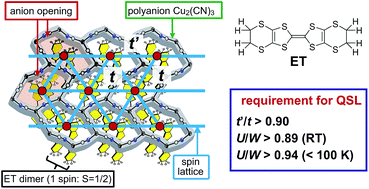
The existence of a spin-disordered quantum state was predicted theoretically by Wannier in 1950 and Anderson in 1973. Various target materials had been considered before the discovery of the first quantum spin liquid (QSL) system in 2003: a Mott insulator κ-(ET)2Cu2(CN)3, where ET is bis(ethylenedithio)tetrathiafulvalene. The family of dimer-type ET conductors κ-(ET)2X (where X = an anion) exhibits various conduction profiles ranging from insulators to metals to superconductors depending on the counter anion. In κ-(ET)2X, the anion molecules form characteristic patterns of anion openings, on each of which an ET dimer corresponding to a single spin site is positioned, namely a key–keyhole relation. The topological consideration of the crystal structure affords the information on both a spin geometry (t′/t) and electron correlation (U/W), where t and t′ are interdimer transfer interactions with an isosceles triangular geometry, and U and W are the on-site Coulomb repulsion energy and bandwidth, respectively. The QSL system κ-(ET)2Cu2(CN)3 is characterized by a spin lattice containing nearly equilateral triangles (t′/t = 1.09) with strong electron correlations (U/W = 0.93) at room temperature. The temperature dependences of t′/t and U/W are bases to understand the transport and magnetic behaviors of κ-(ET)2X. κ-(ET)2Cu2(CN)3 has a superconducting state next to the QSL state under pressure without passing through an antiferromagnetic state. Here, the design of QSL systems next to a superconducting state is discussed based on the crystal and the electronic structures and physical properties of κ-(ET)2X using the key–keyhole relation and temperature variant band parameters t, t′, U, and W.
Recommended Literature
- [1] Distribution pattern and allocation of defects in hydrogenated ZnO thin films? Vitaly Gurylev,Chung-Yi Su,Tsong-Pyng PerngPhys. Chem. Chem. Phys., 2016,18, 16033-16038 10.1039/C6CP01768A
- [2] Enantiomorphic symmetry breaking in crystallization of molten sodium chlorate? Martin R. Ward,Gary W. Copeland,Andrew J. AlexanderChem. Commun., 2010,46, 7634-7636 10.1039/C0CC02563A
- [3] Excited state dynamics of symmetric and asymmetric Cr3(dpa)4Cl2 measured using femtosecond transient absorption spectroscopy? Chao-Han Cheng,Wen-Zhen Wang,Shie-Ming Peng,I-Chia ChenPhys. Chem. Chem. Phys., 2017,19, 25471-25477 10.1039/C7CP03968A
- [4] Evolution of calcium phosphate precipitation in hanging drop vapor diffusion by in situRaman microspectroscopy Gloria Belén Ramírez-Rodríguez,José Manuel Delgado-López,Jaime Gómez-MoralesCrystEngComm, 2013,15, 2206-2212 10.1039/C2CE26556G
- [5] Enantiomeric helical TiO2 nanofibers modulate different peptide assemblies and subsequent cellular behaviors? Xu Jie,Deng Xu,Weili WeiRSC Adv., 2019,9, 29149-29153 10.1039/C9RA04660G
- [6] Estimation of hydrogen sulfide from crude petroleum: a unique invention using a simple chemosensor? Shampa Kundu,Prithidipa SahooNew J. Chem., 2019,43, 12369-12374 10.1039/C9NJ02628B
- [7] Excellent electrochemical performance of LiFe0.4Mn0.6PO4 microspheres produced using a double carbon coating process? Yong Ping Huang,Tao Tao,Zheng Chen,Wei Han,Ying Wu,Chunjiang Kuang,Shaoxiong Zhou,Ying ChenJ. Mater. Chem. A, 2014,2, 18831-18837 10.1039/C4TA03994G
- [8] Examination of the hydrogen-bonding networks in small water clusters (n = 2–5, 13, 17) using absolutely localized molecular orbital energy decomposition analysis? Erika A. Cobar,Paul R. Horn,Robert G. Bergman,Martin Head-GordonPhys. Chem. Chem. Phys., 2012,14, 15328-15339 10.1039/C2CP42522J
- [9] Fe3O4/FeS2 heterostructures enable efficient oxygen evolution reaction? Xingqun Zheng,Lele Song,Xin Feng,Li Li,Zidong WeiJ. Mater. Chem. A, 2020,8, 14145-14151 10.1039/C9TA13775K
- [10] Emerging investigator series: kinetics of diopside reactivity for carbon mineralization in mafic–ultramafic rocks BrianaAguila,LandonHardee,H.ToddSchaef,SiavashZare,MohammadJavadAbdolhosseiniQomi,JarrodV.Crum,JadeE.HollimanJr.,ElenaTajueloRodriguez,LawrenceM.Anovitz,KevinM.Rosso,QuinR.S.Miller 10.1039/d3en00087g

Journal Name:Journal of Materials Chemistry C
research_products
-

CAS no.: 89640-58-4

![1,2,3,4,5,6-Hexahydro-[2,3]bipyridinyl-6-ol](https://ossimg.kuujia.com/scimg/1271000/1270529-38-8x500.png)


![N-(3-cyanothiolan-3-yl)-2-[(2,2,2-trifluoroethyl)sulfanyl]pyridine-4-carboxamide](https://ossimg.kuujia.com/scimg/1444500/1444113-98-7x500.png)

![2,2-Difluoro-3-[methyl(2-methylbutyl)amino]propanoic acid](https://ossimg.kuujia.com/scimg/2138500/2138166-62-6x500.png)

![2-(1H-indol-3-yl)-N-{[6-(thiophen-2-yl)-[1,2,4]triazolo[4,3-b]pyridazin-3-yl]methyl}acetamide](https://ossimg.kuujia.com/scimg/2034500/2034271-14-0x500.png)