Systematic, computer-assisted development of high performance liquid chromatography for multi-component analysis
Analytical Methods Pub Date: 2015-05-06 DOI: 10.1039/C5AY01000D
Abstract
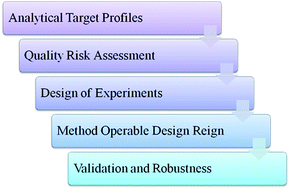
The aim of this study was to develop a multi-component determination analytical method. The analytical Quality by Design (QbD) concept was used in the beginning of the establishment of a high performance liquid chromatography (HPLC) method for compound traditional Chinese medicine (TCM) preparations using a diode-array detector (DAD) and an evaporative light scattering detector (ELSD) in series. Herein, the QbD workflow is discussed and demonstrated with a systematic HPLC method development, including risk assessment, the design of experiments (DOEs), and assessment of the data to provide a method operable design space (DS). Modeling software Drylab was employed to set up experiments for the development of a simple and robust separation method and to visually achieve the required criteria as an initial DS of the analytical method based on simulation. To improve the method development and optimization step, the statistical software JMP@(SAS Institute) was applied to simultaneously optimize the chromatographic conditions such as the gradient time, the concentration of the aqueous phase, the column temperature, the flow rate and the ELSD parameters. Finally, a successful HPLC method was developed and validated to verify the robustness of the QbD system. The use of QbD workflows streamlines the development of methods as compared to traditional approaches. With the addition of systematic DOEs, the optimization resulted in critical resolution Rs, crit ≧ 1.5 for all the six compounds researched. As a result, a robust and reliable method operable design region was established. This method had fewer issues and failures throughout the lifecycle due to the knowledge gained via the QbD process.
Recommended Literature
- [1] An artificial photosynthesis system comprising a covalent triazine framework as an electron relay facilitator for photochemical carbon dioxide reduction? Siquan Zhang,Shengyao Wang,Liping Guo,Hao Chen,Bien Tan,Shangbin JinJ. Mater. Chem. C, 2020,8, 192-200 10.1039/C9TC05297F
- [2] Acenaphthenic hopanoids, a novel series of aromatised Teresita Carrillo-Hernández,Philippe Schaeffer,Pierre AlbrechtChem. Commun., 2001, 1976-1977 10.1039/B105198A
- [3] An apparatus for testing water by measurement of its electrical conductivity Analyst, 1912,37, 538-543 10.1039/AN9123700538
- [4] An aptamer-based keypad lock system? Yaqing Liu,Jiangtao Ren,Jing Li,Jiyang Liu,Erkang WangChem. Commun., 2012,48, 802-804 10.1039/C1CC15979H
- [5] An amphoteric reactivity of a mixed-valent bis(μ-oxo)dimanganese(iii,iv) complex acting as an electrophile and a nucleophile? Muniyandi Sankaralingam,So Hyun Jeon,Yong-Min Lee,Mi Sook Seo,Wonwoo NamDalton Trans., 2016,45, 376-383 10.1039/C5DT04292E
- [6] Alternative synthesis of the anti-baldness compound RU58841? RSC Adv., 2014,4, 14143-14148 10.1039/C4RA00332B
- [7] An ion-gating multinanochannel system based on a copper-responsive self-cleaving DNAzyme? Yang Chen,Di Zhou,Zheyi Meng,Jin ZhaiChem. Commun., 2016,52, 10020-10023 10.1039/C6CC03943J
- [8] An atomically efficient, highly stable and redox active Ce0.5Tb0.5Ox (3% mol.)/MgO catalyst for total oxidation of methane? Juan J. Sánchez,Miguel López-Haro,Juan C. Hernández-Garrido,Ginesa Blanco,Miguel A. Cauqui,José M. Rodríguez-Izquierdo,José A. Pérez-Omil,José J. Calvino,María P. YesteJ. Mater. Chem. A, 2019,7, 8993-9003 10.1039/C8TA11672E
- [9] Alternative donor substrates for inverting and retaining glycosyltransferases? Luke L. Lairson,Warren W. WakarchukChem. Commun., 2007, 365-367 10.1039/B614636H
- [10] An anti-leakage liquid metal thermal interface material Kaiyuan Huang,Wangkang Qiu,Meilian Ou,Xiaorui Liu,Zenan Liao,Sheng ChuRSC Adv., 2020,10, 18824-18829 10.1039/D0RA02351E

Journal Name:Analytical Methods
research_products
-

CAS no.: 89640-58-4


![N-(3-cyanothiolan-3-yl)-2-[(2,2,2-trifluoroethyl)sulfanyl]pyridine-4-carboxamide](https://ossimg.kuujia.com/scimg/1444500/1444113-98-7x500.png)

![1,2,3,4,5,6-Hexahydro-[2,3]bipyridinyl-6-ol](https://ossimg.kuujia.com/scimg/1271000/1270529-38-8x500.png)

![2,2-Difluoro-3-[methyl(2-methylbutyl)amino]propanoic acid](https://ossimg.kuujia.com/scimg/2138500/2138166-62-6x500.png)

![2-(1H-indol-3-yl)-N-{[6-(thiophen-2-yl)-[1,2,4]triazolo[4,3-b]pyridazin-3-yl]methyl}acetamide](https://ossimg.kuujia.com/scimg/2034500/2034271-14-0x500.png)