Poly(ε-caprolactone) with pendant natural peptides: an old polymeric biomaterial with new properties?
Polymer Chemistry Pub Date: 2017-08-01 DOI: 10.1039/C7PY01012E
Abstract
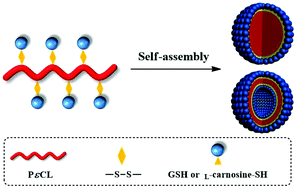
The bio-functionalization of poly(ε-caprolactone) (PεCL) provides an approach to broaden the applications of the polymer in medical and biological engineering fields. In this research, PεCL with pendant glutathione (GSH) or L-carnosine was synthesized by a combination of ring-opening copolymerization, Cu(I)-catalyzed Huisgen 1,3-dipolar cycloaddition reaction (click reaction) and thiol-disulfide exchange reaction. The ring-opening copolymerization of εCL and α-chloro-ε-caprolactone (αCl-εCL) was employed in the synthesis of the PεCL-co-P(αCl-εCL) copolymer. The pendent chlorides were converted into azides by a reaction with sodium azide. N-Hydroxysuccinimide (NHS) groups were introduced into the polymer backbones by the click reaction. PεCL with pendant pyridyl disulfide groups was prepared by a reaction of N-hydroxysuccinimide (NHS) activated ester and pyridine dithioethylamine. Peptide modified PεCL were synthesized by thiol-disulfide exchange reactions between thiol groups on GSH (or thiol-modified L-carnosine) and the pendant pyridyl disulfide groups on the polymer chains. The synthesized copolymers were analyzed by size exclusion chromatography, FTIR, 1H NMR and differential scanning calorimetry. The bio-graft copolymers are able to self-assemble into micelles or vesicles in aqueous solutions, depending on the pH values of the solutions. The assembled structures formed by the bio-graft copolymers in aqueous solutions are essentially nontoxic toward MCF-7 and COS-7 cells. The functionalization of the peptide-stabilized assembled structures with lysozyme was also investigated in this research.
Recommended Literature
- [1] Evidence of field induced slow magnetic relaxation in cis-[Co(hfac)2(H2O)2] exhibiting tri-axial anisotropy with a negative axial component? Denis V. Korchagin,Elena A. Yureva,Alexander V. Akimov,Eugenii Ya. Misochko,Gennady V. Shilov,Artem D. Talantsev,Roman B. Morgunov,Alexander A. Shakin,Sergey M. Aldoshin,Boris S. TsukerblatDalton Trans., 2017,46, 7540-7548 10.1039/C7DT01236E
- [2] Estimates of hydride ion stability in condensed systems: energy of formation and solvation in aqueous and polar-organic solvents Craig A. Kelly,David R. RosseinskyPhys. Chem. Chem. Phys., 2001,3, 2086-2090 10.1039/B010092G
- [3] Evolution of dealloying induced strain in nanoporous gold crystals? Ross Harder,David C. Dunand,Ian McNultyNanoscale, 2017,9, 5686-5693 10.1039/C6NR09635B
- [4] Exchangeability of amino acid residues with similar physicochemical properties in coiled-coil interactions? Guiying Zhang,Maosheng Cheng,Yanni Li,Keliang Liu,Lifeng CaiChem. Commun., 2013,49, 11086-11088 10.1039/C3CC46560H
- [5] Fe(iii)-mediated isomerization of α,α-diarylallylic alcohols to ketones via radical 1,2-aryl migration? Ziyang Deng,Changwei Chen,Sunliang CuiRSC Adv., 2016,6, 93753-93755 10.1039/C6RA20007A
- [6] Exciplex emission from the mixed dimer of naphthalene and 2-cyanonaphthalene in a supersonic jet Aloke Das,K. K. Mahato,Chayan K. Nandi,Tapas Chakraborty,Shridhar R. Gadre,Nikhil A. GokhalePhys. Chem. Chem. Phys., 2002,4, 2162-2168 10.1039/B200124C
- [7] Fast synthesis of copper nanoclusters through the use of hydrogen peroxide additive and their application for the fluorescence detection of Hg2+ in water samples? Liao Xiaoqing,Li Ruiyi,Li Zaijun,Sun Xiulan,Wang Zhouping,Liu JunkangNew J. Chem., 2015,39, 5240-5248 10.1039/C5NJ00831J
- [8] Fe(ii)-Assisted one-pot synthesis of ultra-small core–shell Au–Pt nanoparticles as superior catalysts towards the HER and ORR? Yi Cao,Yujiao Xiahou,Lixiang Xing,Xiang Zhang,Hong Li,ChenShou Wu,Haibing XiaNanoscale, 2020,12, 20456-20466 10.1039/D0NR04995F
- [9] Excess electrons in lithium–ethylamine solutions—density, electrical conductivity and EPR studies Phys. Chem. Chem. Phys., 1999,1, 3561-3565 10.1039/A900683D
- [10] Excellent humidity sensor based on ultrathin HKUST-1 nanosheets? Qiaoe Wang,Meiling Lian,Xiaowen Zhu,Xu ChenRSC Adv., 2021,11, 192-197 10.1039/D0RA08354B

Journal Name:Polymer Chemistry
research_products
-

CAS no.: 89640-58-4


![N-(3-cyanothiolan-3-yl)-2-[(2,2,2-trifluoroethyl)sulfanyl]pyridine-4-carboxamide](https://ossimg.kuujia.com/scimg/1444500/1444113-98-7x500.png)

![1,2,3,4,5,6-Hexahydro-[2,3]bipyridinyl-6-ol](https://ossimg.kuujia.com/scimg/1271000/1270529-38-8x500.png)

![2,2-Difluoro-3-[methyl(2-methylbutyl)amino]propanoic acid](https://ossimg.kuujia.com/scimg/2138500/2138166-62-6x500.png)

![2-(1H-indol-3-yl)-N-{[6-(thiophen-2-yl)-[1,2,4]triazolo[4,3-b]pyridazin-3-yl]methyl}acetamide](https://ossimg.kuujia.com/scimg/2034500/2034271-14-0x500.png)