A subnanomolar fluorescent probe for protein kinase CK2 interaction studies?
Organic & Biomolecular Chemistry Pub Date: 2012-09-04 DOI: 10.1039/C2OB26022K
Abstract
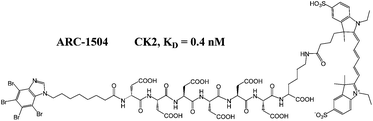
Up-regulation of an acidophilic protein kinase, CK2, has been established in several types of cancer. This cognition has made CK2 an important target for drug development for cancer chemotherapy. The characterization of potential drug candidates, determination of the structure and clarification of the functions of CK2 could be facilitated by the application of small-molecule fluorescent probes that bind to the active site of the enzyme with high affinity and selectivity. We have used a bisubstrate approach for the development of a highly potent inhibitor of CK2. 4,5,6,7-Tetrabromo-1H-benzimidazole was conjugated with peptides containing multiple aspartate residues via different linkers. The design of the inhibitors was by crystallographic analysis of the complex of an inhibitor with the catalytic subunit of the enzyme (CK2α). The inhibitory potency of the synthesized compounds was established in a kinetic assay that used thin layer chromatography for the measurement of the rate of phosphorylation of fluorescently labelled peptide 5-TAMRA-RADDSDDDDD. The most potent inhibitor, ARC-1502 (Ki = 0.5 nM), revealed high selectivity for CK2α in a panel of 140 protein kinases. Labelling of ARC-1502 with PromoFluor-647 gave the fluorescent probe ARC-1504 that possessed subnanomolar affinity towards both CK2α and the holoenzyme. The probe was used in a fluorescence anisotropy-based binding assay to measure the concentration of CK2α and characterize non-labelled ligands binding to the active site of CK2α.
Recommended Literature
- [1] Enabling non-flammable Li-metal batteries via electrolyte functionalization and interface engineering? Jing Yu,Yu-Qi Lyu,Jiapeng Liu,Mohammed B. Effat,Junxiong WuJ. Mater. Chem. A, 2019,7, 17995-18002 10.1039/C9TA03784E
- [2] Evolutionary de novo design of phenothiazine derivatives for dye-sensitized solar cells? Vishwesh Venkatraman,Marco Foscato,Vidar R. Jensen,Bj?rn K?re AlsbergJ. Mater. Chem. A, 2015,3, 9851-9860 10.1039/C5TA00625B
- [3] Establishing empirical design rules of nucleic acid templates for the synthesis of silver nanoclusters with tunable photoluminescence and functionalities towards targeted bioimaging applications? Jason Y. C. Lim,Yong Yu,Guorui Jin,Kai Li,Yi Lu,Jianping XieNanoscale Adv., 2020,2, 3921-3932 10.1039/D0NA00381F
- [4] Establishing the accuracy of position-specific carbon isotope analysis of propane by GC-pyrolysis-GC-IRMS ChangjieLiu,PengLiu,XiaofengWang,XiaoqiangLi,JuskeHorita 10.1002/rcm.9494
- [5] Fast synthesis of copper nanoclusters through the use of hydrogen peroxide additive and their application for the fluorescence detection of Hg2+ in water samples? Liao Xiaoqing,Li Ruiyi,Li Zaijun,Sun Xiulan,Wang Zhouping,Liu JunkangNew J. Chem., 2015,39, 5240-5248 10.1039/C5NJ00831J
- [6] Evidence of CO2 molecule acting as an electron acceptor on a nanoporous metal–organic-framework MIL-53 or Cr3+(OH)(O2C–C6H4–CO2)? Alexandre Vimont,Arnaud Travert,Philippe Bazin,Jean-Claude Lavalley,Marco Daturi,Christian Serre,Gérard Férey,Sandrine Bourrelly,Philip L. LlewellynChem. Commun., 2007, 3291-3293 10.1039/B703468G
- [7] Excellent energy storage performance in NaNbO3-based relaxor antiferroeic ceramics under a low electric field XuxinCheng,XiaomingChen,PengyuanFan 10.1007/s10832-022-00283-w
- [8] Fc microparticles can modulate the physical extent and magnitude of complement activity? David White,Sean R. StowellBiomater. Sci., 2017,5, 463-474 10.1039/C6BM00608F
- [9] Dissociative dynamics of O2 on Ag(110)? Ivor Lon?ari?Phys. Chem. Chem. Phys., 2015,17, 9436-9445 10.1039/C4CP05900J
- [10] Evolution in surface coverage of CH3NH3PbI3?XClXvia heat assisted solvent vapour treatment and their effects on photovoltaic performance of devices Dhirendra K. Chaudhary,Pramendra Kumar,Lokendra KumarRSC Adv., 2016,6, 94731-94738 10.1039/C6RA18729C

Journal Name:Organic & Biomolecular Chemistry
research_products
-

CAS no.: 89640-58-4


![N-(3-cyanothiolan-3-yl)-2-[(2,2,2-trifluoroethyl)sulfanyl]pyridine-4-carboxamide](https://ossimg.kuujia.com/scimg/1444500/1444113-98-7x500.png)

![1,2,3,4,5,6-Hexahydro-[2,3]bipyridinyl-6-ol](https://ossimg.kuujia.com/scimg/1271000/1270529-38-8x500.png)

![2,2-Difluoro-3-[methyl(2-methylbutyl)amino]propanoic acid](https://ossimg.kuujia.com/scimg/2138500/2138166-62-6x500.png)

![2-(1H-indol-3-yl)-N-{[6-(thiophen-2-yl)-[1,2,4]triazolo[4,3-b]pyridazin-3-yl]methyl}acetamide](https://ossimg.kuujia.com/scimg/2034500/2034271-14-0x500.png)