Phenolic compounds alter the ion permeability of phospholipid bilayers via specific lipid interactions?
Physical Chemistry Chemical Physics Pub Date: 2021-09-27 DOI: 10.1039/D1CP03250J
Abstract
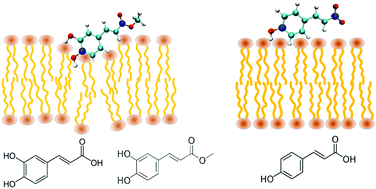
This study aims to understand the role of specific phenolic–lipid interactions in the membrane-altering properties of phenolic compounds. We combine tethered lipid bilayer (tBLM) electrical impedance spectroscopy (EIS) with all-atom molecular dynamics (MD) simulations to study the membrane interactions of six phenolic compounds: caffeic acid methyl ester, caffeic acid, 3,4 dihydroxybenzoic acid, chlorogenic acid, syringic acid and p-coumaric acid. tBLM/EIS experiments showed that caffeic acid methyl ester, caffeic acid and 3,4 dihydroxybenzoic acid significantly increase the permeability of phospholipid bilayers to Na+ ions. In contrast, chlorogenic acid, syringic acid and p-coumaric acid showed no effect. Experiments with lipids lacking the phosphate group show a significant decrease in the membrane-altering effects indicating that specific phenolic–lipid interactions are critical in altering ion permeability. MD simulations confirm that compounds that alter ion permeability form stable interactions with the phosphate oxygen. In contrast, inactive phenolic compounds are superficially bound to the membrane surface and primarily interact with interfacial water. Our combined results show that compounds with similar structures can have very different effects on ion permeability in membranes. These effects are governed by specific interactions at the water–lipid interface and show no correlation with lipophilicity. Furthermore, none of the compounds alter the overall structure of the phospholipid bilayer as determined by area per lipid and order parameters. Based on data from this study and previous findings, we propose that phenolic compounds can alter membrane ion permeability by causing local changes in lipid packing that subsequently reduce the energy barrier for ion-induced pores.
Recommended Literature
- [1] Fe(iii)-mediated isomerization of α,α-diarylallylic alcohols to ketones via radical 1,2-aryl migration? Ziyang Deng,Changwei Chen,Sunliang CuiRSC Adv., 2016,6, 93753-93755 10.1039/C6RA20007A
- [2] Estimation of activation energy for electroporation and pore growth rate in liquid crystalline and gel phases of lipid bilayers using molecular dynamics simulations? Amit Kumar Majhi,Subbarao Kanchi,V. Venkataraman,K. G. Ayappa,Prabal K. MaitiSoft Matter, 2015,11, 8632-8640 10.1039/C5SM02029H
- [3] Ester-directed orthogonal dual C–H activation and ortho aryl C–H alkenylation via distal weak coordination? Manickam Bakthadoss,Tadiparthi Thirupathi Reddy,Vishal Agarwal,Duddu S. SharadaChem. Commun., 2022,58, 1406-1409 10.1039/D1CC06097J
- [4] Fast synthesis of red Li3BaSrLn3(WO4)8:Eu3+ phosphors for white LEDs under near-UV excitation by a microwave-assisted solid state reaction method and photoluminescence studies Bo Wei,Zhenyu Liu,Chen Xie,Shu Yang,Wentao Tang,Aiwei Gu,Wing-Tak Wong,Ka-Leung WongJ. Mater. Chem. C, 2015,3, 12322-12327 10.1039/C5TC03165F
- [5] Fate of Sb(v) and Sb(iii) species along a gradient of pH and oxygen concentration in the Carnoulès mine waters (Southern France) Eléonore Resongles,Corinne Casiot,Fran?oise Elbaz-Poulichet,Rémi Freydier,Odile Bruneel,Christine Piot,Sophie Delpoux,Aurélie Volant,Angélique DesoeuvreEnviron. Sci.: Processes Impacts, 2013,15, 1536-1544 10.1039/C3EM00215B
- [6] Emerging 2D hybrid nanomaterials: towards enhanced sensitive and selective conductometric gas sensors at room temperature Hanie Hashtroudi,Ian D. R. MackinnonJ. Mater. Chem. C, 2020,8, 13108-13126 10.1039/D0TC01968B
- [7] Enabling non-flammable Li-metal batteries via electrolyte functionalization and interface engineering? Jing Yu,Yu-Qi Lyu,Jiapeng Liu,Mohammed B. Effat,Junxiong WuJ. Mater. Chem. A, 2019,7, 17995-18002 10.1039/C9TA03784E
- [8] Empowering microfluidics by micro-3D printing and solution-based mineral coating? Hongxia Li,Aikifa Raza,Qiaoyu Ge,Jin-You Lu,TieJun ZhangSoft Matter, 2020,16, 6841-6849 10.1039/D0SM00958J
- [9] Emerging investigator series: kinetics of diopside reactivity for carbon mineralization in mafic–ultramafic rocks BrianaAguila,LandonHardee,H.ToddSchaef,SiavashZare,MohammadJavadAbdolhosseiniQomi,JarrodV.Crum,JadeE.HollimanJr.,ElenaTajueloRodriguez,LawrenceM.Anovitz,KevinM.Rosso,QuinR.S.Miller 10.1039/d3en00087g
- [10] Evidence of rutile-to-anatase photo-induced electron transfer in mixed-phase TiO2 by solid-state NMR spectroscopy? Weili Dai,Guangjun Wu,Michael HungerChem. Commun., 2015,51, 13779-13782 10.1039/C5CC04971G

Journal Name:Physical Chemistry Chemical Physics
research_products
-

CAS no.: 89640-58-4

![1,2,3,4,5,6-Hexahydro-[2,3]bipyridinyl-6-ol](https://ossimg.kuujia.com/scimg/1271000/1270529-38-8x500.png)


![N-(3-cyanothiolan-3-yl)-2-[(2,2,2-trifluoroethyl)sulfanyl]pyridine-4-carboxamide](https://ossimg.kuujia.com/scimg/1444500/1444113-98-7x500.png)

![2,2-Difluoro-3-[methyl(2-methylbutyl)amino]propanoic acid](https://ossimg.kuujia.com/scimg/2138500/2138166-62-6x500.png)

![2-(1H-indol-3-yl)-N-{[6-(thiophen-2-yl)-[1,2,4]triazolo[4,3-b]pyridazin-3-yl]methyl}acetamide](https://ossimg.kuujia.com/scimg/2034500/2034271-14-0x500.png)