One hundred years of helicene chemistry. Part 1: non-stereoselective syntheses of carbohelicenes?
Chemical Society Reviews Pub Date: 2012-11-15 DOI: 10.1039/C2CS35154D
Abstract
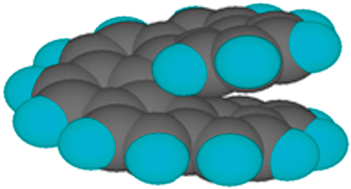
Carbohelicenes belong to a class of fascinating, chiral, and helicoidal molecules, which have a rich history in chemistry since the very beginning of the 20th century. A renewed interest in polyaromatic chemistry and new synthetic challenges toward the search for innovative physical, biological, chemical and opto-electronic properties have brought high motivation in this field of studies. Theoretical insights gained from polyaromatic, chiral, conjugated and distorted π-systems are also responsible for this development. Several synthetic avenues were originally reported for making lower helicenes, but for many years, photochemical synthesis has remained a major method for producing small amount of helicenes. High-dilution conditions is still a limiting factor in their synthesis. The fulgurous impact of organometallic chemistry, novel synthetic methods, and recent catalytic systems has promoted the development of helicene chemistry, toward a library of tailor-made and highly functionalized helicene molecules. Helicene chemistry is being considered as an expanding and modern field, leading to several applications in supramolecular chemistry, in nanosciences, in chemical-biology, in polymers and materials science. This first part of a series of three reviews on carbohelicenes will be devoted to a comprehensive report on non-stereoselective reactions and methods for producing helicenes, along with their functionalization.
Recommended Literature
- [1] An apparatus for testing water by measurement of its electrical conductivity Analyst, 1912,37, 538-543 10.1039/AN9123700538
- [2] An aquatic host–guest complex between a supramolecular G-quadruplex and the anticancer drug doxorubicin? José M. Rivera,Mariana Martín-Hidalgo,Jean C. Rivera-RíosOrg. Biomol. Chem., 2012,10, 7562-7565 10.1039/C2OB25913C
- [3] An investigation on the interaction modes of a single-strand DNA aptamer and RBP4 protein: a molecular dynamic simulations approach? Raheleh Torabi,Hedayatollah Ghourchian,Massoud AmanlouOrg. Biomol. Chem., 2016,14, 8141-8153 10.1039/C6OB01094F
- [4] An amorphous carbon nitride/NiO/CoN-based composite: a highly efficient nonprecious electrode for supercapacitors and the oxygen evolution reaction? Huifang Yang,Haoran Guo,Peidong Fan,Xinpan Li,Wenlu Ren,Rui SongNanoscale, 2020,12, 7024-7034 10.1039/D0NR00001A
- [5] An amphipathic trans-acting phosphorothioate RNA element delivers an uncharged phosphorodiamidate morpholino sequence in mdx mouse myotubes? H. V. Jain,D. Verthelyi,S. L. BeaucageRSC Adv., 2017,7, 42519-42528 10.1039/C7RA04247G
- [6] An Assessment of the Laminar Hypersonic Double-Cone Experiments in the LENS-XX Tunnel JaideepRay,PatrickBlonigan,EricT.Phipps,KathrynMaupin 10.2514/1.j062802
- [7] An all-solid-state imprinted polymer-based potentiometric sensor for determination of bisphenol S? Rongning Liang,Tanji Yin,Ruiqing Yao,Wei QinRSC Adv., 2016,6, 73308-73312 10.1039/C6RA14461F
- [8] An atlas of endohedral Sc2S cluster fullerenes? Li-Hua Gan,Rui Wu,Jian-Lei Tian,Patrick W. FowlerPhys. Chem. Chem. Phys., 2017,19, 419-425 10.1039/C6CP07370K
- [9] An atom efficient route to N-aryl and N-alkyl pyrrolines by transition metal catalysis? Supaporn Sawadjoon,Joseph S. M. SamecOrg. Biomol. Chem., 2011,9, 2548-2554 10.1039/C0OB00383B
- [10] An alumina stabilized graphene oxide wrapped SnO2 hollow sphere LIB anode with improved lithium storage? Xiang Liu,Qian Sun,A. B. Djuri?i?,Maohai Xie,Baohu Dai,Jinyao Tang,Charles Surya,Changzhong Liao,Kaimin ShihRSC Adv., 2015,5, 100783-100789 10.1039/C5RA22482A

Journal Name:Chemical Society Reviews
research_products
-

CAS no.: 89640-58-4


![N-(3-cyanothiolan-3-yl)-2-[(2,2,2-trifluoroethyl)sulfanyl]pyridine-4-carboxamide](https://ossimg.kuujia.com/scimg/1444500/1444113-98-7x500.png)

![1,2,3,4,5,6-Hexahydro-[2,3]bipyridinyl-6-ol](https://ossimg.kuujia.com/scimg/1271000/1270529-38-8x500.png)

![2,2-Difluoro-3-[methyl(2-methylbutyl)amino]propanoic acid](https://ossimg.kuujia.com/scimg/2138500/2138166-62-6x500.png)

![2-(1H-indol-3-yl)-N-{[6-(thiophen-2-yl)-[1,2,4]triazolo[4,3-b]pyridazin-3-yl]methyl}acetamide](https://ossimg.kuujia.com/scimg/2034500/2034271-14-0x500.png)