Pillar-layered MOFs: functionality, interpenetration, flexibility and applications
Journal of Materials Chemistry A Pub Date: 2018-09-17 DOI: 10.1039/C8TA03306D
Abstract
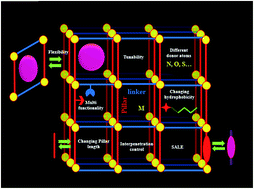
Pillar-layered metal–organic frameworks (MOFs) are among the most interesting research areas in crystalline materials. Due to the great number of reports related to pillar-layered MOFs, investigating their structural diversity, properties and applicability as multi-donor porous frameworks is of great interest. Modifying pillar moieties as a third building block of pillar-layered MOFs, together with metal nodes and oxygen donor linkers, can enhance control of the structure assembly, leading to specific properties of the obtained structures. Although the past decade has witnessed remarkable advances in this research area, pillar-layered MOFs have not been reviewed as an independent subject to date. Therefore, a review summarizing their performance is greatly needed. This review covers issues related to pillar-layered MOFs, including their structural properties, synthesis, stability, diversity of linkers, and improved applicability. Finally, pillar linkers are studied separately according to their diverse donor atoms and functional groups.
Recommended Literature
- [1] An astrophysically-relevant mechanism for amino acid enantiomer enrichment Stephen P. Fletcher,Richard B. C. Jagt,Ben L. FeringaChem. Commun., 2007, 2578-2580 10.1039/B702882B
- [2] An amphipathic trans-acting phosphorothioate RNA element delivers an uncharged phosphorodiamidate morpholino sequence in mdx mouse myotubes? H. V. Jain,D. Verthelyi,S. L. BeaucageRSC Adv., 2017,7, 42519-42528 10.1039/C7RA04247G
- [3] An alternative biorefinery approach to address microalgal seasonality: blending with spent coffee grounds Andre Prates Pereira,Tao Dong,Eric P. Knoshaug,Nick Nagle,Ryan Spiller,Bonnie Panczak,Christopher J. Chuck,Philip T. PienkosSustainable Energy Fuels, 2020,4, 3400-3408 10.1039/D0SE00164C
- [4] An amino group functionalized metal–organic framework as a luminescent probe for highly selective sensing of Fe3+ ions? Zhonghua Xiang,Chuanqi Fang,Sanhua Leng,Dapeng CaoJ. Mater. Chem. A, 2014,2, 7662-7665 10.1039/C4TA00313F
- [5] An intermolecular C–C coupling reaction of iridium complexes? Kathrin Kutlescha,Rhett KempeNew J. Chem., 2010,34, 1954-1960 10.1039/C0NJ00158A
- [6] Alternative donor substrates for inverting and retaining glycosyltransferases? Luke L. Lairson,Warren W. WakarchukChem. Commun., 2007, 365-367 10.1039/B614636H
- [7] An ion-gating multinanochannel system based on a copper-responsive self-cleaving DNAzyme? Yang Chen,Di Zhou,Zheyi Meng,Jin ZhaiChem. Commun., 2016,52, 10020-10023 10.1039/C6CC03943J
- [8] An approach towards the synthesis of novel fused nitrogen tricyclic heterocyclic scaffolds via GBB reaction? Sandip Gangadhar Balwe,Yeon Tae JeongOrg. Biomol. Chem., 2018,16, 1287-1296 10.1039/C7OB02933K
- [9] An integrated cathode and solid electrolyte via in situ polymerization with significantly reduced interface resistance? Jialiang Yuan,Ran Dong,Yuan Li,Yang Liu,Zhuo Zheng,Yuxia Liu,Yan Sun,Benhe Zhong,Zhenguo Wu,Xiaodong GuoChem. Commun., 2021,57, 13004-13007 10.1039/D1CC04485K
- [10] An all-solid-state asymmetric device based on a polyaniline hydrogel for a high energy flexible supercapacitor? Hamid Heydari,Mohammad B. GholivandNew J. Chem., 2017,41, 237-244 10.1039/C6NJ02266A

Journal Name:Journal of Materials Chemistry A
research_products
-

CAS no.: 89640-58-4


![N-(3-cyanothiolan-3-yl)-2-[(2,2,2-trifluoroethyl)sulfanyl]pyridine-4-carboxamide](https://ossimg.kuujia.com/scimg/1444500/1444113-98-7x500.png)

![1,2,3,4,5,6-Hexahydro-[2,3]bipyridinyl-6-ol](https://ossimg.kuujia.com/scimg/1271000/1270529-38-8x500.png)

![2,2-Difluoro-3-[methyl(2-methylbutyl)amino]propanoic acid](https://ossimg.kuujia.com/scimg/2138500/2138166-62-6x500.png)

![2-(1H-indol-3-yl)-N-{[6-(thiophen-2-yl)-[1,2,4]triazolo[4,3-b]pyridazin-3-yl]methyl}acetamide](https://ossimg.kuujia.com/scimg/2034500/2034271-14-0x500.png)