Natural product modulators of human sensations and mood: molecular mechanisms and therapeutic potential
Chemical Society Reviews Pub Date: 2017-09-21 DOI: 10.1039/C7CS00411G
Abstract
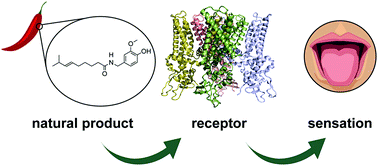
Humans perceive physical information about the surrounding environment through their senses. This physical information is registered by a collection of highly evolved and finely tuned molecular sensory receptors. A multitude of bioactive, structurally diverse ligands have evolved in nature that bind these molecular receptors. The complex, dynamic interactions between the ligands and the receptors lead to changes in our sensory perception or mood. Here, we review our current knowledge of natural products and their derived analogues that interact specifically with human G protein-coupled receptors, ion channels, and nuclear hormone receptors to modulate the sensations of taste, smell, temperature, pain, and itch, as well as mood and its associated behaviour. We discuss the molecular and structural mechanisms underlying such interactions and highlight cases where subtle differences in natural product chemistry produce drastic changes in functional outcome. We also discuss cases where a single compound triggers complex sensory or behavioural changes in humans through multiple mechanistic targets. Finally, we comment on the therapeutic potential of the reviewed area of research and draw attention to recent technological developments in genomics, metabolomics, and metabolic engineering that allow us to tap the medicinal properties of natural product chemistry without taxing nature.
Recommended Literature
- [1] Enantio- & chemo-selective preparation of enantiomerically enriched aliphatic nitro alcohols using Candida parapsilosis ATCC 7330 Sowmyalakshmi VenkataramanRSC Adv., 2015,5, 73807-73813 10.1039/C5RA13593A
- [2] Excitable dynamics in the bromate–sulfite–ferrocyanide reaction J. Zagora,M. Vosla?,L. Schreiberová,I. SchreiberPhys. Chem. Chem. Phys., 2002,4, 1284-1291 10.1039/B110048C
- [3] Distributed research: a new paradigm for undergraduate research and global problem solving? Bruce ParkinsonEnergy Environ. Sci., 2010,3, 509-511 10.1039/B919523H
- [4] Evolution of shape, size, and areal density of a single plane of Si nanocrystals embedded in SiO2 matrix studied by atom probe tomography Bin Han,Yasuo Shimizu,Gabriele Seguini,Celia Castro,Gérard Ben Assayag,Koji Inoue,Yasuyoshi Nagai,Sylvie Schamm-Chardon,Michele PeregoRSC Adv., 2016,6, 3617-3622 10.1039/C5RA26710B
- [5] Fe(ii)-Assisted one-pot synthesis of ultra-small core–shell Au–Pt nanoparticles as superior catalysts towards the HER and ORR? Yi Cao,Yujiao Xiahou,Lixiang Xing,Xiang Zhang,Hong Li,ChenShou Wu,Haibing XiaNanoscale, 2020,12, 20456-20466 10.1039/D0NR04995F
- [6] Fe3O4 nanoparticle chains with N-doped carbon coating: magnetotactic bacteria assisted synthesis and high-rate lithium storage? Dan Yang,Yanping Zhou,Xianhong Rui,Jixin Zhu,Ziyang Lu,Eileen Fong,Qingyu YanRSC Adv., 2013,3, 14960-14962 10.1039/C3RA42116C
- [7] Embedding cyclic nitrone in mesoporous silica particles for EPR spin trapping of superoxide and other radicals? Eric Besson,Stéphane Gastaldi,Emily Bloch,Selma Aslan,Hakim Karoui,Olivier Ouari,Micael HardyAnalyst, 2019,144, 4194-4203 10.1039/C9AN00468H
- [8] Evolved polymerases facilitate selection of fully 2′-OMe-modified aptamers? Zhixia Liu,Tingjian Chen,Floyd E. RomesbergChem. Sci., 2017,8, 8179-8182 10.1039/C7SC03747C
- [9] Exceptional activity of sub-nm Pt clusters on CdS for photocatalytic hydrogen production: a combined experimental and first-principles study? Qiyuan Wu,Shangmin Xiong,Peichuan Shen,Shen Zhao,Alexander OrlovCatal. Sci. Technol., 2015,5, 2059-2064 10.1039/C4CY01563K
- [10] Exchangeability of amino acid residues with similar physicochemical properties in coiled-coil interactions? Guiying Zhang,Maosheng Cheng,Yanni Li,Keliang Liu,Lifeng CaiChem. Commun., 2013,49, 11086-11088 10.1039/C3CC46560H

Journal Name:Chemical Society Reviews
research_products
-

CAS no.: 89640-58-4


![N-(3-cyanothiolan-3-yl)-2-[(2,2,2-trifluoroethyl)sulfanyl]pyridine-4-carboxamide](https://ossimg.kuujia.com/scimg/1444500/1444113-98-7x500.png)

![1,2,3,4,5,6-Hexahydro-[2,3]bipyridinyl-6-ol](https://ossimg.kuujia.com/scimg/1271000/1270529-38-8x500.png)

![2,2-Difluoro-3-[methyl(2-methylbutyl)amino]propanoic acid](https://ossimg.kuujia.com/scimg/2138500/2138166-62-6x500.png)

![2-(1H-indol-3-yl)-N-{[6-(thiophen-2-yl)-[1,2,4]triazolo[4,3-b]pyridazin-3-yl]methyl}acetamide](https://ossimg.kuujia.com/scimg/2034500/2034271-14-0x500.png)