Mechanistic study of electrochemical treatment of basic green 4 dye with aluminum electrodes through zeta potential, TOC, COD and color measurements, and characterization of residues
RSC Advances Pub Date: 2013-06-27 DOI: 10.1039/C3RA41605D
Abstract
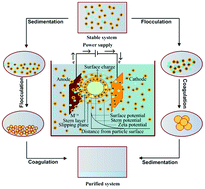
Herein we report a study on the changes in zeta potential during the electrochemical (EC) treatment of basic green 4 (BG) dye solutions. BG is a basic acrylic dye with a triphenylmethane group. It is extensively used in the textile and other industries. This study was conducted in a batch electrochemical reactor using a sacrificial aluminum anode. Zeta potentials were measured with changes in operating variables such as current density (j), initial pH (pH0), and initial dye concentration (C0). The process performance was analyzed in terms of the chemical oxygen demand (COD), total organic carbon (TOC) and decolorization efficiency along with important cost-related parameters such as electrode and energy consumption. At the optimum conditions, 82.4% COD, 63.5% TOC and 99.4% color removal efficiencies were observed, when C0 = 100 mg L?1, the treatment time was 45 min, with j = 117.64 A m?2 and the initial pH0 = 6.2. The respective electrode and energy consumptions at the optimum conditions were 0.16 kg Al per kg COD removed and 2.48 kW h per kg COD removed. The magnitude of the zeta potential gave an indication regarding the potential stability of the colloidal suspensions of BG dye and aluminum flocs present in the solution over the pH range of 3.2–12.2. It was found that the removal of the cationic dye was maximum when the zeta potential was least negative and that the removal was due to adsorption on neutral aluminum hydroxide. Finally, Fourier transform infrared spectroscopy (FTIR), X-ray diffraction (XRD), scanning electron microscopy (SEM), energy dispersive X-ray spectroscopy (EDX), pore size distribution and thermogravimetric analysis (TGA) techniques were used to characterize the solid residues obtained during the EC treatment of aqueous solutions with and without BG dye.
Recommended Literature
- [1] Excimer and exciplex formation in a pair of bright phosphorescent isomers constructed from Cu3(pyrazolate)3 and Cu3I3 coordination luminophores? Shun-Ze Zhan,Mian Li,Xiao-Ping Zhou,Dan Li,Seik Weng NgRSC Adv., 2011,1, 1457-1459 10.1039/C1RA00566A
- [2] Enabling high-throughput single-animal gene-expression studies with molecular and micro-scale technologies Jason WanLab Chip, 2020,20, 4528-4538 10.1039/D0LC00881H
- [3] Excellent energy storage performance in NaNbO3-based relaxor antiferroeic ceramics under a low electric field XuxinCheng,XiaomingChen,PengyuanFan 10.1007/s10832-022-00283-w
- [4] Exchangeability of amino acid residues with similar physicochemical properties in coiled-coil interactions? Guiying Zhang,Maosheng Cheng,Yanni Li,Keliang Liu,Lifeng CaiChem. Commun., 2013,49, 11086-11088 10.1039/C3CC46560H
- [5] Excellent mechanical performance and enhanced dielectric properties of OBC/SiO2 elastomeric nanocomposites: effect of dispersion of the SiO2 nanoparticles? Xing Zhao,Lu Bai,Rui-Ying Bao,Zheng-Ying Liu,Ming-Bo Yang,Wei YangRSC Adv., 2017,7, 46297-46305 10.1039/C7RA08074C
- [6] Fast-Track to Research Data Management in Experimental Material Science-Setting the Ground for Research Group Level Materials Digitalization. LarsBanko,AlfredLudwig 10.1021/acscombsci.0c00057
- [7] EWOD-driven droplet microfluidic device integrated with optoelectronic tweezers as an automated platform for cellular isolation and analysis? Gaurav J. Shah,Eric P.-Y. Chiou,Ming C. Wu,Chang-Jin “CJ” KimLab Chip, 2009,9, 1732-1739 10.1039/B821508A
- [8] Emulsifier-free, organotellurium-mediated living radical emulsion polymerization (emulsion TERP) of styrene: poly(dimethylaminoethyl methacrylate) macro-TERP agent? Yukiya KitayamaPolym. Chem., 2014,5, 2784-2792 10.1039/C3PY01539D
- [9] Evolution study of photo-synthesized gold nanoparticles by spectral deconvolution model: a quantitative approach Chung-Sung Yang,Mong-Shian Shih,Fang-Yi ChangNew J. Chem., 2006,30, 729-735 10.1039/B516465F
- [10] Emergence of cationic polyamine dendrimersomes: design, stimuli sensitivity and potential biomedical applications Partha Laskar,Christine DufèsNanoscale Adv., 2021,3, 6007-6026 10.1039/D1NA00536G

Journal Name:RSC Advances
research_products
-

CAS no.: 89640-58-4

![1,2,3,4,5,6-Hexahydro-[2,3]bipyridinyl-6-ol](https://ossimg.kuujia.com/scimg/1271000/1270529-38-8x500.png)


![N-(3-cyanothiolan-3-yl)-2-[(2,2,2-trifluoroethyl)sulfanyl]pyridine-4-carboxamide](https://ossimg.kuujia.com/scimg/1444500/1444113-98-7x500.png)

![2,2-Difluoro-3-[methyl(2-methylbutyl)amino]propanoic acid](https://ossimg.kuujia.com/scimg/2138500/2138166-62-6x500.png)

![2-(1H-indol-3-yl)-N-{[6-(thiophen-2-yl)-[1,2,4]triazolo[4,3-b]pyridazin-3-yl]methyl}acetamide](https://ossimg.kuujia.com/scimg/2034500/2034271-14-0x500.png)