Magnetization of biochar nanoparticles as a novel support for fabrication of organo nickel as a selective, reusable and magnetic nanocatalyst in organic reactions?
New Journal of Chemistry Pub Date: 2021-01-08 DOI: 10.1039/D0NJ04990E
Abstract
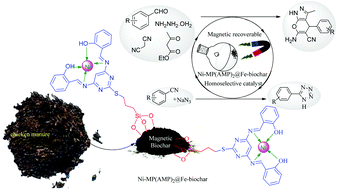
Catalyst species are an important class of materials in chemistry, industry, medicine and biotechnology. Also, waste recycling is an important process in green chemistry and economic efficiency. Therefore, in order to recycle waste, biochar nanoparticles were prepared from chicken manure. Then, the biochar nanoparticles were magnetized under a green and environmentally friendly method. Finally, the surface of the magnetic biochar nanoparticles was modified and further they were applied as a novel support for fabrication of nickel as a homoselective and reusable catalyst in organic reactions. The structure of this organic–inorganic catalyst has been characterized by N2 adsorption–desorption isotherms, and the SEM, EDS, WDX, XRD, TGA, AAS, FT-IR and VSM techniques. This magnetically recyclable catalyst was used in the homoselective synthesis of tetrazole and pyranopyrazole derivatives. This catalyst can be reused several times without significant loss of its catalytic efficiency. The heterogeneity and stability of this nanocatalyst were studied by hot filtration and the AAS technique. Also, the reused catalyst was characterized by the SEM, EDS, AAS and BET techniques.
Recommended Literature
- [1] An apparatus for determining small amounts of alchohol in sour milk and urine Analyst, 1964,89, 272-275 10.1039/AN9648900272
- [2] An artificial photosynthetic system for photoaccumulation of two electrons on a fused dipyridophenazine (dppz)–pyridoquinolinone ligand? Philipp Traber,Stephan Kupfer,Stefanie Gr?fe,Isabelle Baussanne,Martine Demeunynck,Jean-Marie Mouesca,Serge Gambarelli,Vincent Artero,Murielle Chavarot-KerlidouChem. Sci., 2018,9, 4152-4159 10.1039/C7SC04348A
- [3] An approach to biodegradable star polymeric architectures using disulfide coupling? Jingquan Liu,Huiyun Liu,Zhongfan Jia,Volga Bulmus,Thomas P. DavisChem. Commun., 2008, 6582-6584 10.1039/B817037A
- [4] An atomic scale study of defects in Co2FeAl Ravi Kumar Yadav,R. GovindarajPhys. Chem. Chem. Phys., 2020,22, 26876-26886 10.1039/D0CP04572A
- [5] An amplified fluorescence detection of T4 polynucleotide kinase activity based on coupled exonuclease III reaction and a graphene oxide platform? Ni-Na Sun,Fengli Qu,Xiaobing Zhang,Shufang Zhang,Jinmao YouAnalyst, 2015,140, 1827-1831 10.1039/C4AN01953A
- [6] An amino group functionalized metal–organic framework as a luminescent probe for highly selective sensing of Fe3+ ions? Zhonghua Xiang,Chuanqi Fang,Sanhua Leng,Dapeng CaoJ. Mater. Chem. A, 2014,2, 7662-7665 10.1039/C4TA00313F
- [7] An aptamer-based keypad lock system? Yaqing Liu,Jiangtao Ren,Jing Li,Jiyang Liu,Erkang WangChem. Commun., 2012,48, 802-804 10.1039/C1CC15979H
- [8] An insight into the hybridization mechanism of hairpin DNA physically immobilized on chemically modified graphenes Adeline Huiling Loo,Alessandra Bonanni,Martin PumeraAnalyst, 2013,138, 467-471 10.1039/C2AN36199J
- [9] An aqueous ammonia sensor based on an inkjet-printed polyaniline nanoparticle-modified electrode Karl Crowley,Eimer O'Malley,Aoife Morrin,Malcolm R. Smyth,Anthony J. KillardAnalyst, 2008,133, 391-399 10.1039/B716154A
- [10] An amorphous lanthanum–iridium solid solution with an open structure for efficient water splitting? Wei Sun,Chenglong Ma,Xinlong Tian,Jianjun Liao,Ji Yang,Chengjun Ge,Weiwei HuangJ. Mater. Chem. A, 2020,8, 12518-12525 10.1039/D0TA03351K

Journal Name:New Journal of Chemistry
research_products
-

CAS no.: 89640-58-4


![N-(3-cyanothiolan-3-yl)-2-[(2,2,2-trifluoroethyl)sulfanyl]pyridine-4-carboxamide](https://ossimg.kuujia.com/scimg/1444500/1444113-98-7x500.png)

![1,2,3,4,5,6-Hexahydro-[2,3]bipyridinyl-6-ol](https://ossimg.kuujia.com/scimg/1271000/1270529-38-8x500.png)

![2,2-Difluoro-3-[methyl(2-methylbutyl)amino]propanoic acid](https://ossimg.kuujia.com/scimg/2138500/2138166-62-6x500.png)

![2-(1H-indol-3-yl)-N-{[6-(thiophen-2-yl)-[1,2,4]triazolo[4,3-b]pyridazin-3-yl]methyl}acetamide](https://ossimg.kuujia.com/scimg/2034500/2034271-14-0x500.png)