Identification of bioactive compounds that contribute to the α-glucosidase inhibitory activity of rosemary?
Food & Function Pub Date: 2020-02-06 DOI: 10.1039/C9FO02448D
Abstract
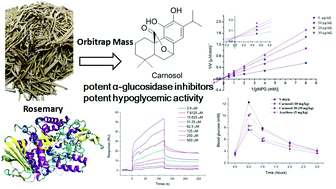
To investigate the bioactive compounds that contribute to the α-glucosidase inhibitory activity of rosemary, phenolics and triterpene acids were characterized and quantified using quadrupole-Orbitrap mass spectrometry and enzyme assay. Two phenolic diterpenes (carnosol and hydroxy p-quinone carnosic acid) and two triterpene acids (betulinic acid and ursolic acid) were identified as potent α-glucosidase inhibitors. Carnosol, a major diterpene in rosemary, showed significant α-glucosidase inhibitory activity with IC50 value of 12 μg mL?1, and its inhibition mode was competitive. The inhibition mechanism of carnosol on α-glucosidase was further investigated by a combination of surface plasmon resonance (SPR) spectroscopy, fluorescence quenching studies and molecular-modeling techniques. The SPR assay suggested that carnosol had a high affinity to α-glucosidase with equilibrium dissociation constant (KD) value of 72.6 M. Fluorescence quenching studies indicated that the binding between carnosol and α-glucosidase was spontaneous and mainly driven by hydrophobic forces. Molecular docking studies revealed that carnosol bound to the active site of α-glucosidase. Furthermore, the oral administration of carnosol at 30 mg kg?1 significantly reduced the postprandial blood glucose levels of normal mice. This is the first report on the α-glucosidase inhibition and hypoglycemic activity of phenolic diterpenes, and these results could facilitate the utilization of rosemary as a dietary supplement for the treatment of diabetes.
Recommended Literature
- [1] Excimer emission and magnetoluminescence of radical-based zinc(ii) complexes doped in host crystals? Shojiro Kimura,Tetsuro KusamotoChem. Commun., 2020,56, 11195-11198 10.1039/D0CC04830E
- [2] Evidence of field induced slow magnetic relaxation in cis-[Co(hfac)2(H2O)2] exhibiting tri-axial anisotropy with a negative axial component? Denis V. Korchagin,Elena A. Yureva,Alexander V. Akimov,Eugenii Ya. Misochko,Gennady V. Shilov,Artem D. Talantsev,Roman B. Morgunov,Alexander A. Shakin,Sergey M. Aldoshin,Boris S. TsukerblatDalton Trans., 2017,46, 7540-7548 10.1039/C7DT01236E
- [3] Enabling shape memory and healable effects in a conjugated polymer by incorporating siloxane via dynamic imine bond? Yaling Zhang,Chunhui Dai,Shiwei Zhou,Bin LiuChem. Commun., 2018,54, 10092-10095 10.1039/C8CC05410J
- [4] Empowering microfluidics by micro-3D printing and solution-based mineral coating? Hongxia Li,Aikifa Raza,Qiaoyu Ge,Jin-You Lu,TieJun ZhangSoft Matter, 2020,16, 6841-6849 10.1039/D0SM00958J
- [5] Evolution of cellulose into flexible conductive green electronics: a smart strategy to fabricate sustainable electrodes for supercapacitors Tengfei Yu,Yuehan Wu,Wei Li,Bin LiRSC Adv., 2014,4, 34134-34143 10.1039/C4RA07017H
- [6] Enabling non-flammable Li-metal batteries via electrolyte functionalization and interface engineering? Jing Yu,Yu-Qi Lyu,Jiapeng Liu,Mohammed B. Effat,Junxiong WuJ. Mater. Chem. A, 2019,7, 17995-18002 10.1039/C9TA03784E
- [7] EWOD-driven droplet microfluidic device integrated with optoelectronic tweezers as an automated platform for cellular isolation and analysis? Gaurav J. Shah,Eric P.-Y. Chiou,Ming C. Wu,Chang-Jin “CJ” KimLab Chip, 2009,9, 1732-1739 10.1039/B821508A
- [8] Fast-pulsing NMR techniques for the detection of weak interactions: successful natural abundance probe of hydrogen bonds in peptides? Amandine Altmayer-Henzien,Valérie Declerck,David J. Aitken,Ewen Lescop,Denis Merlet,Jonathan FarjonOrg. Biomol. Chem., 2013,11, 7611-7615 10.1039/C3OB41876F
- [9] Emerging 2D hybrid nanomaterials: towards enhanced sensitive and selective conductometric gas sensors at room temperature Hanie Hashtroudi,Ian D. R. MackinnonJ. Mater. Chem. C, 2020,8, 13108-13126 10.1039/D0TC01968B
- [10] Embedding cyclic nitrone in mesoporous silica particles for EPR spin trapping of superoxide and other radicals? Eric Besson,Stéphane Gastaldi,Emily Bloch,Selma Aslan,Hakim Karoui,Olivier Ouari,Micael HardyAnalyst, 2019,144, 4194-4203 10.1039/C9AN00468H

Journal Name:Food & Function
research_products
-

CAS no.: 89640-58-4


![N-(3-cyanothiolan-3-yl)-2-[(2,2,2-trifluoroethyl)sulfanyl]pyridine-4-carboxamide](https://ossimg.kuujia.com/scimg/1444500/1444113-98-7x500.png)

![1,2,3,4,5,6-Hexahydro-[2,3]bipyridinyl-6-ol](https://ossimg.kuujia.com/scimg/1271000/1270529-38-8x500.png)

![2,2-Difluoro-3-[methyl(2-methylbutyl)amino]propanoic acid](https://ossimg.kuujia.com/scimg/2138500/2138166-62-6x500.png)

![2-(1H-indol-3-yl)-N-{[6-(thiophen-2-yl)-[1,2,4]triazolo[4,3-b]pyridazin-3-yl]methyl}acetamide](https://ossimg.kuujia.com/scimg/2034500/2034271-14-0x500.png)