Influence of organic colloids on the uptake, accumulation and effects of benzophenone-3 in aquatic animals?
Environmental Science: Nano Pub Date: 2021-10-29 DOI: 10.1039/D1EN00639H
Abstract
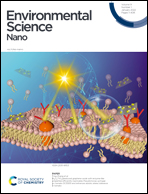
The environmental behavior of pollutants in water is associated with aquatic colloids, especially organic colloids, which may be swallowed by aquatic organisms. In this study, bovine serum albumin (BSA) and phycocyanin (PCA) as organic protein colloids were used to evaluate their impacts on the accumulation and biotoxicity of benzophenone-3 (BP3). A bioaccumulation kinetic model based on daphnids (Daphnia magna) and zebrafish (Danio rerio) was established to quantify the effects of colloids on the different absorption pathways for BP3. When the freely dissolved concentration of BP3 was fixed at 100 μg L?1, environmentally relevant concentrations of colloids always acted as a carrier in the intestine, transferring BP3 to lipids, and the positive carrier efficiency decreased with the increase of colloid concentration. Protein colloids also enhanced passive absorption, of which the efficiency increased with colloid concentration. However, the contribution of the carrier effect of colloids in the intestine was almost negligible. Two aquatic organisms obtained BP3 mainly from water, and the upper limit of bioaccumulation in the colloid matrix was dependent on the absorption of colloid–BP3 by organisms or the mass transfer on the surface of organisms. Besides, BP3 caused thyroid hormone content and gene expression disorders on the hypothalamus–pituitary–thyroid axis in zebrafish larvae. The opposite colloid concentration dependence of gene expression was observed for BSA and PCA. The colloids may affect the active BP3 concentration in organisms through their adsorption and desorption behaviour outside and inside organisms, thereby affecting the toxicity of pollutants. This study suggests reconsidering the true ecological risks of pollutants bound to organic colloids in natural environments.

Recommended Literature
- [1] An ion-gating multinanochannel system based on a copper-responsive self-cleaving DNAzyme? Yang Chen,Di Zhou,Zheyi Meng,Jin ZhaiChem. Commun., 2016,52, 10020-10023 10.1039/C6CC03943J
- [2] An air-stable organometallic polymer containing titanafluorene moieties obtained by the Sonogashira–Hagihara cross-coupling polycondensation? Alvin Tanudjaja,Shinsuke Inagi,Fusao Kitamura,Toshikazu Takata,Ikuyoshi TomitaDalton Trans., 2021,50, 3037-3043 10.1039/D0DT03663C
- [3] An atomically efficient, highly stable and redox active Ce0.5Tb0.5Ox (3% mol.)/MgO catalyst for total oxidation of methane? Juan J. Sánchez,Miguel López-Haro,Juan C. Hernández-Garrido,Ginesa Blanco,Miguel A. Cauqui,José M. Rodríguez-Izquierdo,José A. Pérez-Omil,José J. Calvino,María P. YesteJ. Mater. Chem. A, 2019,7, 8993-9003 10.1039/C8TA11672E
- [4] Alternative donor substrates for inverting and retaining glycosyltransferases? Luke L. Lairson,Warren W. WakarchukChem. Commun., 2007, 365-367 10.1039/B614636H
- [5] An anti-leakage liquid metal thermal interface material Kaiyuan Huang,Wangkang Qiu,Meilian Ou,Xiaorui Liu,Zenan Liao,Sheng ChuRSC Adv., 2020,10, 18824-18829 10.1039/D0RA02351E
- [6] Acenaphthenic hopanoids, a novel series of aromatised Teresita Carrillo-Hernández,Philippe Schaeffer,Pierre AlbrechtChem. Commun., 2001, 1976-1977 10.1039/B105198A
- [7] An artificial photosynthesis system comprising a covalent triazine framework as an electron relay facilitator for photochemical carbon dioxide reduction? Siquan Zhang,Shengyao Wang,Liping Guo,Hao Chen,Bien Tan,Shangbin JinJ. Mater. Chem. C, 2020,8, 192-200 10.1039/C9TC05297F
- [8] An aptamer-based keypad lock system? Yaqing Liu,Jiangtao Ren,Jing Li,Jiyang Liu,Erkang WangChem. Commun., 2012,48, 802-804 10.1039/C1CC15979H
- [9] An integrated process of CO2 capture and in situ hydrogenation to formate using a tunable ethoxyl-functionalized amidine and Rh/bisphosphine system? Yu-Nong Li,Liang-Nian He,Xian-Dong Lang,Xiao-Fang Liu,Shuai ZhangRSC Adv., 2014,4, 49995-50002 10.1039/C4RA08740B
- [10] An approach to biodegradable star polymeric architectures using disulfide coupling? Jingquan Liu,Huiyun Liu,Zhongfan Jia,Volga Bulmus,Thomas P. DavisChem. Commun., 2008, 6582-6584 10.1039/B817037A
Journal Name:Environmental Science: Nano
research_products
-

CAS no.: 89640-58-4


![N-(3-cyanothiolan-3-yl)-2-[(2,2,2-trifluoroethyl)sulfanyl]pyridine-4-carboxamide](https://ossimg.kuujia.com/scimg/1444500/1444113-98-7x500.png)

![1,2,3,4,5,6-Hexahydro-[2,3]bipyridinyl-6-ol](https://ossimg.kuujia.com/scimg/1271000/1270529-38-8x500.png)

![2,2-Difluoro-3-[methyl(2-methylbutyl)amino]propanoic acid](https://ossimg.kuujia.com/scimg/2138500/2138166-62-6x500.png)

![2-(1H-indol-3-yl)-N-{[6-(thiophen-2-yl)-[1,2,4]triazolo[4,3-b]pyridazin-3-yl]methyl}acetamide](https://ossimg.kuujia.com/scimg/2034500/2034271-14-0x500.png)