Improving the functionality of carbon nanodots: doping and surface functionalization
Journal of Materials Chemistry A Pub Date: 2016-06-27 DOI: 10.1039/C6TA04813G
Abstract
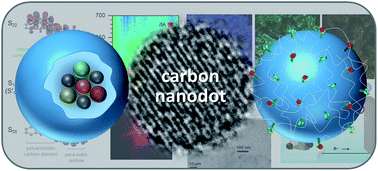
Distinct from conventional carbon nanostructures, such as fullerene, graphene, and carbon nanotubes, carbon nanodots (C-dots) exhibit unique properties such as strong fluorescence, high photostability, chemical inertness, low toxicity, and biocompatibility. Various synthesis routes for C-dots have been developed in the last few years, and now intense research efforts have been focused on improving their functionality. In this aspect, doping and surface functionalization are two major ways to control the chemical, optical, and electrical properties of C-dots. Doping introduces atomic impurities into C-dots to modulate their electronic structure, and surface functionalization modifies the C-dot surface with functional molecules or polymers. In this review, we summarize recent progress in doping and surface functionalization of C-dots for improving their functionality, and offer insight into controlling the properties of C-dots for a variety of applications ranging from biomedicine to optoelectronics to energy.
Recommended Literature
- [1] Alternative donor substrates for inverting and retaining glycosyltransferases? Luke L. Lairson,Warren W. WakarchukChem. Commun., 2007, 365-367 10.1039/B614636H
- [2] An asymmetric supercapacitor based on controllable WO3 nanorod bundle and alfalfa-derived porous carbon? Kanjun Sun,Fengting Hua,Shuzhen Cui,Yanrong Zhu,Hui Peng,Guofu MaRSC Adv., 2021,11, 37631-37642 10.1039/D1RA04788D
- [3] Acetyl group orientation modulates the electronic ground-state asymmetry of the special pair in purple bacterial reaction centers P. K. Wawrzyniak,M. T. P. Beerepoot,H. J. M. de Groot,F. BudaPhys. Chem. Chem. Phys., 2011,13, 10270-10279 10.1039/C1CP20213H
- [4] Alternative synthesis of the anti-baldness compound RU58841? RSC Adv., 2014,4, 14143-14148 10.1039/C4RA00332B
- [5] An apparatus for testing water by measurement of its electrical conductivity Analyst, 1912,37, 538-543 10.1039/AN9123700538
- [6] An analysis of the WTC fires using CIB correlations and simple modeling JGQuintiere 10.1177/0734904121989670
- [7] An inter-tangled network of redox-active and conducting polymers as a cathode for ultrafast rechargeable batteries Jieun Kim,Han-Saem Park,Tae-Hee Kim,Sung Yeol Kim,Hyun-Kon SongPhys. Chem. Chem. Phys., 2014,16, 5295-5300 10.1039/C3CP54624A
- [8] An integrated cathode and solid electrolyte via in situ polymerization with significantly reduced interface resistance? Jialiang Yuan,Ran Dong,Yuan Li,Yang Liu,Zhuo Zheng,Yuxia Liu,Yan Sun,Benhe Zhong,Zhenguo Wu,Xiaodong GuoChem. Commun., 2021,57, 13004-13007 10.1039/D1CC04485K
- [9] An amorphous carbon nitride/NiO/CoN-based composite: a highly efficient nonprecious electrode for supercapacitors and the oxygen evolution reaction? Huifang Yang,Haoran Guo,Peidong Fan,Xinpan Li,Wenlu Ren,Rui SongNanoscale, 2020,12, 7024-7034 10.1039/D0NR00001A
- [10] Acetyl protected thiol methacrylic polymers as effective ligands to keep quantum dots in luminescent standby mode? Marta Liras,Isabel Quijada-Garrido,Marta Palacios-Cuesta,Sonia Mu?oz-Durieux,Olga GarcíaPolym. Chem., 2014,5, 433-442 10.1039/C3PY00987D

Journal Name:Journal of Materials Chemistry A
research_products
-

CAS no.: 89640-58-4


![N-(3-cyanothiolan-3-yl)-2-[(2,2,2-trifluoroethyl)sulfanyl]pyridine-4-carboxamide](https://ossimg.kuujia.com/scimg/1444500/1444113-98-7x500.png)

![1,2,3,4,5,6-Hexahydro-[2,3]bipyridinyl-6-ol](https://ossimg.kuujia.com/scimg/1271000/1270529-38-8x500.png)

![2,2-Difluoro-3-[methyl(2-methylbutyl)amino]propanoic acid](https://ossimg.kuujia.com/scimg/2138500/2138166-62-6x500.png)

![2-(1H-indol-3-yl)-N-{[6-(thiophen-2-yl)-[1,2,4]triazolo[4,3-b]pyridazin-3-yl]methyl}acetamide](https://ossimg.kuujia.com/scimg/2034500/2034271-14-0x500.png)