Gas-phase thermochemistry of polycyclic aromatic hydrocarbons: an approach integrating the quantum chemistry composite scheme and reaction generator?
Physical Chemistry Chemical Physics Pub Date: 2021-12-24 DOI: 10.1039/D1CP03702A
Abstract
We introduce a protocol aimed at predicting the accurate gas-phase enthalpies of formation of polycyclic aromatic hydrocarbons (PAHs). Automatic generation of a dataset of equilibrated chemical reactions preserving the number of carbon atoms in each hybridization state on each side of equations is at the core of our scheme. The performed tests suggest the recommended enthalpy of formation to be derived via a two-step scheme. First, we consider the reactions with a minimal sum of the total number of particles involved, N, and the absolute difference between the total number of products and reactants, |ΔN|. Second, among these reactions, we identify the one with the smallest absolute reaction enthalpy change, 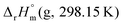 . This approach has been applied to predict the gas-phase enthalpies of formation of 113 PAHs via the Feller–Peterson–Dixon approach. Our calculated
 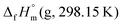 values provide the mean absolute deviations of 1.7, 1.9, 4.2, 8.1, and 18.5 kJ mol?1 with respect to the literature group-based error corrected (GBEC) G3MP2B3, ATOMIC (HC), group equivalent M06-2X, GBEC B3LYP, and G4MP2 values. Our predicted
 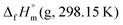 values give the mean signed and mean absolute errors of ?7.5 and 12.9 kJ mol?1 with respect to the experimental enthalpies of formation. The combination of our predicted
 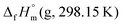 and the experimental
 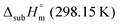 values provide the solid-state enthalpies of formation,
  , which are not available for a few species. Approaching these values
  as well as
 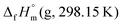 , producing large discrepancies from the experimental side, would be indispensable for testing and further tuning of computational chemistry approaches.

Recommended Literature
- [1] An approach to 7-aza-1-phosphanorbornane complexes: strain promoted rearrangement of 1-iminylphosphirane complexes and cycloaddition with olefins? Yang Xu,Min Wang,Donghui Wei,Rongqiang Tian,Zheng Duan,Fran?ois MatheyDalton Trans., 2019,48, 5523-5526 10.1039/C9DT00838A
- [2] Aluminium alkyl and aryloxide complexes of pyrazine and bipyridines: synthesis and structure? Doug Ogrin,Laura H. van Poppel,Simon G. Bott,Andrew R. BarronDalton Trans., 2004, 3689-3694 10.1039/B410662H
- [3] An alumina stabilized graphene oxide wrapped SnO2 hollow sphere LIB anode with improved lithium storage? Xiang Liu,Qian Sun,A. B. Djuri?i?,Maohai Xie,Baohu Dai,Jinyao Tang,Charles Surya,Changzhong Liao,Kaimin ShihRSC Adv., 2015,5, 100783-100789 10.1039/C5RA22482A
- [4] An apparatus for testing water by measurement of its electrical conductivity Analyst, 1912,37, 538-543 10.1039/AN9123700538
- [5] An amorphous carbon nitride/NiO/CoN-based composite: a highly efficient nonprecious electrode for supercapacitors and the oxygen evolution reaction? Huifang Yang,Haoran Guo,Peidong Fan,Xinpan Li,Wenlu Ren,Rui SongNanoscale, 2020,12, 7024-7034 10.1039/D0NR00001A
- [6] An investigation of the electrochemical delithiation process of carbon coated α-Fe2O3nanoparticles Adrian Brandt,Florian Winter,Sebastian Klamor,Frank Berkemeier,Jatinkumar Rana,Rainer P?ttgen,Andrea BalducciJ. Mater. Chem. A, 2013,1, 11229-11236 10.1039/C3TA11821E
- [7] An anti-leakage liquid metal thermal interface material Kaiyuan Huang,Wangkang Qiu,Meilian Ou,Xiaorui Liu,Zenan Liao,Sheng ChuRSC Adv., 2020,10, 18824-18829 10.1039/D0RA02351E
- [8] Acentric and chiral heterometallic inorganic–organic hybrid frameworks mediated by alkali or alkaline earth ions: synthesis and NLO properties Huabin Zhang,Shaowu DuCrystEngComm, 2014,16, 4059-4068 10.1039/C3CE42419G
- [9] An astrophysically-relevant mechanism for amino acid enantiomer enrichment Stephen P. Fletcher,Richard B. C. Jagt,Ben L. FeringaChem. Commun., 2007, 2578-2580 10.1039/B702882B
- [10] An analyte-triggered artificial peroxidase system based on dimanganese complex for a versatile enzyme assay? Suji Lee,Min Su HanChem. Commun., 2021,57, 9450-9453 10.1039/D1CC03638F

Journal Name:Physical Chemistry Chemical Physics
research_products
-

CAS no.: 89640-58-4


![N-(3-cyanothiolan-3-yl)-2-[(2,2,2-trifluoroethyl)sulfanyl]pyridine-4-carboxamide](https://ossimg.kuujia.com/scimg/1444500/1444113-98-7x500.png)

![1,2,3,4,5,6-Hexahydro-[2,3]bipyridinyl-6-ol](https://ossimg.kuujia.com/scimg/1271000/1270529-38-8x500.png)

![2,2-Difluoro-3-[methyl(2-methylbutyl)amino]propanoic acid](https://ossimg.kuujia.com/scimg/2138500/2138166-62-6x500.png)

![2-(1H-indol-3-yl)-N-{[6-(thiophen-2-yl)-[1,2,4]triazolo[4,3-b]pyridazin-3-yl]methyl}acetamide](https://ossimg.kuujia.com/scimg/2034500/2034271-14-0x500.png)