Controlling viscosity in methyl oleate derivatives through functional group design?
New Journal of Chemistry Pub Date: 2014-09-12 DOI: 10.1039/C4NJ01453G
Abstract
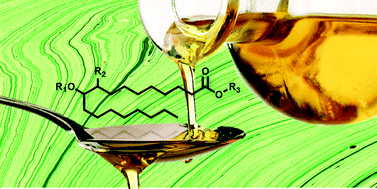
Fatty acid methyl ester (FAME) derivatives have received considerable attention as potential biofuel additives and as sustainable lubricants. One common strategy for the modification of FAMEs, such as methyl oleate, involves epoxidation of the C9–C10 alkene followed by oxirane ring-opening to introduce branches into the FAME backbone. This strategy has been shown to improve cold-flow properties and oxidative stability relative to the parent oleates, and some derivatives have shown promise as lubricants. However, the effect of this strategy on viscosity has not been well established, if at all. Here we present the viscosity properties of methyl oleate derivatives as controlled by rational functional group manipulation with important implications for the preparation of bio-derived lubricants, where viscosity properties must be tightly controlled. The effect of selected derivatives as cold-flow additives in biodiesel is also reported.
Recommended Literature
- [1] Enabling high-throughput single-animal gene-expression studies with molecular and micro-scale technologies Jason WanLab Chip, 2020,20, 4528-4538 10.1039/D0LC00881H
- [2] Excess electrons in lithium–ethylamine solutions—density, electrical conductivity and EPR studies Phys. Chem. Chem. Phys., 1999,1, 3561-3565 10.1039/A900683D
- [3] Evolutionary approaches in protein engineering towards biomaterial construction Brindha J.,Balamurali M. M.,Kaushik ChandaRSC Adv., 2019,9, 34720-34734 10.1039/C9RA06807D
- [4] Distinct impact of glycation towards the aggregation and toxicity of murine and human amyloid-β? Eunju Nam,Jiyeon Han,Sunhee Choi,Mi Hee LimChem. Commun., 2021,57, 7637-7640 10.1039/D1CC02695J
- [5] Exceptionally high temperature spin crossover in amide-functionalised 2,6-bis(pyrazol-1-yl)pyridine iron(ii) complex revealed by variable temperature Raman spectroscopy and single crystal X-ray diffraction? Max Attwood,Hiroki Akutsu,Lee Martin,Toby J. Blundell,Pierre Le Maguere,Scott S. TurnerDalton Trans., 2021,50, 11843-11851 10.1039/D1DT01743H
- [6] Exchanged ligands on the surface of a giant cluster: [(MoO3)176(H2O)63(CH3OH)17Hn](32 – n)– Chem. Commun., 1998, 1501-1502 10.1039/A801804I
- [7] Essential effect of the electrolyte on the mechanical and chemical degradation of LiNi0.8Co0.15Al0.05O2 cathodes upon long-term cycling?? Xiaoming Liu,Zachary D. Hood,Wangda Li,Donovan N. Leonard,Arumugam Manthiram,Miaofang ChiJ. Mater. Chem. A, 2021,9, 2111-2119 10.1039/D0TA07814J
- [8] Evidence of field induced slow magnetic relaxation in cis-[Co(hfac)2(H2O)2] exhibiting tri-axial anisotropy with a negative axial component? Denis V. Korchagin,Elena A. Yureva,Alexander V. Akimov,Eugenii Ya. Misochko,Gennady V. Shilov,Artem D. Talantsev,Roman B. Morgunov,Alexander A. Shakin,Sergey M. Aldoshin,Boris S. TsukerblatDalton Trans., 2017,46, 7540-7548 10.1039/C7DT01236E
- [9] Excited state dynamics of symmetric and asymmetric Cr3(dpa)4Cl2 measured using femtosecond transient absorption spectroscopy? Chao-Han Cheng,Wen-Zhen Wang,Shie-Ming Peng,I-Chia ChenPhys. Chem. Chem. Phys., 2017,19, 25471-25477 10.1039/C7CP03968A
- [10] Elusive 2-aminofuran Diels–Alder substrates for a straightforward synthesis of polysubstituted anilines? Ana G. Neo,Ana Bornadiego,Jesús Díaz,Stefano Marcaccini,Carlos F. MarcosOrg. Biomol. Chem., 2013,11, 6546-6555 10.1039/C3OB41411F

Journal Name:New Journal of Chemistry
research_products
-

CAS no.: 89640-58-4


![N-(3-cyanothiolan-3-yl)-2-[(2,2,2-trifluoroethyl)sulfanyl]pyridine-4-carboxamide](https://ossimg.kuujia.com/scimg/1444500/1444113-98-7x500.png)

![1,2,3,4,5,6-Hexahydro-[2,3]bipyridinyl-6-ol](https://ossimg.kuujia.com/scimg/1271000/1270529-38-8x500.png)

![2,2-Difluoro-3-[methyl(2-methylbutyl)amino]propanoic acid](https://ossimg.kuujia.com/scimg/2138500/2138166-62-6x500.png)

![2-(1H-indol-3-yl)-N-{[6-(thiophen-2-yl)-[1,2,4]triazolo[4,3-b]pyridazin-3-yl]methyl}acetamide](https://ossimg.kuujia.com/scimg/2034500/2034271-14-0x500.png)