Copper-catalyzed synthesis of pyrido-fused quinazolinones from 2-aminoarylmethanols and isoquinolines or tetrahydroisoquinolines?
Organic & Biomolecular Chemistry Pub Date: 2021-04-28 DOI: 10.1039/D1OB00229E
Abstract
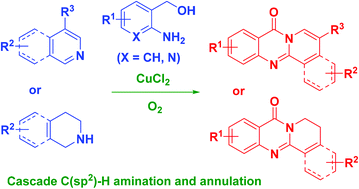
Pyrido-fused quinazolinones were synthesized via copper-catalyzed cascade C(sp2)–H amination and annulation of 2-aminoarylmethanols with isoquinolines or pyridines. The transformation proceeded readily in the presence of a commercially available CuCl2 catalyst with molecular oxygen as a green oxidant. Moreover, the dehydrogenative cross-coupling of 2-aminoarylmethanols with tetrahydroisoquinolines was explored, in which CuBr exhibited higher catalytic activity than CuCl2. Broad substrate scope with good tolerance of functionalities was observed under the optimized reaction conditions. The bioactive naturally occurring alkaloid rutaecarpine could be obtained by this strategy. The remarkable feature of this protocol is that complicated heterocyclic structures are readily achieved in a single synthetic step from easily accessible reactants and catalysts. This pathway to pyrido-fused quinazolinones would be complementary to existing protocols.
Recommended Literature
- [1] Excimer and exciplex formation in a pair of bright phosphorescent isomers constructed from Cu3(pyrazolate)3 and Cu3I3 coordination luminophores? Shun-Ze Zhan,Mian Li,Xiao-Ping Zhou,Dan Li,Seik Weng NgRSC Adv., 2011,1, 1457-1459 10.1039/C1RA00566A
- [2] Enabling non-flammable Li-metal batteries via electrolyte functionalization and interface engineering? Jing Yu,Yu-Qi Lyu,Jiapeng Liu,Mohammed B. Effat,Junxiong WuJ. Mater. Chem. A, 2019,7, 17995-18002 10.1039/C9TA03784E
- [3] Excitable dynamics in the bromate–sulfite–ferrocyanide reaction J. Zagora,M. Vosla?,L. Schreiberová,I. SchreiberPhys. Chem. Chem. Phys., 2002,4, 1284-1291 10.1039/B110048C
- [4] Excimer formation effects and trap-assisted charge recombination loss channels in organic solar cells of perylene diimide dimer acceptors? Min Kim,Jae-Joon Lee,Tengling Ye,Panagiotis E. Keivanidis,Kilwon ChoJ. Mater. Chem. C, 2020,8, 1686-1696 10.1039/C9TC04955J
- [5] Emulsion soft templating of carbide-derived carbon nanospheres with controllable porosity for capacitive electrochemical energy storage? M. Zeiger,N. J?ckel,P. Strubel,L. Borchardt,R. Reinhold,W. Nickel,J. Eckert,V. Presser,S. KaskelJ. Mater. Chem. A, 2015,3, 17983-17990 10.1039/C5TA03730A
- [6] Excited state potential energy surfaces and their interactions in FeIVO active sites Shaun D. Wong,Edward I. SolomonDalton Trans., 2014,43, 17567-17577 10.1039/C4DT01366B
- [7] Dissolution of cork biopolymers in biocompatible ionic liquids Helga Garcia,Rui Ferreira,Marija Petkovic,Jamie L. Ferguson,Maria C. Leit?o,H. Q. Nimal Gunaratne,Luís Paulo N. RebeloGreen Chem., 2010,12, 367-369 10.1039/B922553F
- [8] Fatty acid eutectic mixtures and derivatives from non-edible animal fat as phase change materials? Pau Gallart-Sirvent,Marc Martín,Gemma Villorbina,Mercè Balcells,Aran Solé,Luisa F. Cabeza,Ramon Canela-GarayoaRSC Adv., 2017,7, 24133-24139 10.1039/C7RA03845C
- [9] Excimer–monomer switch: a reaction-based approach for selective detection of fluoride? Qiao Song,Angela Bamesberger,Lingyun Yang,Haley Houtwed,Haishi CaoAnalyst, 2014,139, 3588-3592 10.1039/C4AN00522H
- [10] Emergence of microfluidic wearable technologies Joo Chuan Yeo,KenryLab Chip, 2016,16, 4082-4090 10.1039/C6LC00926C

Journal Name:Organic & Biomolecular Chemistry
research_products
-

CAS no.: 89640-58-4


![N-(3-cyanothiolan-3-yl)-2-[(2,2,2-trifluoroethyl)sulfanyl]pyridine-4-carboxamide](https://ossimg.kuujia.com/scimg/1444500/1444113-98-7x500.png)

![1,2,3,4,5,6-Hexahydro-[2,3]bipyridinyl-6-ol](https://ossimg.kuujia.com/scimg/1271000/1270529-38-8x500.png)

![2,2-Difluoro-3-[methyl(2-methylbutyl)amino]propanoic acid](https://ossimg.kuujia.com/scimg/2138500/2138166-62-6x500.png)

![2-(1H-indol-3-yl)-N-{[6-(thiophen-2-yl)-[1,2,4]triazolo[4,3-b]pyridazin-3-yl]methyl}acetamide](https://ossimg.kuujia.com/scimg/2034500/2034271-14-0x500.png)