Continuous flow fabrication of Fmoc-cysteine based nanobowl infused core–shell like microstructures for pH switchable on-demand anti-cancer drug delivery?
Biomaterials Science Pub Date: 2020-11-11 DOI: 10.1039/D0BM01386B
Abstract
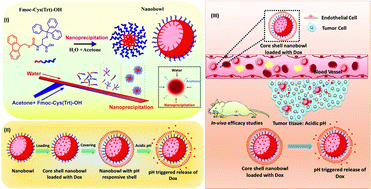
Asymmetric nanostructures such as nanobowls (NBs) can exhibit superior drug delivery performances owing to their concave structure and interior asymmetric cavities. Here, we present a facile one-step method for the fabrication of NB like structures from a mere single amino acid mimetic, N-(9-fluorenylmethoxycarbonyl)-S-triphenylmethyl-L-cysteine following continuous-flow microfluidics enabled supramolecular self-assembly. Following fabrication, NBs were further infused into a vesicular shell consisting of the amino acid N-(tert-butoxycarbonyl)-S-triphenylmethyl-L-cysteine, carrying dual acid labile groups, the triphenylmethyl and the tert-butyloxycarbonyl groups. The NB infused core–shell like microstructures formed after the shell coating will now be addressed as NB-shells. Presence of pH-responsive shells bestowed the core–shell NB like structures with the ability to actively tune their surface pore opening and closing in response to environmental pH switch. To illustrate the potential use of the NB-shells in the field of anticancer drug delivery, the particles were loaded with doxorubicin (Dox) with an encapsulation efficiency of 42% and Dox loaded NB-shells exhibited enhanced efficacy in C6 glioma cells. Additionally, when tested in an animal model of glioblastoma, the nanoformulations demonstrated significantly higher retardation of tumour growth as compared to free Dox. Thus, this work strives to provide a new research area in the development of well turned-out and neatly fabricated pH switchable on/off anti-cancer drug delivery systems with significant translational potential.
Recommended Literature
- [1] An asymmetric supercapacitor based on controllable WO3 nanorod bundle and alfalfa-derived porous carbon? Kanjun Sun,Fengting Hua,Shuzhen Cui,Yanrong Zhu,Hui Peng,Guofu MaRSC Adv., 2021,11, 37631-37642 10.1039/D1RA04788D
- [2] An amide probe as a selective Al3+ and Fe3+ sensor inside the HeLa and a549 cell lines: Pictet–Spengler reaction for the rapid detection of tryptophan amino acid? Bidyut Kumar Kundu,Rinky Singh,Ritudhwaj Tiwari,Debasis NayakNew J. Chem., 2019,43, 4867-4877 10.1039/C9NJ00138G
- [3] An integrated cathode and solid electrolyte via in situ polymerization with significantly reduced interface resistance? Jialiang Yuan,Ran Dong,Yuan Li,Yang Liu,Zhuo Zheng,Yuxia Liu,Yan Sun,Benhe Zhong,Zhenguo Wu,Xiaodong GuoChem. Commun., 2021,57, 13004-13007 10.1039/D1CC04485K
- [4] An analysis of the WTC fires using CIB correlations and simple modeling JGQuintiere 10.1177/0734904121989670
- [5] An approach to 7-aza-1-phosphanorbornane complexes: strain promoted rearrangement of 1-iminylphosphirane complexes and cycloaddition with olefins? Yang Xu,Min Wang,Donghui Wei,Rongqiang Tian,Zheng Duan,Fran?ois MatheyDalton Trans., 2019,48, 5523-5526 10.1039/C9DT00838A
- [6] An automatic determination of thoria in thoria-urania mixtures Analyst, 1966,91, 208-210 10.1039/AN9669100208
- [7] An atomic scale study of defects in Co2FeAl Ravi Kumar Yadav,R. GovindarajPhys. Chem. Chem. Phys., 2020,22, 26876-26886 10.1039/D0CP04572A
- [8] An atom efficient route to N-aryl and N-alkyl pyrrolines by transition metal catalysis? Supaporn Sawadjoon,Joseph S. M. SamecOrg. Biomol. Chem., 2011,9, 2548-2554 10.1039/C0OB00383B
- [9] An artificial enzyme cascade amplification strategy for highly sensitive and specific detection of breast cancer-derived exosomes? Huiying Xu,Lu Zheng,Yu Zhou,Bang-Ce YeAnalyst, 2021,146, 5542-5549 10.1039/D1AN01071A
- [10] An intensified π-hole in beryllium-doped boron nitride meshes: its determinant role in CO2 conversion into hydrocarbon fuels? Luis Miguel Azofra,Douglas R. MacFarlane,Chenghua SunChem. Commun., 2016,52, 3548-3551 10.1039/C5CC07942J

Journal Name:Biomaterials Science
research_products
-

CAS no.: 89640-58-4

![1,2,3,4,5,6-Hexahydro-[2,3]bipyridinyl-6-ol](https://ossimg.kuujia.com/scimg/1271000/1270529-38-8x500.png)


![N-(3-cyanothiolan-3-yl)-2-[(2,2,2-trifluoroethyl)sulfanyl]pyridine-4-carboxamide](https://ossimg.kuujia.com/scimg/1444500/1444113-98-7x500.png)

![2,2-Difluoro-3-[methyl(2-methylbutyl)amino]propanoic acid](https://ossimg.kuujia.com/scimg/2138500/2138166-62-6x500.png)

![2-(1H-indol-3-yl)-N-{[6-(thiophen-2-yl)-[1,2,4]triazolo[4,3-b]pyridazin-3-yl]methyl}acetamide](https://ossimg.kuujia.com/scimg/2034500/2034271-14-0x500.png)