Catalysts
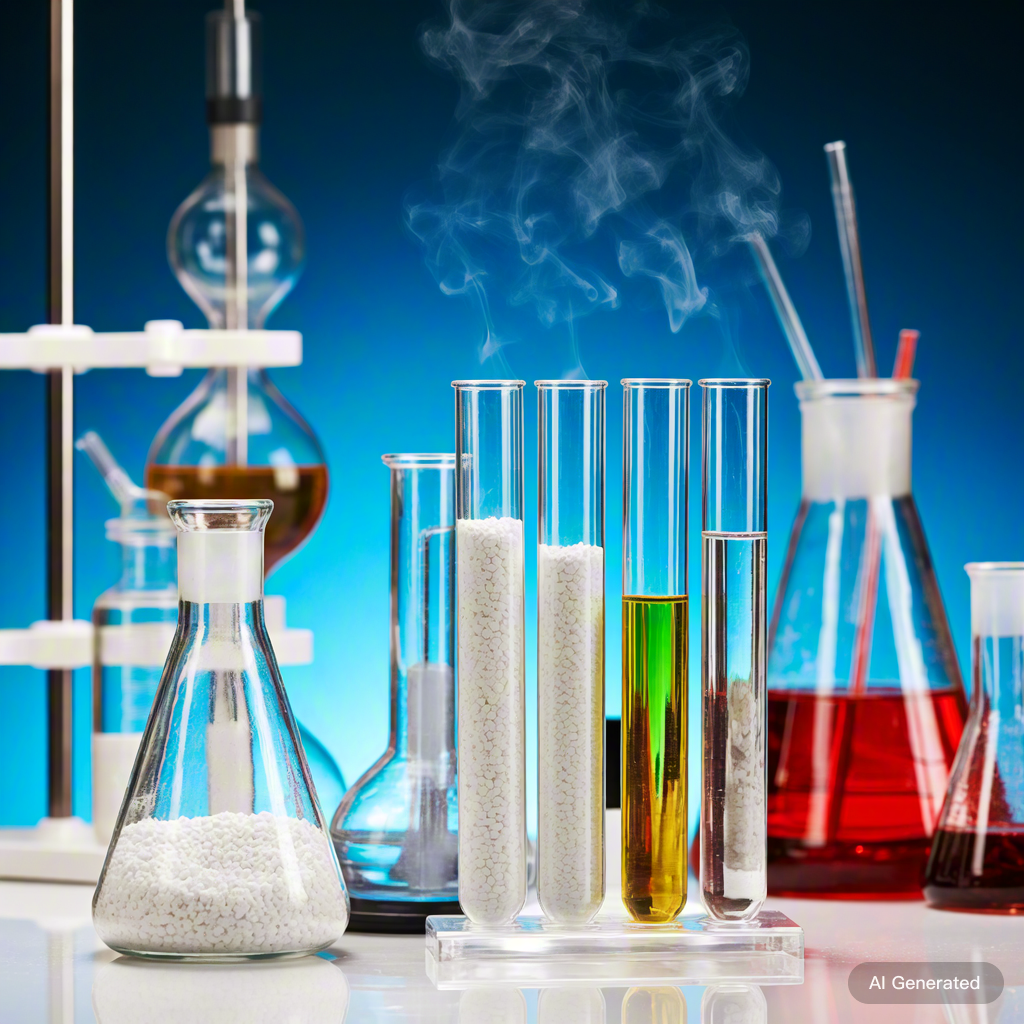
Catalysts are substances that increase the rate of a chemical reaction without being consumed or altered in the process. They play a critical role in various industrial processes, including petrochemicals, pharmaceuticals, and environmental remediation. By lowering the activation energy required for reactions to occur, catalysts enhance efficiency and reduce energy consumption, making them indispensable in modern chemistry. Common types of catalysts include homogeneous and heterogeneous catalysts, each with unique characteristics suited to different applications.
In the petrochemical industry, platinum is a widely used homogeneous catalyst that facilitates cracking reactions. Heterogeneous catalysts, such as zeolites or metal oxides, are employed in industries like refining and synthesis to promote selective catalytic reactions. Their ability to accelerate chemical processes while maintaining stability under harsh conditions makes them essential for improving both productivity and sustainability across numerous sectors.
Catalysts not only enhance the efficiency of chemical reactions but also contribute significantly to environmental protection by reducing waste and emissions during manufacturing processes. Their versatility and effectiveness make them a cornerstone of modern chemical engineering, driving innovation and advancing technological boundaries in various industries.
| Structure | Chemical Name | CAS | MF |
|---|---|---|---|
 |
Dodecacarbonyltriruthenium (0) | 15243-33-1 | C12O12Ru3 |
 |
dichlorobis[1,1'-thiobis[ethane]]platinum | 15337-84-5 | C8H20Cl2PtS2 |
 |
(R)-(+)-N,N-Dimethyl-1-ferrocenylethylamine | 31886-58-5 | C14H19FeN |
 |
Dichlorobis(di-tert-butylphenylphosphine)palladium(II) | 34409-44-4 | C28H46Cl2P2Pd |
 |
Tris(2,2-bipyridyl)ruthenium(II) Chloridehexahydrate | 50525-27-4 | C30H36Cl2N6O6Ru |
 |
Hexakisμ-(Acetato-κO:κO')triaqua-μ3-oxotri-iridium(1+) Acetate | 52705-52-9 | |
 |
Tin Ditriflate | 62086-04-8 | C2F6O6S2Sn |
 |
(1,5-Cyclooctadiene)(pyridine)(tricyclohexylphosphine)iridium(I) Hexafluorophosphate | 64536-78-3 | C31H50F6IrNP2 |
 |
2-(3-benzyl-4-methyl-thiazol-3-ium-5-yl)ethanol;chloride | 4568-71-2 | C13H16ClNOS |
 |
Phosphonium,tetramethyl-, chloride (8CI,9CI) | 1941-19-1 | C4H12ClP |
Related Literature
-
Kay S. McMillan,Anthony G. McCluskey,Annette Sorensen,Marie Boyd,Michele Zagnoni Analyst, 2016,141, 100-110
-
Xiaotong Feng,Lei Bian,Jie Ma,Lei Zhou,Xiayan Wang,Guangsheng Guo,Qiaosheng Pu Chem. Commun., 2019,55, 3963-3966
-
Hongxia Li,Aikifa Raza,Qiaoyu Ge,Jin-You Lu,TieJun Zhang Soft Matter, 2020,16, 6841-6849
-
Qiyuan Wu,Shangmin Xiong,Peichuan Shen,Shen Zhao,Alexander Orlov Catal. Sci. Technol., 2015,5, 2059-2064
-
David White,Sean R. Stowell Biomater. Sci., 2017,5, 463-474
Recommended suppliers
-
Shenzhen GeneSeqTools Bioscience & Technology Co. Ltd.Factory Trade Brand reagentsCompany nature: Private enterprises
-
Shandong Feiyang Chemical Co., LtdFactory Trade Brand reagentsCompany nature: Private enterprises
-
Shenzhen Yaoyuan R&D Center Co.,LtdFactory Trade Brand reagentsCompany nature: Private enterprises
-
煙臺朗裕新材料科技有限公司Factory Trade Brand reagentsCompany nature: Private enterprises
-
Zhejiang Brunova Technology Co., Ltd.Factory Trade Brand reagentsCompany nature: Private enterprises
Recommended products